ICAI Winds and Waves – Networking

ICAI Winds and Waves, April 2014 - coverThis article was written for ICAI Winds and Waves, April 2014.

Welcome to this latest issue of Winds & Waves, the online magazine of ICA International.

While many international NGOs have shifted from a more centralised to a more networked approach to their operations in recent years, ICA has operated globally as a network of autonomous and independent national NGOs for over half of its 50 years. Many member ICAs themselves operate as networks, both nationally and internationally, and many individuals around the world remain connected and involved with ICA in various ways long after they have moved on from a formal role within an ICA organisation. Such loose and diverse structures with such ‘leaky boundaries’ can be challenging in some respects, not least in terms of governance. However, they can also enable greater local relevance, responsiveness and self-reliance in conjunction with greater global connectedness, learning and mutual support. Networking is one of the ways by which these advantages can be realised, and so supporting networking among ICAs and ICA colleagues is central to the role of ICA International and networking makes a fitting theme for this issue.

Within these pages you will find stories and reports from individual ICA colleagues and from national ICAs, on their work of research, training and demonstration to advance human development worldwide. Networking and a networked approach feature strongly in many of them.

Terry Bergdall in Chicago reports on the Sustainability Leaders Network of ICA USA’s Accelerate 77 programme, empowering community leaders from across the city by supporting them to ‘connect, align and produce’ together. Lorraine Margherita in Paris reflects on the role that networking has played for her as she has established herself as a professional facilitator within the emerging ICA network there. Larry Philbrook in Taipei reveals the findings of a recent research initiative conducted through ICA networks, online and face to face. Gerald Gomani in Harare reports on ICA Zimbabwe’s work helping communities fight HIV/AIDS – this work has been supported over many years by ICAI network partners in the USA, Canada and the UK among others, and networks people living with HIV with each other and with local health and social service resources. Charles Jago in Australia writes of an online networked approach to holding government and politicians accountable by ‘asking real questions’. Ishu Subha in Kathmandu writes of the network power of a local women’s group that grew to a leading financial institution. Teresa Sosa in Caracas writes of how principles and values she has learned from ICA have enabled her to gain strength from networks to strive re-create a country in times in chaos.

The global network of ICA International now comprises member ICAs and related groups and organisations in 40 countries worldwide. We welcomed ICA Ukraine as our newest statutory member at our ICAI online General Assembly in December. I have been privileged these last few weeks to serve as a mentor to one of ICA Ukraine’s ToP facilitation trainers, Natasha Karpova, and to learn something of how she and ICA are working to network diverse actors in Ukraine, another country in a time of some chaos, to re-envisage and rebuild their country’s future together.  It was a privilege also (and fun!) to help to network ICA Ukraine’s facilitators with Russian facilitators attending the Moscow Facilitators conference this month, by exchanging real-time Facebook updates between my post-conference ToP strategic planning course in Moscow and Natasha’s simultaneous ToP strategic planning course in Lviv.

Moscow facilitators study the ToP Participatory Strategic Planning by planning ‘What can we do over the next 3 years to promote a culture of participation in our organisations?’

Moscow facilitators learned the ToP Participatory Strategic Planning process this month by planning ‘What can we do over the next 3 years to promote a culture of participation in our organisations?’

Meanwhile ICA Ukraine’s initiative connecting mentor ToP facilitators from ICA’s global network with mentees in Ukraine prompted Larry Philbrook of ICA Taiwan to adapt and apply the model globally, attracting so far 25 mentors and 36 mentees – just the sort of peer-to-peer initiative within the ICA network that ICAI seeks to support.

The ICAI Board updated its Business Plan for 2014 in the last month, in light of the experience of 2013 and discussions and decisions at the December General Assembly, and supporting peer-to-peer networking for mutual support and collaboration remains at the heart of our approach. Whatever the extent and nature of your relationship to ICA or ICAI, if you share our collective concern with ‘the human factor in world development’ then please join in networking with us.

Please share this issue of Winds & Waves and consider contributing to the next, please connect and share with us online via ICAI on Facebook and @ICAI on twitter, and please connect directly with whichever national ICA of the ICAI global network is closest to you in your geography or in your passion.

Enjoy this issue!

ICA International Board update, February 2014

Global BuzzThis post was first published in ICAI’s monthly bulletin the Global Buzz.

In January the ICAI Board began to develop its Business Plan for 2014, based on the strategic framework and budget included in the 2013 plan that were re-affirmed by the General Assembly in December. We aim to finalise this and circulate it to members for information in February.

We are grateful to 40 respondents so far who have offered their feedback by our online survey on the December online regional gatherings and GA, and particularly the 21 who had not participated in those meetings. This was designed to help the ICAI Board to make this year’s gatherings and GA more inclusive and more effective. Our conclusion at the January Board meeting is to keep doing the Adobe Connect meetings this year, because those who attend appreciate them and are increasingly familiar with the technology. We will try to make them more inclusive by looking into free-phone audio options and by supporting people to improve their internet access or to attend the meeting from somewhere where access is better. However we will do this format of adobe meetings only twice in June and twice in December, instead of three times in each of March, July & December, to allow extra time to support the regions to experiment with other approaches such as google hangout, Skype or simple tele-conferencing.  For the GA we will use adobe for the meeting but do the voting by surveymonkey over 10 days to allow everyone to vote.

The Board has announced a special General Assembly meeting to be held 1-2pm UK time on Wednesday 26 February.  This special meeting will be to discuss and vote on a resolution to revise the ICAI Bylaws, as discussed at the GA in December.  Some minor revisions are needed in order to comply with new requirements under Canadian law  for all Canadian-registered non-profits such as ICAI to obtain a ‘Continuance” in order to continue. The one hour meeting will be held online using Adobe Connect, to allow for questions and discussion as needed, and representatives of statutory ICAs in particular are encouraged to attend.  For the voting we will use surveymonkey, and allow 10 days for responses from the time of the meeting, so that all statutory ICAs are able to vote even if they cannot attend the meeting. Please ask for details if you are interested and have not received them.

I was in New York last week attending a conference, and was able to take the opportunity to collect a UN grounds pass and attend a briefing session on behalf of ICAI for NGOs with consultative status. Also I was glad to meet with Larry Philbrook and Seva Gandhi on Monday, as they were there also to deliver a course.

We have been shocked and saddened by the sudden and unexpected death last week of Wayne Nelson of ICA Associates in Canada. Our thoughts are with Jo and his family, and also his close ICA colleagues in Canada.  Wayne has been greatly involved and supportive of ICAI over his long years with ICA globally and in Canada, and will be sorely missed.

ICAI online regional gatherings and General Assembly

Winds and Waves December 2013These three articles were first published in the ICA International magazine Winds and Waves, December 2013.

Welcome to another great issue of Winds & Waves, the online magazine of ICA International. The theme of this issue is Imaginal Education, a whole-person approach to life and learning that has been at the core of ICA’s work in human development and participatory social change since it began some 50 years ago.

The 2012 book Changing Lives Changing Societies, republished by ICA International this year, quotes Gail West of ICA Taiwan:

“Imaginal learning is what ICA has always been about. Enabling the shifting of one’s images or internal pictures of ‘what is’ is what directs my beliefs and behaviour. As a facilitator or trainer, or any person supporting another’s development, my understanding is that learning requires image shift. In order for that to happen, a person needs to change the messages that one pays attention to. No change in learning, no change in behaviour.”

This important link between self-image and personal behaviour remains core to ICA’s approach to ToP facilitation and human development worldwide, as illustrated by the many rich and varied stories from ICA colleagues included that book.  It has also been at the heart of the of global, online community of practice on Reshaping Education for the 21st Century that grew out of the 8th ICAI Global Conference  on Human Development hosted last year by ICA Nepal in Kathmandu.

This issue draws on the work of that community of practice and others to share something of what works, and some of the challenges and the rewards, of applying such an Imaginal Learning approach in the field of education and more broadly.  Marge Philbrook of ICA USA writes of the ICA Archives project in Chicago, and its efforts to make these and other ICA models and tools from the archive more available online to a generation. Svitlana Salamatova and her colleagues of ICA Ukraine, in a country and a city again currently in the midst of profound social change, write of their use of online communication tools for connecting, learning and empowering of communities. Nelson Stover and Shankar Jadhav share insights from ICAI India’s ‘Global classroom in a village school’, and Isabel de la Maza writes of changing self-images in Chile. Mane Arratia writes of ICA Spain’s facilitation role in the global conferences of Initiatives of Change in Caux, Switzerland, and Amani Jensen-Bentley of Australia writes on ‘a teen’s perspective on a rural Aussie initiative aimed at celebrating multiculturalism’.

As I write, ICA International has just completed its third series of online regional gatherings this year, to connect ICAs and ICA colleagues and facilitate peer-to-peer learning and collaboration worldwide, and we are poised for our online General Assembly in a couple of days’ time.  Nineteen ICAs participated and shared reports for the regional gatherings, and also in this issue you will find an overview of the gatherings and excerpts from some of those reports.

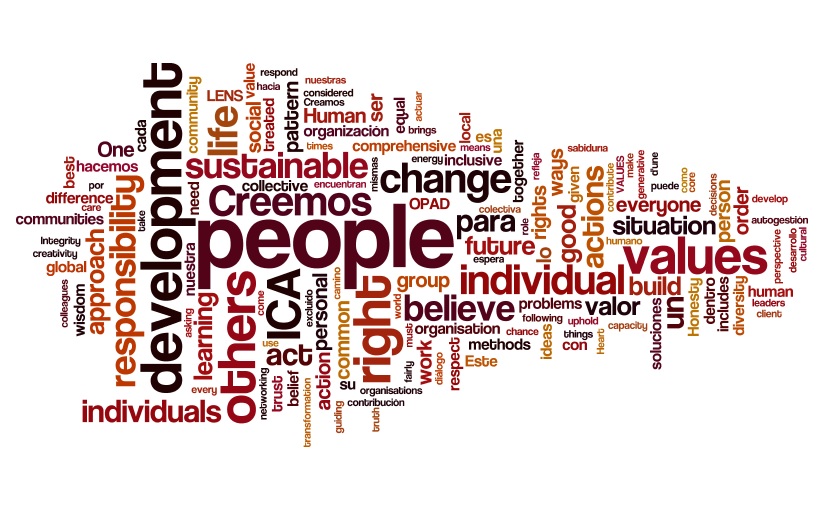
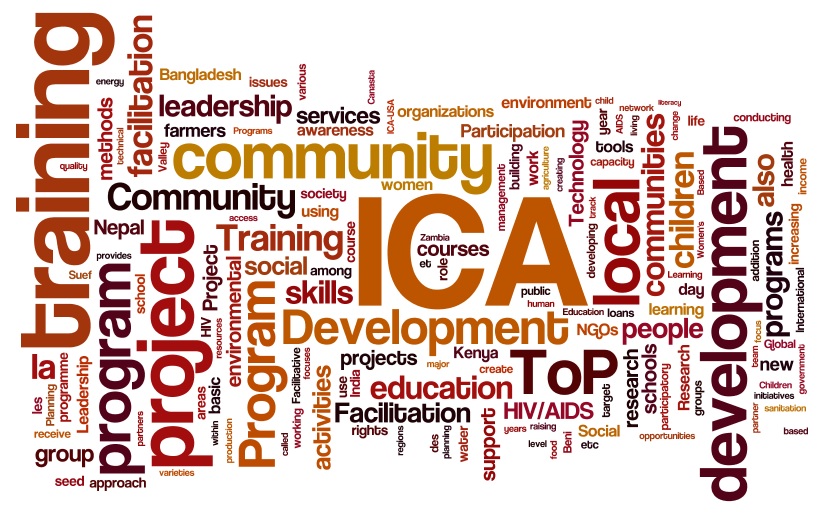
ICAs Name of OrganizationYou will also find a scattering of graphs, maps and word clouds, illustrating both the diversity and the commonalities of our global ICA community. These are drawn from the 37 responses to this year’s new ICAI global membership survey that we have received from ICA locations around the world. We are grateful to all those who took the time and effort to respond.

I hope you will agree that all this makes for a stimulating and inspiring read. Please let us know what you think, and connect and learn with each other online, by posting your thoughts on our facebook page.

ICA International online regional gatherings facilitate peer to peer support and collaboration

ICAs Values StatementThe Institute of Cultural Affairs (ICA) is a global community of non-profit organisations advancing human development worldwide. The role of ICA International is to facilitate peer-to-peer interchange, learning and mutual support across the network. ICA International also maintains consultative status on behalf of the membership with UN ECOSOC, UNESCO, UNICEF, WHO & FAO.

With member organisations and related organisations and groups in over 40 countries worldwide, online gatherings play a key role in facilitating peer to peer support and collaboration among ICAs and ICA colleagues, within and across regions.  ICAI currently convenes online regional gatherings three times per year, for three regional time zone groups – Asia/Pacific, the Americas, and Europe/MENA/Africa.

ICAs Mission StatementThese regional gatherings are open to all ICA members, staff and volunteers worldwide, and people are welcome to attend another region’s gathering if they cannot attend their own.  The third series of gatherings for 2013 were held December 9-11, and attracted 23 people from 19 countries.

The aims of the gatherings are to connect ICAs and ICA colleagues with each other, and help to build & strengthen relationships between them; to share information and facilitate peer-to-peer support and collaboration among ICAs and ICA colleagues; and to hold ICAI accountable to its members, and seek input & support to strengthen our global network and advance our global mission.

The agenda every time includes introductions and questions & discussion on reports shared by ICAs and ICAI. Agenda items particular to the December gatherings, in preparation for the following online General Assembly, included criteria for ICAI financial support to member initiatives, a proposed procedure for developing global policy for ICA, our pattern of face-to-face global conferences, and categories of ICAI membership. A full transcript of the gatherings has been circulated, including links to the meeting papers and online recordings of the three 90-minute meetings – please ask if you’d like a copy.

ICAs Current ProgrammesIf you have not been able to join the online gatherings this year, please do let me or another ICAI Board member know if there is anything that we can do to make these online regional gatherings more relevant and accessible to you next year.  Please also let us know what alternative approaches to remote networking might work better for you, whether synchronous (such as online meetings and twitter chats) or asynchronous (such as email, facebook and linkedin).

ICAI December 2013 General Assembly

The ICAI General Assembly meets normally once per year. Its aims are to take ICAI membership decisions, including approval of Associate & Statutory memberships; to take ICAI strategy & policy decisions, to direct the work of the Board and to guide & support the peer-to-peer collaboration among ICAs; and to elect the ICAI Board and hold it accountable to the membership, including by receipt of an annual audited finance report.

The 2013 GA was held online on December 16, using Adobe Connect. Nineteen people from 12 ICAs participated, including voting representatives from 10 of 19 voting statutory members. We were grateful for technical support for the meeting from ICA:UK Associate and virtual facilitator Orla Cronin.

ICAs Major funders and partnersSeven ICAs were accepted as new or renewed statutory members, bringing the total to 19. A further 11 ICAs were accepted subject to payment of dues and/or formal request. It was decided to change the term of membership from the January-December calendar year to the 12-month period following receipt of dues.  The GA received the audited financial statements for 2012, and Timothy Wright in Canada was re-appointed to audit ICAI’s Financial Statements again for 2014. The seven serving members of the ICAI Board were re-elected as Directors. A new procedure for development of global policy was approved, and a number of ICAs agreed to propose a working group to use the procedure to develop a new global policy for ToP facilitation and training.

In addition to this decision-making, feedback was invited on the Board’s plan to develop its work plan for 2014 on the basis of the 2013-14 strategy approved by the GA in 2013, and no objections were raised.  Further discussion was had on the question of whether to call a face-to-face General Assembly for 2014 and/or a Global Conference for 2016, although it was decided not to hold a vote due to insufficiently inclusive and in-depth discussion among members prior to the meeting. The meeting was notified of the new legal requirement to obtain a ‘continuance’ in order maintain ICAI’s registration as a non-profit in Canada. A special General Assembly will be called for February 2014 to amend the Bylaws for that purpose.

A full report is available on request, with a link to the full online recording of the 90 minute meeting. Feedback from those participating included: “Efficient and effective”, “Very smooth and good timing”, “It was excellent. Thanks for all who made it possible”, “Awesome organization! Thank you for such professionalism!” and “Appreciate clarity, preparation from area meetings and moving well”. Isabel de la Maza of ICA Chile was unable to attend but watched the recording and wrote:: “It was a great meeting!!!!, Thanks for a very professional virtual facilitation job. Wow!!! It is incredible what technology is permitting in these days”.

ICAs collaborative projects, funding relationships, etcA brief online survey has been circulated by email to 99 representatives of 42 ICA locations worldwide to seek further feedback, particularly from those who did not participate, to help the Board make future online gatherings and GAs more inclusive and more effective.

ICA International Board update, December 2013

Global BuzzThis post was first published in ICAI’s monthly bulletin the Global Buzz.

November has been a busy month for ICAI, and December will be busier.  We have been preparing for the three online regional gatherings and General Assembly scheduled for December – see below for further details, and please join us if you can!  Draft agendas were first circulated to members for consultation when the dates were announced in September, and revised drafts were circulated with further details this month.  Please ask for details if you are interested to join.

Also we have been busy following up the last few responses to the ICAI global membership survey that remain outstanding in advance of these meetings. We are grateful to the 34 ICA locations that have already responded, and are urging the last remaining locations to share their responses now.  Responses from the first 30 locations were circulated to members this month.  These suggest (among other things) that we have at least 152 full-time and 112 part-time employees worldwide, over 170 Board members and 251 ToP trainers; and that over 2,544 people were trained in 193 public ToP courses last year.  ToP training and group facilitation are the most common programme areas of ICAs (23 & 25 locations respectively) followed by education, leadership development and comunity development (20 locations each).

We have updated the global network email list according to the survey responses, and launched new ICAI groups on LinkedIn and Facebook as additional forums for discussion.  Working with the global communications team we have drafted a site map for a new, simpler & cleaner ICAI website to be developed next year.  Meanwhile the team has been working on the new December issue of ICAI’s Winds & Waves magazine.

The December regional gatherings & General Assembly are now only a couple of weeks away. Everyone with an involvement or interest in ICA worldwide is welcome and encouraged to attend and participate in the regional gatherings, so please join us if you can.  Voting at the GA will be restricted to one vote per statutory member ICA.  Please complete the doodle poll to see your own local times and to register for the meetings you plan to attend (scroll down for meeting aims):
·     Europe Africa – Mon 9 Dec 12 noon UK time
·     Americas – Tue 10 Dec 3pm UK time
·     Asia Pacific – Wed 11 Dec 10am UK time
·     General Assembly (GA) – Mon 16 Dec 12 noon UK time

Each meeting will last for up to 90 minutes, and each will be preceded by a pre-meeting 30 minutes in advance for orientation to the online meeting technology and for technical support.  The meetings will be held on Adbobe Connect, and log-in details will be circulated the week before.

Regional Gathering Aims
1. to connect ICAs and ICA colleagues with each other, and help to build & strengthen relationships between them
2. to share information and facilitate peer-to-peer support and collaboration among ICAs and ICA colleagues
3. to hold ICAI accountable to its members, and seek input & support to strengthen our global network and advance our global mission.

General Assembly Aims
1. to take ICAI membership decisions, including approval of Associate & Statutory memberships
2. to take ICAI strategy & policy decisions, to direct the work of the Board and to guide & support the peer-to-peer collaboration among ICAs
3. to hold the ICAI Board accountable to the membership, including by receipt of an annual audited finance report.