
How engaging can a large facilitated online session be?

Economics of climate change mitigation options in the forest sector

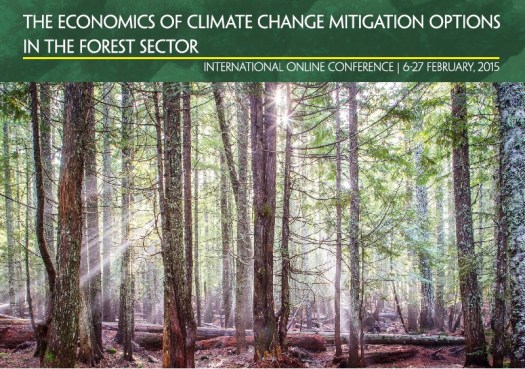
This was the question that intrigued me when I was first invited to work with with the Forestry Economics team of FAO, to design and facilitate an online conference this month on the Economics of climate change mitigation options in the forest sector. The answer, as it turns out, is pretty engaging!

FAO approached me last September for my experience with the Adobe Connect online meeting platform, with which they are also familiar and which they had chosen to use for the project. Their aims for the conference were to connect researchers, practitioners and others to learn from each other on the costs and benefits of various mitigation options in the forestry sector in different countries, to gather data for a forthcoming FAO publication and perhaps also to establish a community of practice among participants for further learning and collaboration in the future.

The team had not before convened such a substantial online conference, however, and were uncertain how many people they would attract to be involved. Our initial design was for a series of six 90-minute sessions for up to 100 people each, involving a keynote presentation and two shorter case studies followed by questions and answers with the presenters and some small group discussion in break-out rooms. As registrations came in from prospective participants and presenters we were keen to accommodate as many of them as as we could, and our ambitions grew. I was thankful to have partnered on the project with Sheila Cooke of 5Deep, as meeting producer and co-facilitator, for her extensive experience of working with Adobe Connect and with FAO as well.

In the end the conference attracted more than 1,600 registrations from 127 countries, and 126 case studies from 47 counties. Fifty-one presentations on the six conference themes have been shared on the conference website, and over 700 people already have attended the first three sessions. Our remaining sessions continue tomorrow and next week – see below for how to join.

The design we settled on is for six sessions of two hours, using an Adobe Connect ‘seminar room’ with a maximum capacity of 1,500. Participants engage through submitting typed questions for presenters, and responding to questions themselves by text chat and polls. Pre-recorded presentations are replayed by video, to reduce the technical risks of delivering the presentations live. Up to a dozen presenters and expert panellists respond live to questions put to them, and they discuss participants’ typed responses to questions put to them. We dispensed with the idea of small group discussion in breakout rooms because of the technical challenge of supporting so many people to configure their own audio to be heard effectively.

The conference team

The FAO team (led by Illias Animon, Forestry Officer- Economics, and comprising Ruth Mallet, Eros Fornari, Sarah Butler, Marcelo Rezende and Johan Trennestam) lead all content-related tasks, select and assign questions for presenters and also provide technical support behind the scenes to participants and panellists.

After a brief technical orienation and introduction, each session begins with a series of questions to participants to help them and the panellists know something of who is in the room and what experience and interests they bring to the session. The keynote presentation then provides an overview of the topic, followed by questions and answers with the keynote presenter. Each of the additional presenters is then invited to introduce themselves and their presentations briefly, before participants vote for one presentation to view together in full during the session followed by questions and answers with that presenter.

A panel discussion follows, where all panellists share and discuss responses to questions raised by participants before and during the session, on all of their presentations. During the following plenary discussion, participants are invited to share what successes they are proud of, what challenges they face and what resources and other support they can share, while panellists respond and discuss verbally.

The session closes with a brief summary of key points raised, and an opportunity for participants to evaluate the session and share feedback, and what follow-up actions they would like to see or take themselves. Feedback has been largely very positive so far, with more than 60% rating yesterday’s session 9 or 10 out of 10 overall.

If you are wondering just how engaging such a large facilitated online session can be, then join us for one of the remaining sessions, or watch out for the session recordings to be posted to the conference website.

If you are wondering how you might engage large or smaller numbers of people through virtual facilitation, then please do contact me – and see Sheila’s Virtual Facilitation Online training course with ICA USA.

In the meantime, for a flavour of the conference and the importance of its content, take a look at the opening remarks recorded for our first session by Dr. Eva Muller, Director of FAO’s Forest Economics, Policy and Products Division:


For more on my work, and what others have to say about it, please see how I work, who I work with and recommendations & case studies – or view my profile and connect with me on LinkedIn.

You can connect with me also by joining my free facilitation webinars online, and IAF England & Wales’ free facilitation meetups in London and elsewhere.

Team-building and planning with EMERGE Manchester

This piece ‘from the archive’ was first published in ICA:UK Network News #5, January 1998. It was one of my first client contracts as a freelancer and ICA:UK Associate (the first time, before I was an ICA:UK employee).

It was early days also for Emerge,then just newly registered as a company and with an all-volunteer team. EMERGE now provides a full range of waste, recycling and confidential shredding services to businesses and schools, and promotes sustainable resource management by offering advice, information and educational services within the wider community.


Emerge

Emerge (East Manchester Environment and Resources Group) is a local community-based initiative operating in Manchester since early 1996 and involving a pilot door-to-door recycling scheme and a complementary arts and education programme.  Through a referral from Manchester LETS, I was invited to help facilitate a team-building and planning weekend for around 20 Emerge volunteers and associates, November 21-23.  The fee was negotiated in sterling and Bobbins (local currency).

In a couple of preparatory meetings in Manchester we agreed a schedule for the weekend that included a number of sessions to be facilitated by me using ToP methods, and sessions led by other guest speakers and facilitators, with me co-ordinating the overall event.  When the weekend came, we all descended by minibus on the venue, Stanford Hall Co-operative College near Loughborough – a beautiful stately home with woods and a lake, kindly donated by the Co-operative Bank and well worth returning to for future ICA events!

The weekend opened with introductions, a review of the group’s anticipations and the schedule for the weekend, and then a Wall of Wonder looking at key events of the period 1982-2007 at the levels of the world, the community recycling movement and the individual.  The “Evolution of Consciousness’, as the group titled this journey, progressed through periods of Consumerism, Realisation and Action to culminate in Sustainability by 2007 – an optimistic start to the weekend!

Saturday morning’s presentations from Urban Mines and the Community Recycling Network were followed in the afternoon by an outdoor team-building exercise.  Modifying the indoor Tower Game I learned in ICA Egypt’s annual International Development Practitioner’s  Exchange Programme, I had three teams gather organic matter from the nearby woods and each build a tower to be judged on the basis of height, strength and beauty.  The teams took their tasks quite seriously and produced some fantastic structures, and seemed to have lots of fun in the process.

Although participants were all involved in some way or another in the daily work of Emerge, many had not met or worked much together, so this was an important part of the weekend.  This was followed by a presentation from Emerge’s Arts & Education team and, after dinner, by a pub quiz.

Sunday was given over entirely to a six-month planning session using the ToP Action Planning method, the project being defined as – “a demonstration community recycling project, including education and awareness raising, to impact Greater Manchester’s waste disposal policy toward ‘Reduce Reuse Recycle’”.  Although the session took half as long again as I had anticipated, finally finishing around 4pm, the group’s energy was sustained throughout and they came away committed to a six month calendar of tasks assigned to new work teams and including regular follow-up sessions – and a long-term Participatory Strategic Planning to look at the next 3-5 years.

Matthew Adams of Emerge writes:

“Our first excursion as a group was a resounding success.  All in all we came away feeling more positive, more organised, with a better idea of where we are heading, and with realistic targets that can be achieved. Oh, and it was a good laugh as well!  Thanks to all those who helped out, including Martin from ICA – lets hope we can keep the momentum up, and see a cleaner brighter future around the corner”

Four members of Emerge subsequently attended the January Group Facilitation Methods course in Manchester.

Reviewing the past to prepare for the future: #FacHistory in Copenhagen

Facilitating #FacHistory workshop - photo @jppoupardThank you to everyone who joined my session Reviewing the past to prepare for the future on Friday, at the IAF Europe conference in Copenhagen Facilitation Reloaded.  Here I am sharing links to the resources and case studies that I mentioned during the session – both on our topic, which was the history of facilitation, and on the process we used, which was the ICA ‘ToP’ Historical Scan method.

FacHistory Historical ScanFor more on the history of facilitation, and the events and links shared online and at various IAF conferences this year, cick to enlarge the photos here of our own session and of the IAF travelling timeline, andIAF travelling timeline see also:

On ICA’s ToP Historical Scan method, see:

For case studies of real-life applications of the method in different contexts, see:

To join me and other faciliators worldwide in reflecting together on the past and future development of facilitation and our profession, please join our #FacWeekChat twitter chats, October 22 & 23 during International Facilitation Week 2014., or do also share any comments on the post, here below. Thank you!

Facilitation case study: Building a future together – broadening ownership in corporate planning

This piece ‘from the archive‘ is the story of a 12 month programme of facilitation training and capacity building support with a cadre of 80 managers, engaging over 1,000 stakeholders in developing a new 5-year corporate plan for Bron Afon Community Housing in South Wales. I led the contracting and co-design process and managed the project for ICA:UK as Chief Executive, and I supported ICA:UK colleagues Jonathan Dudding and Ann Lukens in delivering the programme.

The article was authored by Jonathan and Ann, and is posted here with their permission. It was first published by AMED in a special edition of its journal e-O&P, in a partnership I brokered for IAF to mark the 2011 IAF Europe conference in Istanbul. Extracts are reprinted below, and to read the full article please click on the image or go to Building a future together – broadening ownership in corporate planning.

A Visioning workshop, with over 80 people working individually, together and at tables, supported by Bron Afon facilitators

How do you develop a new plan for organisational growth and success and, at the same time, design a process which provides the opportunity for full involvement of the organisation’s members, staff, and partners? This article describes how we worked with a housing organisation on their year-long journey as they sought to develop a new corporate plan, build up an internal team of facilitators, and strengthen the members’ ownership of their future direction.

Involving all staff and client members in full corporate planning processes may seem to stretch the ‘need for consultation’ to its limits. However, in 2010, a community based housing organisation in Wales that is widely recognised for its community engagement strategy did exactly that. Bron Afon Community Housing wanted a corporate plan that was developed with maximum community, member and staff involvement; that enhanced the organisation’s capacity continually to design and facilitate participatory events; and that broke down the barriers between departments to provide more cohesive and integrated services to tenants. This is the story of how we co-designed and facilitated that project.

Penny Jeffreys, Bron Afon Learning and Development Manager, wrote:

“One of our aims in undertaking the project was to build capacity which we could use in the future and this has already been a proven positive outcome: the facilitation skills and techniques learnt and developed during the project have already been used in a number of other areas in the organisation. For example a workshop was held to identify and prioritise the support needs of our tenants to inform the future direction of this service using the trained facilitators and the process learnt which yielded really useful and comprehensive results.”

Shelley Hier, one of the Community support team facilitators,
said:

“The process came at just the right time – we had a year’s worth of data and using what we had learned, we were able to make sense of it all with our members group – coming up with an outcome that was clear, concise and (in the end) easy. The members really felt they owned it and in fact they said  it was the best thing we‘ve ever done at Bron Afon. They could see actions and ways forward – the result of us having better processes and understanding how to apply them in different situations.”

Jonathan Dudding is Director of International Programmes at ICA:UK. Jonathan has an MSc in Social Development Planning and Management from the University of Wales (Swansea) and a background in international development work in India, Zambia and Kenya. Jonathan specialises in the Technology of Participation, facilitating and training both in the UK and internationally; working with local partners to bring about change in Africa; and researching and developing new approaches to participation and partnership.

Ann Lukens, GroupWorks, is a facilitator, mediator, conflict practitioner and trainer. She has an MSc in Conflict Resolution and Mediation from Birkbeck (London), and has worked with and facilitated groups of all shapes and sizes to find ways to meet their needs and move forward in both exciting and difficult times. She has experience in Solutions Focus coaching and training, trains Mediators, Conflict Practitioners, and Facilitators and uses ICA ToP methods as a cornerstone of that work.

Facilitation Reloaded: Reviewing the past to prepare for the future

Facilitation ReloadedI am excited to be included among an impressive range of international presenters offering no less than 40 workshops at the upcoming IAF Europe MENA conference Facilitation Reloaded, October 3-5 in Copenhagen. It is shaping up to be a fantastic learning and networking event, so do join us – it is not too late to register at www.facilitationreloaded.com!

The conference theme will be explored through a wide range of highly interactive sessions in 12 conference tracks.  In my own workshop, Reviewing the past to prepare for the future, I will demonstrate the Technology of Participation (ToP) ‘Historical Scan’ method (or ‘Wall of Wonder’). This is a powerful tool to enable a group to share and learn from their varied perspectives of a journey through history – to review the past in order to prepare for the future.

IAF 20 year logo 500The session will draw on, and contribute to, a wider six-month collaborative process to develop a collective story of the history of facilitation (past, present and future), as IAF celebrates its 20th anniversary this year. This has included a ‘travelling timeline’ that will be coming to Copenhagen with contributions from IAF conferences earlier this year in Orlando and Singapore, and it will culminate with a series of online and and local events during International Facilitation Week, October 20-26. For more on that wider process, see my recent post How has facilitation developed over time, and where might it be heading?, and see #FacHistory on twitter.

During the Copenhagen session we will plot key events in the unfolding history of facilitation on a timeline, alongside key events in our own lives and work and in the wider environment. We will reflect together to share stories, successes and challenges, to draw insights, and to discern chapters and trends for the future. We will have time to reflect together on the method and it’s applicability to participants’ own work situations, and a method handout will be provided as a resource.

For a recent example of the ToP Historical Scan method in action, with a diverse, international group of around 120 in Turin, see also Facilitation case study: Celebrating 20 years with the European Training Foundation in Turin – #ETF20.

Do join us in Copenhagen if you can, and if you can’t be with us in person then please join us by sharing and discussing online – Celebrating the development of facilitation – world-wide and history long!