
ICAI online regional gatherings and General Assembly

Winds and Waves December 2013These three articles were first published in the ICA International magazine Winds and Waves, December 2013.

Welcome to another great issue of Winds & Waves, the online magazine of ICA International. The theme of this issue is Imaginal Education, a whole-person approach to life and learning that has been at the core of ICA’s work in human development and participatory social change since it began some 50 years ago.

The 2012 book Changing Lives Changing Societies, republished by ICA International this year, quotes Gail West of ICA Taiwan:

“Imaginal learning is what ICA has always been about. Enabling the shifting of one’s images or internal pictures of ‘what is’ is what directs my beliefs and behaviour. As a facilitator or trainer, or any person supporting another’s development, my understanding is that learning requires image shift. In order for that to happen, a person needs to change the messages that one pays attention to. No change in learning, no change in behaviour.”

This important link between self-image and personal behaviour remains core to ICA’s approach to ToP facilitation and human development worldwide, as illustrated by the many rich and varied stories from ICA colleagues included that book.  It has also been at the heart of the of global, online community of practice on Reshaping Education for the 21st Century that grew out of the 8th ICAI Global Conference  on Human Development hosted last year by ICA Nepal in Kathmandu.

This issue draws on the work of that community of practice and others to share something of what works, and some of the challenges and the rewards, of applying such an Imaginal Learning approach in the field of education and more broadly.  Marge Philbrook of ICA USA writes of the ICA Archives project in Chicago, and its efforts to make these and other ICA models and tools from the archive more available online to a generation. Svitlana Salamatova and her colleagues of ICA Ukraine, in a country and a city again currently in the midst of profound social change, write of their use of online communication tools for connecting, learning and empowering of communities. Nelson Stover and Shankar Jadhav share insights from ICAI India’s ‘Global classroom in a village school’, and Isabel de la Maza writes of changing self-images in Chile. Mane Arratia writes of ICA Spain’s facilitation role in the global conferences of Initiatives of Change in Caux, Switzerland, and Amani Jensen-Bentley of Australia writes on ‘a teen’s perspective on a rural Aussie initiative aimed at celebrating multiculturalism’.

As I write, ICA International has just completed its third series of online regional gatherings this year, to connect ICAs and ICA colleagues and facilitate peer-to-peer learning and collaboration worldwide, and we are poised for our online General Assembly in a couple of days’ time.  Nineteen ICAs participated and shared reports for the regional gatherings, and also in this issue you will find an overview of the gatherings and excerpts from some of those reports.

ICAs Name of OrganizationYou will also find a scattering of graphs, maps and word clouds, illustrating both the diversity and the commonalities of our global ICA community. These are drawn from the 37 responses to this year’s new ICAI global membership survey that we have received from ICA locations around the world. We are grateful to all those who took the time and effort to respond.

I hope you will agree that all this makes for a stimulating and inspiring read. Please let us know what you think, and connect and learn with each other online, by posting your thoughts on our facebook page.

ICA International online regional gatherings facilitate peer to peer support and collaboration
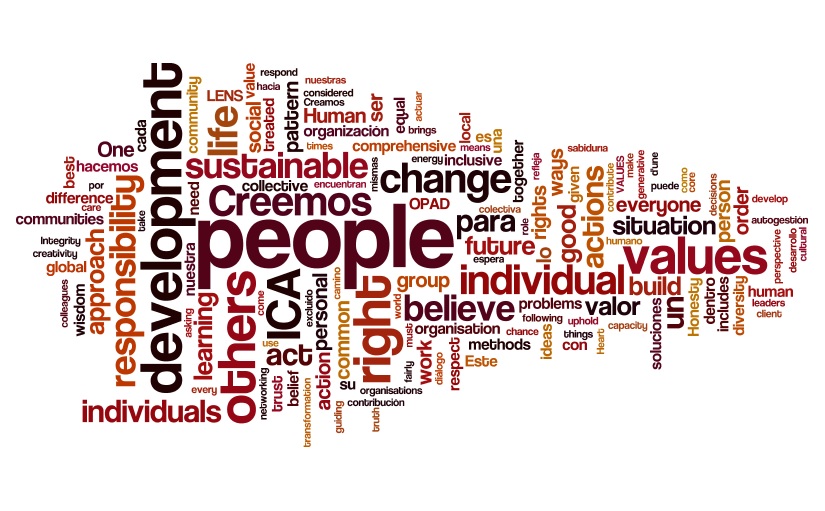
ICAs Values StatementThe Institute of Cultural Affairs (ICA) is a global community of non-profit organisations advancing human development worldwide. The role of ICA International is to facilitate peer-to-peer interchange, learning and mutual support across the network. ICA International also maintains consultative status on behalf of the membership with UN ECOSOC, UNESCO, UNICEF, WHO & FAO.

With member organisations and related organisations and groups in over 40 countries worldwide, online gatherings play a key role in facilitating peer to peer support and collaboration among ICAs and ICA colleagues, within and across regions.  ICAI currently convenes online regional gatherings three times per year, for three regional time zone groups – Asia/Pacific, the Americas, and Europe/MENA/Africa.

ICAs Mission StatementThese regional gatherings are open to all ICA members, staff and volunteers worldwide, and people are welcome to attend another region’s gathering if they cannot attend their own.  The third series of gatherings for 2013 were held December 9-11, and attracted 23 people from 19 countries.

The aims of the gatherings are to connect ICAs and ICA colleagues with each other, and help to build & strengthen relationships between them; to share information and facilitate peer-to-peer support and collaboration among ICAs and ICA colleagues; and to hold ICAI accountable to its members, and seek input & support to strengthen our global network and advance our global mission.

The agenda every time includes introductions and questions & discussion on reports shared by ICAs and ICAI. Agenda items particular to the December gatherings, in preparation for the following online General Assembly, included criteria for ICAI financial support to member initiatives, a proposed procedure for developing global policy for ICA, our pattern of face-to-face global conferences, and categories of ICAI membership. A full transcript of the gatherings has been circulated, including links to the meeting papers and online recordings of the three 90-minute meetings – please ask if you’d like a copy.
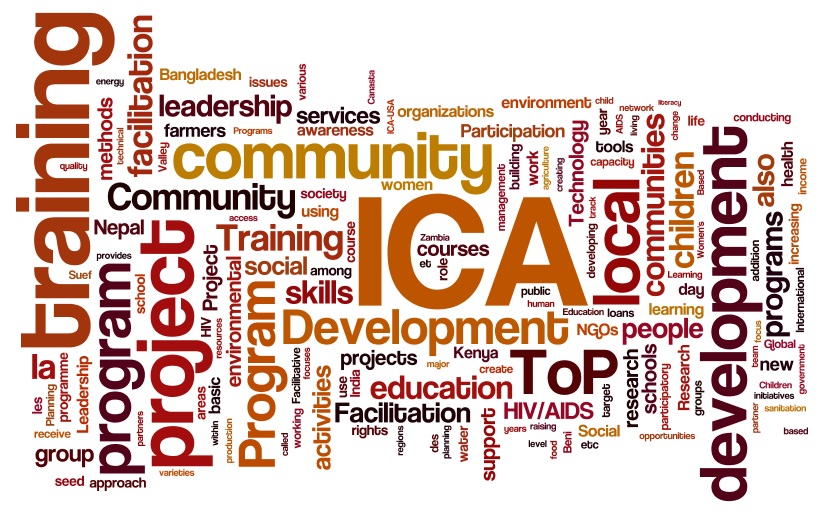
ICAs Current ProgrammesIf you have not been able to join the online gatherings this year, please do let me or another ICAI Board member know if there is anything that we can do to make these online regional gatherings more relevant and accessible to you next year.  Please also let us know what alternative approaches to remote networking might work better for you, whether synchronous (such as online meetings and twitter chats) or asynchronous (such as email, facebook and linkedin).

ICAI December 2013 General Assembly

The ICAI General Assembly meets normally once per year. Its aims are to take ICAI membership decisions, including approval of Associate & Statutory memberships; to take ICAI strategy & policy decisions, to direct the work of the Board and to guide & support the peer-to-peer collaboration among ICAs; and to elect the ICAI Board and hold it accountable to the membership, including by receipt of an annual audited finance report.

The 2013 GA was held online on December 16, using Adobe Connect. Nineteen people from 12 ICAs participated, including voting representatives from 10 of 19 voting statutory members. We were grateful for technical support for the meeting from ICA:UK Associate and virtual facilitator Orla Cronin.

ICAs Major funders and partnersSeven ICAs were accepted as new or renewed statutory members, bringing the total to 19. A further 11 ICAs were accepted subject to payment of dues and/or formal request. It was decided to change the term of membership from the January-December calendar year to the 12-month period following receipt of dues.  The GA received the audited financial statements for 2012, and Timothy Wright in Canada was re-appointed to audit ICAI’s Financial Statements again for 2014. The seven serving members of the ICAI Board were re-elected as Directors. A new procedure for development of global policy was approved, and a number of ICAs agreed to propose a working group to use the procedure to develop a new global policy for ToP facilitation and training.

In addition to this decision-making, feedback was invited on the Board’s plan to develop its work plan for 2014 on the basis of the 2013-14 strategy approved by the GA in 2013, and no objections were raised.  Further discussion was had on the question of whether to call a face-to-face General Assembly for 2014 and/or a Global Conference for 2016, although it was decided not to hold a vote due to insufficiently inclusive and in-depth discussion among members prior to the meeting. The meeting was notified of the new legal requirement to obtain a ‘continuance’ in order maintain ICAI’s registration as a non-profit in Canada. A special General Assembly will be called for February 2014 to amend the Bylaws for that purpose.

A full report is available on request, with a link to the full online recording of the 90 minute meeting. Feedback from those participating included: “Efficient and effective”, “Very smooth and good timing”, “It was excellent. Thanks for all who made it possible”, “Awesome organization! Thank you for such professionalism!” and “Appreciate clarity, preparation from area meetings and moving well”. Isabel de la Maza of ICA Chile was unable to attend but watched the recording and wrote:: “It was a great meeting!!!!, Thanks for a very professional virtual facilitation job. Wow!!! It is incredible what technology is permitting in these days”.

ICAs collaborative projects, funding relationships, etcA brief online survey has been circulated by email to 99 representatives of 42 ICA locations worldwide to seek further feedback, particularly from those who did not participate, to help the Board make future online gatherings and GAs more inclusive and more effective.

ICA International Board update, December 2013

Global BuzzThis post was first published in ICAI’s monthly bulletin the Global Buzz.

November has been a busy month for ICAI, and December will be busier.  We have been preparing for the three online regional gatherings and General Assembly scheduled for December – see below for further details, and please join us if you can!  Draft agendas were first circulated to members for consultation when the dates were announced in September, and revised drafts were circulated with further details this month.  Please ask for details if you are interested to join.

Also we have been busy following up the last few responses to the ICAI global membership survey that remain outstanding in advance of these meetings. We are grateful to the 34 ICA locations that have already responded, and are urging the last remaining locations to share their responses now.  Responses from the first 30 locations were circulated to members this month.  These suggest (among other things) that we have at least 152 full-time and 112 part-time employees worldwide, over 170 Board members and 251 ToP trainers; and that over 2,544 people were trained in 193 public ToP courses last year.  ToP training and group facilitation are the most common programme areas of ICAs (23 & 25 locations respectively) followed by education, leadership development and comunity development (20 locations each).

We have updated the global network email list according to the survey responses, and launched new ICAI groups on LinkedIn and Facebook as additional forums for discussion.  Working with the global communications team we have drafted a site map for a new, simpler & cleaner ICAI website to be developed next year.  Meanwhile the team has been working on the new December issue of ICAI’s Winds & Waves magazine.

The December regional gatherings & General Assembly are now only a couple of weeks away. Everyone with an involvement or interest in ICA worldwide is welcome and encouraged to attend and participate in the regional gatherings, so please join us if you can.  Voting at the GA will be restricted to one vote per statutory member ICA.  Please complete the doodle poll to see your own local times and to register for the meetings you plan to attend (scroll down for meeting aims):
·     Europe Africa – Mon 9 Dec 12 noon UK time
·     Americas – Tue 10 Dec 3pm UK time
·     Asia Pacific – Wed 11 Dec 10am UK time
·     General Assembly (GA) – Mon 16 Dec 12 noon UK time

Each meeting will last for up to 90 minutes, and each will be preceded by a pre-meeting 30 minutes in advance for orientation to the online meeting technology and for technical support.  The meetings will be held on Adbobe Connect, and log-in details will be circulated the week before.

Regional Gathering Aims
1. to connect ICAs and ICA colleagues with each other, and help to build & strengthen relationships between them
2. to share information and facilitate peer-to-peer support and collaboration among ICAs and ICA colleagues
3. to hold ICAI accountable to its members, and seek input & support to strengthen our global network and advance our global mission.

General Assembly Aims
1. to take ICAI membership decisions, including approval of Associate & Statutory memberships
2. to take ICAI strategy & policy decisions, to direct the work of the Board and to guide & support the peer-to-peer collaboration among ICAs
3. to hold the ICAI Board accountable to the membership, including by receipt of an annual audited finance report.

My first 416 days as a freelance facilitator, 2012-13

National Freelancers DayToday is National Freelancers Day here in the UK, and so a good day I think to reflect on my own first year and a bit as a freelancer.  I did think that twice before, but on my anniversary on October 1st I was too busy with client work, and during International Facilitation Week (October 21-27) I was too busy with International Facilitation Week.  At 7am this morning I was working with Orla Cronin to facilitate an online workshop for worldwide contributors to a collaborative writing process taking place in South Africa this week, ‘Exploring the Real Work of Social Change‘, but apart from that I am happy to be having a relatively quiet week. So here goes. I have even updated my profile photo to mark the occasion – a new look for a new year.

London Mayor Boris Johnson is quoted as saying in support for National Freelancers Day that “taking the plunge as a freelancer is an immense decision that in many ways can appear daunting but it’s also a choice that’s brave, ambitious, fulfilling and rewarding“. My own decision initially was to work freelance to earn an income and keep my options open for a while, while deciding what to do next after stepping down as Chief Executive of ICA:UK after 16 years. I thought of it more as a sabbatical at first than as a new career, and after delivering facilitation, training and consulting services to ICA:UK clients all those years it did not seem particularly brave or ambitious. The immense part had been deciding to step down from my previous role. It was indeed rewarding and fulfilling, however, and soon enough I had decided that this was how I wanted to continue to work.

In that sense the process has been a little like the way my career as a whole began and then continued. I took a ‘year out’ after my undergraduate degree to volunteer with ICA in India in 1986, and 27 years later I am still with ICA and serving as volunteer President of ICA International. Working freelance is enabling me to do that now, and whatever other paid or unpaid work I want to take on, with maximum flexibility and minimum administration and overheads.  What’s not to like?

In my first year as a freelancer I have had the opportunity to deliver facilitation and facilitation training contracts in Dublin, Geneva, Moscow, Ramallah, Zurich and online, as well as around the UK and even within walking distance from my home base in London. The groups I have worked with have ranged from local community-based organisations to UN-mandated international agencies, and from global corporations to small consultancies and social enterprise start-ups (see also who I work with and how I work). This diversity is a major attraction for me – always stimulating, mostly challenging and never dull.

Having worked for years as well with public sector clients in the UK, these have been notable for me by their absence this past year. Notwithstanding David Cameron’s enthusiasm for freelancers (and entrepreneurs) ‘as the engine of our economy and economic revival’, it has certainly been a good year not to be reliant on UK clients, and especially not on UK public sector clients. Many years of international involvement and Board service with my professional association the International Association of Facilitators has been very helpful there, as well as long-standing relationships with ICA colleagues worldwide. I have Brussels, Geneva and New York to look forward to in December & January, and a number of mostly European prospects in the pipeline for after that, so I am happy to say an over-reliance on UK work does not seem to be a problem as yet. I would welcome more gigs that I can walk to as well though!

On deciding to establish myself in business as a freelancer I also joined PCG: the Freelancers Association (the people behind National Freelancers Day), and have found this invaluable.  I have experience of non-profit management and governance, including registering and preparing SORP-compliant accounts for a UK charitable company, but it has been a relief to be able to learn quickly and easily the particularities of company and tax law etc. as they apply to me now as a freelancer – and to discover just how less onerous it is to establish and run a private company with one shareholder, one Director and one employee.  For someone whose stock in trade is participatory decision making, it’s nothing short of revolutionary for me that I get to decide everything by myself, without consultation, and within much lesser constraints than I am used to.  I am proud to say that Martin Gilbraith Associates Ltd is now well and truly in business, and even has its new cloud-based Crunch accounting system up to date (quote ‘mg15641m’ if you join too, and we both get free vouchers).

Throughout this past year I have particularly enjoyed and appreciated the extra time I have been able to find for professional development, reflection, reading and writing.  I am pleased to have accumulated over 40 posts and 6,000 site views on this blog, and to have read many books (and many more than each of the previous years) and attended numerous events with IAF, at the RSA and elsewhere. I still aspire to make more connection between the professional development, reflection and reading and the writing, but happy for that to be a goal.

In the meantime, I enjoyed so much the opportunity to use my Arabic again on my recent trips to Palestine that I have joined an Arabic conversation meet-up group in London. That experience has also got me wondering more about the reality and prospects for participation and facilitative leadership in the Arab world generally, almost 20 years on from my own six years with ICA Egypt and my masters research on civil society and democtratisation, and with the revolutions of the so called ‘Arab Spring’ continuing to unfold.

Thank you for following, and please feel free to share your own reflections and comments as well.


See also about me, how I work, who I work with and recommendations & case studies, and please contact me about how we might work together.

Register now on Eventbrite for my free facilitation webinars, and for my regularly scheduled ToP facilitation training courses in London and Brussels.

ICAI Winds and Waves – Edge thinking in human development

ICAI Winds and Waves, August 2103 - coverThis article was written for ICAI Winds and Waves, August 2013.

Welcome to the 6th issue of Winds and Waves, the online magazine of ICA International.

This issue on the theme of Edge Thinking in Human Development is packed with insightful and thought-provoking articles including stories of outrage and hope in the UK and the Arab world, of self-esteem and humility in Chile, of myth and metaphor in political science in Venezuela, of restorative practice in Australia, of Theatre of the Oppressed in Tajikistan and of higher education in public health online and worldwide – even of a comprehensive perspective from the international space station! Also included are news briefs from ICAs around the world, book reviews and much more. Woven through-out are the values of human development and the methods of facilitative leadership that are the hallmark of our global ICA network.

It is the role of ICA International to facilitate international peer-to-peer support and collaboration among ICAs and ICA colleagues, so I hope you will find something here to inspire or provoke you to reach out to colleagues you may or may not know, and to connect and perhaps to collaborate with them.

In our last issue in April we reported on the appointment of new ICAI Board members, and the development of a new 2013 business plan for ICAI. The ICAI Board took the opportunity of our July meeting, a little over half way through the year, to reflect on progress against that plan. I would like to share a little here on two key elements of our plan, as a couple of immediate opportunities for readers to get better connected and more involved in ICA globally.

The new network survey is intended primarily to enable ICAs and ICA colleagues around the world to know each other better, to facilitate peer to peer support and collaboration. It also includes questions designed to indicate how ICAs meet the ICAI membership criteria, to enable the ICAI Board and General Assembly to monitor that and take membership decisions, and questions on activity with UN agencies to enable ICAI to report on that to maintain ICAI’s consultative status with UN agencies.

We are grateful to the many ICA colleagues around the world that contributed to the survey design, and to the 19 ICA locations that have already completed and returned their responses – five from Africa, three from the Americas, seven from Asia and four from Europe. It is too early yet to draw any conclusions from the responses received to date, but we look forward to making all the data available to all members when all responses have been received. If your ICA hasn’t already responded, then please do so as soon as you can by completing the online questionnaire.

ICAI’s online regional gatherings are convened three times per year, for three regional time zone groups – Asia/Pacific, the Americas, and Europe/MENA/Africa. These gatherings are open to all ICA members, staff and volunteers worldwide, and people are welcome to attend another region’s gathering if they cannot attend their own.

The aims of the gatherings are to connect ICAs and ICA colleagues with each other, and help to build and strengthen relationships between them; to share information and facilitate peer-to-peer support and collaboration among ICAs and ICA colleagues; and to hold ICAI accountable to its members, and seek input and support to strengthen our global network and advance our global mission. The first gatherings of 2013 were held in March, and reported in the April issue. The recent August gatherings will be reported in the December issue of Winds and Waves. Everyone with an involvement or interest in ICA worldwide is welcome and encouraged to attend these on-line meetings.

Thank you again to the Winds and Waves global editorial team, and to all of our contributors, for so generously sharing their time, expertise, experience and ideas with us all in this issue!

Move beyond ‘seat of the pants’ facilitation


“Move beyond ‘seat of the pants’ facilitation and reliance on instinct, and use the most powerful facilitation methods and processes available in the world today.”

Well done and thank you to Bill Staples and ICA Associates in Canada for another great little video in their series introducing ICA’s Technology of Participation (ToP) facilitation approach – see also Introducing the Technology of Participation on Vimeo and How I work.

This new 3 minute video (above) previews ICA’s flagship 2-day ToP Group Facilitation Methods training course. This course introduces the foundational ToP Focused Conversation and ToP Consensus Workshop methods, through demonstration, theory, practice and application.

This course, and others building on these two foundational methods, are available from ICAs in all continents worldwide – including ICA Associates and of course ICA:UK.  For links and further details, please see ICA International or contact me.