ToP masterclass: Facilitating dialogue, learning, consensus & change at #Facilitate2025

I am excited to be offering pre-conference training again this year in conjunction with the UK’s premier facilitation learning event, the IAF England & Wales annual Annual Conference Facilitate2025, held Friday 25 and Saturday 26 April in Birmingham.

Facilitate2025 is an opportunity for facilitators to come together to share, learn and develop understanding, skills and practice. Everyone interested in facilitation is welcome, whether you are brand new to this work or have been doing it for years, whether you work in-house or externally and whether you facilitate some or all of the time.  As part of the 2025 programme there will be a thread on anti-racism and what this means for us as facilitators.

There will be a number of facilitation training courses being offered in the same training venue the day before the conference, at an additional cost. You can check them out and find the booking links here.

My own pre-conference training is the ToP masterclass: Facilitating dialogue, learning, consensus & changeintroducing ICA’s Technology of Participation (ToP), transformational tools for dialogue, learning, consensus & change – Thursday 24 April.

This one-day master-class is suitable for all those who want to be able to involve people more effectively in dialogue, learning, consensus & change, including team leaders and managers within organisations, those working with Boards, management teams, partnerships and external stakeholders, youth and community workers and independent facilitators. The course has no pre-requisite.

This course will introduce two foundational methods of ICA’s ‘Technology of Participation’ (ToP) methodology, and two that adapt and apply these foundations to strategic review, planning and change:

  • ToP Focused Conversation provides a structured, four-level process for effective communication which ensures that everyone in a group has the opportunity to participate
  • ToP Consensus Workshop is a five stage process that enables a facilitator to draw out and weave together everybody’s wisdom into a clear and practical consensus
  • ToP Historical Scan (or ‘Wall of Wonder) is a powerful tool to enable a group to share and learn from their varied perspectives of a journey through history, and in context, to review the past in order to prepare for the future
  • ToP Participatory Strategic Planning is a structured long-range planning process which incorporates ToP Consensus Workshop for building consensus, ToP Focused Conversation for effective group communication, and an implementation process for turning ideas into productive action and concrete accomplishments.

Register now for public courses in Eventbrite

Register now in Eventbrite for this and other upcoming public courses in London, Brussels & elsewhere – scroll down for dates & locations.

Discounts: IAF members enjoy a special 10% discount – see Exclusive Offers for IAF Members.  Conference attendees enjoy a 25% discount (IAF members and non-members).

For additional courses offered by fellow ICA:UK Associates, see the full ICA:UK public course schedule.


See also about me, how I work, who I work with and recommendations & case studies, and please contact me about how we might work together.

Dramatically Reducing Embodied Carbon in Europe’s Built Environment – ToP facilitation case study

The Carbon Neutral Cities Alliance (CNCA) is a collaboration of leading global cities working to achieve carbon neutrality in the next 10-20 years – the most aggressive Greenhouse Gas (GHG) reduction targets undertaken anywhere by any city.

CNCA’s mission is to mobilize transformative climate action in cities in order to achieve prosperity, social equity, resilience and better quality of life for all on a thriving planet.

Context

In March 2023 I was approached by Irene Garcia of the Carbon Neutral Cities Alliance (CNCA) to facilitate a 3-day event in Lille in June. In her first draft agenda she wrote:

“The project “Dramatically Reducing Embodied Carbon in Europe’s Built Environment” led by Carbon Neutral Cities Alliance (CNCA) aims to organize an in-person meeting in 2023 gathering the cities participating in the project.

The program will focus on developing an understanding of what the built environment looks like today in European cities, what are the main drivers and game changers to have the highest potential to produce deep, durable GHG emissions reductions in key systems at a “transformational” scale, and what efforts and policy changes would be required for cities to double down efforts on its decarbonization.

Recognizing the urgency, magnitude and multi-level nature of the change required in the built environment, the meeting will provide room for multi-level conversations with national and EU stakeholders. The organizations leading the national work in France, Finland and Scotland, as well the European work will be invited to join and contribute to the discussions.

Further, the programme will showcase to participants the hosts’ stellar projects to address embodied carbon and/or increase the use of bio-based materials, and seek to engage key community stakeholders involved in the projects that the group will visit.

The results of the workshop will feed into the ongoing project of CNCA and will influence future work from 2024 onwards.”

I learned in conversation with Irene that it would be only the second in-person, and final, meeting of a three-year project where cities have been participating to get policy support to address embodied carbon and increase the use of bio-based materials in their built environment.  The group had had bi-monthly online meetings that would continue to the end of 2023. She hoped to use this final in-person meeting to create a moment where all participants could reflect together on where cities were at the moment, share their insights and approaches in a meaningful way that resonates and co-create some solutions to specific challenges they were currently facing.

Participants would be mostly city officials, including climate directors or technical staff in charge of the built environment. We would also have some participants dealing with the built environment at the national and EU level, as well as the project’s funder.  She expected a group of up to 30 people, and the hosting city would provide meeting space.  A photographer and videographer would help to record the meeting for publicity purposes.

Aims

In conversation, the aims of the meeting were agreed as follows:

  • to reflect and learn together on where cities are at the moment, and co-create solutions to specific challenges they are currently facing – in particular, what are the main drivers and game changers, and what efforts and policy changes would be required,
  • to provide room for multi-level conversations, including those leading the national work in France, Finland and Scotland,
  • to share top-notch practices in a meaningful way that resonates, to think out of the box and untap all the knowledge in the room,
  • to inform the ongoing project of CNCA and identify support that cities need from 2024 onwards,
  • to inspire, energise and enthuse, and build a sense of shared trust, commitment and mutual support.

Methodology and approach

I proposed to draw on the following three of ICA’s Technology of Participation (ToP) methods in particular, plus other methods and tools as appropriate:

The Focused Conversation method provides a structured, four-level process for effective communication which ensures that everyone in a group has the opportunity to participate.

The Consensus Workshop method is a five stage process that enables a facilitator to draw out and weave together everybody’s wisdom into a clear and practical consensus.

The Participatory Strategic Planning process is a 5-stage process, each stage typically involving a specially tailored Consensus Workshop process.

Design, adaptation and delivery

A key aspect of the meeting’s design was to work in three different venues around the city, each selected by the host city to highlight different aspects of building decarbonization—a central theme of the sessions. This added a dynamic layer to the event and allowed participants to fully experience the city’s commitment to sustainability.

I wasn’t able to visit the rooms in advance of designing the agenda and process, however I received pictures of the venue and I was able to arrive early on each day to set up the layout and adapt the methodology to suit each space.  I was able to arrive in Lille early enough to view the first room on the afternoon before the meeting began, and the group’s site visits allowed me time during the meeting to plan and prepare in advance how best to make use of the other two.

In the end I was (just) able to use the Consensus Workshop method for a vision workshop, as I had proposed. I used the ToP Participatory Strategic Planning process as a design framework for the flow of the following sessions, but took considerable liberties with the methods and tools used for each – in order to best align with the agreed aims of the event, as well as to align with what would work best in the spaces available. I used the Focused Conversation method for opening and closing conversations throughout, and as a design framework for the structure of individual sessions.

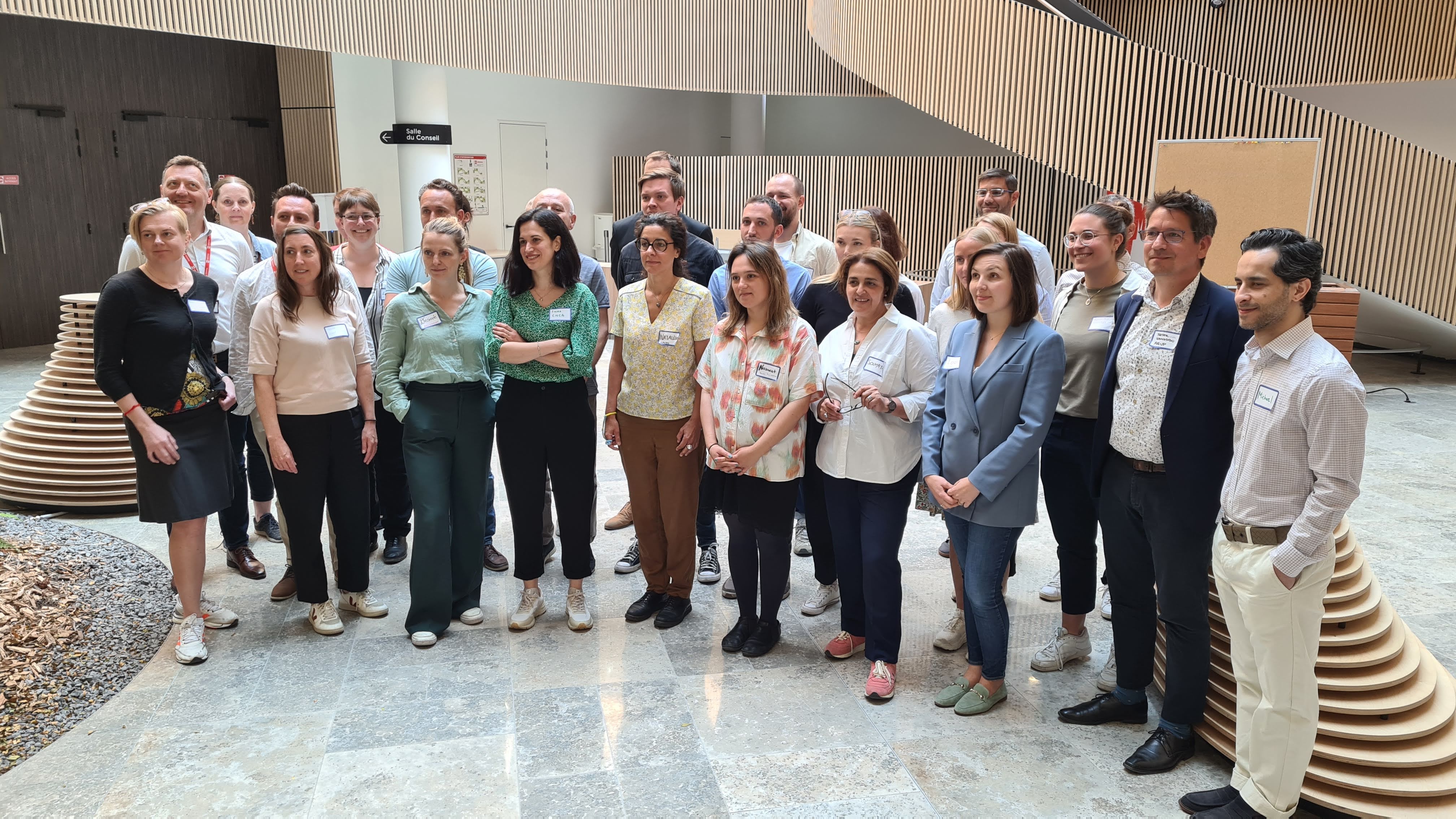
The event began on Tuesday in a large, multi-purpose function space opening on to the lobby of the modern Lille Metropole headquarters building (pictured). Cabaret style seating at pairs of tables served to accommodate an opening World Cafe conversation.

The rear of one of the doors from the lobby provided just enough space for a small sticky wall wide enough to accommodate a vision workshop using the Consensus Workshop method, by clustering cards in columns instead of groups. Delegates sat at their World Cafe tables to brainstorm and write their ideas on cards, and they stood at smaller, high tables for the clustering of cards and naming of clusters at the sticky wall.

After lunch was a slide presentation of the City Handbook for Building Carbon Neutral Buildings, followed by questions and discussion, and then the group left for their first site visit at Blanchemaille while I turned my attention to the space we would be using the next day.

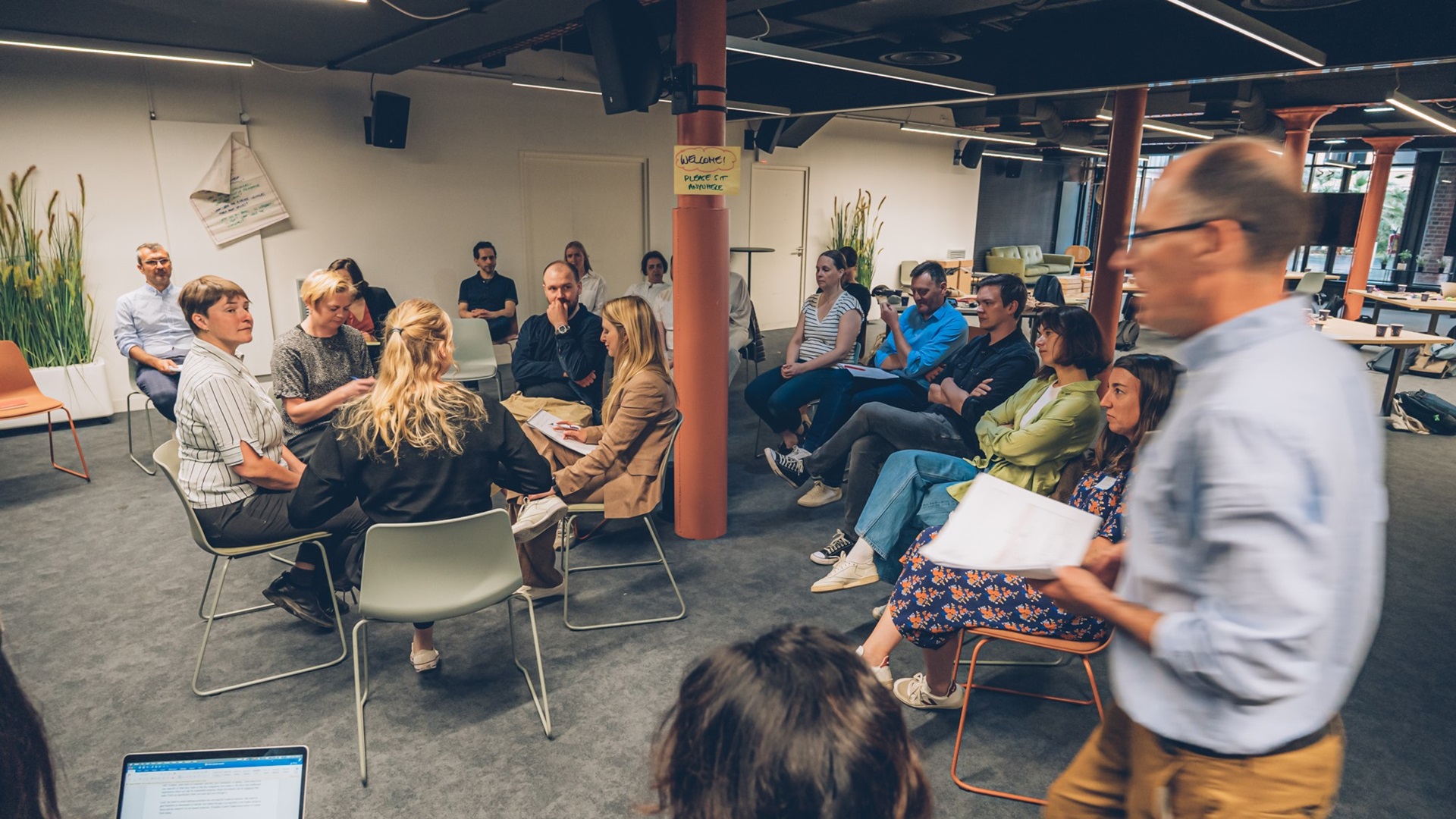
On Wednesday we met at the site of that afternoon’s visit at EuraTechnologies, a refurbished factory building. The large meeting room (pictured) was able to accommodate circles of chairs at one end, for a Fishbowl conversation on challenges in the morning, and cabaret style seating at pairs of tables for working on strategies and implementation the afternoon.

Once again, the many pillars in the room were not too much of an obstacle to people being able to see each other. A large, flat expanse of wall space by the window was able to accommodate a larger sticky wall. That was useful for displaying flip charts after they had been presented to the group, even though it was not central to the seating area and so not easily visible from all tables.

A large screen TV was available for short slide presentations illustrating strategies for success.  As the group took their visit around the site at the end of the day, I returned to the hotel to prepare the space for final morning on Thursday.

On Thursday morning we met in the delightful former chapel of the charming and historic L’Hermitage Gantois (pictured), the hotel where delegates had been staying.

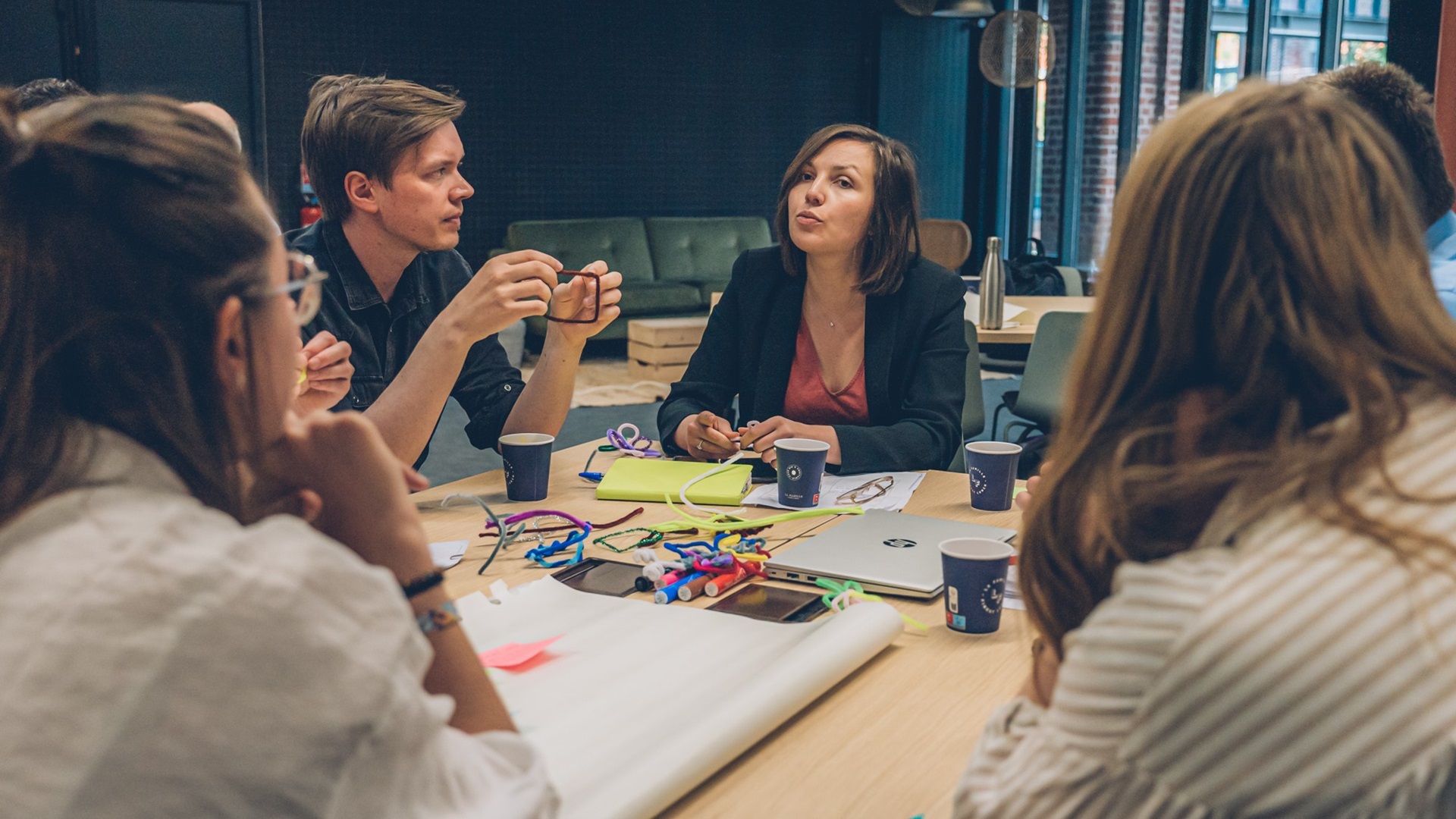
The space was very much larger than necessary, it had poor accoustics and nothing could be attached to the walls. However, the projector screen worked well enough to accommodate a sticky wall for the purpose of convening an Open Space style workshop, as did the banqueting style tables. As delegates left throughout the morning for their trips home, it was very convenient to be located at the hotel rather than somewhere else.

Feedback and impact

Participants’ on-site feedback included:

  • Room for discussions and disagreement
  • A good flow and engagement of the group within the sessions
  • Capacity to listen to each other
  • Everyone can participate
  • Open conversation and sharing of knowledge
  • Not many presentation but discussions
  • Very nice & rich programme, great contributions!
  • Good solutions, focused final session!
  • New insights & contacts
  • Dessert

Irene wrote soon after the workshop, on LinkedIn:

Really inspiring to witness first hand the tremendous progress that European cities are making to decarbonize the built environment. And how every year they keep breaking new ground over what gets to be constructed and how to mainstream sustainable buildings and dramatically reduce their embodied carbon.

She added in October 2024:

I had the pleasure of working with Martin Gilbraith for a 3-day event in Lille in June 2023 as part of the “Dramatically Reducing Embodied Carbon in Europe’s Built Environment” project, led by the Carbon Neutral Cities Alliance (CNCA). His facilitation skills played a crucial role in guiding multi-level conversations among participants. He was instrumental in organizing the flow of the sessions and seamlessly adapted to the unique needs of the group, making sure that the voices of all stakeholders were given due consideration. His preparation, energy, and professionalism enabled us to dive deeply into the complexities of decarbonizing the built environment, and the results of this workshop were wonderful.

Credit: video and photos as indicated by Fabrice Caterini, Inediz.


See also about mehow I workwho I work with and recommendations & case studies, and please contact me about how we might work together.

Reflecting on another year in freelance facilitation, 2023-24

As last summer, when I reviewed the year to June 2023, I shall share in this longer read some data and reflections on the last year of my professional practice.

In this past year to June 2024 I delivered 16 contracts for 11 clients. That compares with 14 contracts for 12 clients the year before and 19 for 15 the year before that. This past year’s contracts involved just 2 individual online sessions plus 13 wholly in-person and 2 hybrid events. Events were in Birmingham, Brussels, Leeds, London, Madrid, Sevenoaks and Windsor. That compares with 7 online sessions, 10 in-person & 3 hybrid events last year and 76 online and just 2 in-person the year before that to June 2022, still in the midst of the COVID pandemic.

So contracts have risen a little this year while clients have fallen slightly, however both remain considerably fewer than the largely pre-Covid years to June 2019 and to June 2020 which saw 25 contracts each. The continuing decline in online and hybrid events may partly reflect a continuing post-pandemic return to more in-person collaboration where possible. The lower numbers of clients, contracts and events at least in part reflects my own choices – pre-pandemic to work more locally and online, and post-pandemic to work more selectively and less. 

I resolved in January 2020 to restrict my travel mostly to places accessible to London without flying, and to try to travel less and work more online, and happily that is exactly what I have been able to do since then – albeit without working much online this year. Having also begun to spend more time more often in Sitges, near Barcelona, as I had also resolved then, it was fortunate that the invitation to work in Madrid came at a time when I was scheduled to be there. So I have not flown for work since February 2020, and I have not been tempted to do so.

I was sub-contracted by colleagues for two contracts this year, and for two contracts I sub-contracted to colleagues myself. That compares to none & 3 last year and 1 & 9 the year before. So my return to more working in-person and with travel continues to be associated with more working solo and less as part of a team. 

Partners that I have contracted with this past year included ICA:UK colleagues Alan Heckman and IAF colleagues Marie Dubost and Camilla Gordon

Clients I have worked with this past year have again included UK and European charities, NGOs, and professional & trade associations and multi-sector partnerships. This year also I have worked again with UK local government, with the health service and with Universities.

Of this past year’s contracts, 9 involved facilitation while 7 involved training and none involved coaching and consulting. That compares to 10 facilitation, 3 training and one coaching & consulting the year before, and 7, 7 and 6 the year before that.  So the proportion of facilitation to training has returned to close to 50/50, while that of coaching and consulting this year has returned to zero. Perhaps that reflects a return to pre-pandemic business as usual.

Crafting a joint commitment on living wages in banana supply chains - workshopFacilitation contracts this past year have ranged in scale from a single half-day workshop to a 3 day retreat, for groups ranging from less than 10 to around 100:

  • with the Royal College of Ophthalmologists and NHS England, design and facilitation of a workshop in London for around 25 stakeholders to build collaboration to improve eye care in England
  • with the Architects Council of Europe design and facilitation of a strategy retreat involving around 15 staff & Board members in Brussels 
  • with Amnesty International, design and facilitation of a 2-day global strategy and team-building retreat for around 55 member Fundraising Directors and Secretariat fundraising staff in London and online
  • with iStandUK, design and facilitation of a strategy away day in London for partners working on data standards in UK public services
  • with Amnesty International, design and facilitation of a pair of tri-lingual, cross-regional online consultation sessions on global governance, involving 2-3 delegates of each of around 70 member entities worldwide
  • with Shelter, design and facilitation of a 2-day ‘Changemakers Summit’ for around 100 staff of the Communications, Policy & Campaigns Directorate and others in London
  • with Amnesty International, design and facilitation of a one day retreat of the Regional Human Rights Impact Directorate of the International Secretariat in Windsor
  • with Amnesty International, design and facilitation of a 3-day team retreat in Sevenoaks for around 30 members of the East Europe & Central Asia Regional Office of the International Secretariat
  • with IDH Trade, design and facilitation of a one day hybrid workshop for around 30 in Madrid and a dozen online, representatives of European partner organisations working to develop joint commitments on living wages in Banana supply chains – case study 

Architects’ Council of Europe (ACE-CAE), wrote on LinkedIn:

“Reflecting on last week’s inspiring #strategy workshop!  The ACE Executive Board came together in #Brussels to #brainstorm and pave the path for the future of the organisation. Strategic workshops are not just about planning for the future; they are about transforming vision into actionable steps, highlighted Ruth Schagemann, ACE President. Over the course of this collaborative and creative day, we engaged in strategic discussions about how to leverage impactful advocacy and the organisation’s agenda for action. Excited for what’s ahead and proud of what we’ve accomplished together!” 

Shelley Heckman, Deputy Director at iNetwork wrote on LinkedIn:

“I’ve never been as inspired and energised about the topic of data standards as I have been today with this fantastic group of people! The iStandUK Executive Board met in London to talk ambitiously about our collective commitment to data standards for public services.” 

Training contracts this past year have involved more or less tailored delivery of three standard ICA:UK ToP facilitation training courses:

During this past year I relaunched my own regular schedule of public ToP facilitation training under license with ICA:UK, in collaboration with the ICA:UK team of ToP Associates and in support of a wider ICA:UK organisational restructure.  As part of that restructure I have taken on a volunteer role supporting ICA:UK with it’s website, mailing list and social media.  

In my new schedule for 2024 I re-established my pre-COVID pattern of offering three pairs of courses per year in London plus occasional courses elsewhere, in partnership or on demand – so far in Birmingham and Bristol. I also re-established my 2013 partnership offer ToP facilitation training at your place – and free places for you!. I am particularly interested to partner to offer public courses in Brussels again, as I did from 2014-2020, and/or in Barcelona. 

Abi Green, Company Director at The Conscious Project, wrote this year:

“I attended [Group Facilitation Methods] a few years ago, and I have been using what I learned ever since! In my experience you are a patient teacher who accurately judges the individual’s need for stretch or reassurance. As a facilitator, you create a space where people can listen to each other and be heard. I’d wholeheartedly recommend both your courses and your practice.” 

Trey Darley, cat herder; bit-flipper; human, wrote this year:

“Martin Gilbraith’s group facilitation training was a terrific investment of three days, the best training of my career hands-down…” 

free facilitation coachingMy coaching and mentoring this past year has all been pro bono. It has included four younger facilitators taking up my offer of free facilitation coaching in support of their work for climate justice, gender equity or anti-racism, six ToP trainees taking up my offer of an hour’s free post-course coaching and my support of another three on their journey to become ICA:UK ToP trainers. 

For IAF I continue to serve as a volunteer mentor in the IAF mentoring programme, working with two mentees of each six-month cohort. I have been in conversation this past year with members of the IAF Board to support a new programme along similar lines, by which incoming new Board members could be supported in their roles by former Board members such as me.

For the Power of Facilitation, I continued to support more than 80 IAF colleagues around the world to work to translate the book into more than a dozen languages. Additional translated editions were launched during the year in Japanese, Portuguese, Romanian, Russian & Spanish

My free facilitation webinars this year were limited to one further session on Feminist Facilitation, for Facilitation Week 2023, following two on the same topic the previous year. This year’s attracted 95 participants.

In my own professional development I have continued to value the professional community and facilitation meetups of IAF England & Wales, and particularly again the in-person conference in Birmingham in April, this year titled Facilitate2024: GrowingTogether.

I have also enjoyed returning to share in the hosting of IAF coffee meetups in London, after taking a break since I hosted such meetups for 5 years until 2020.   

My volunteering with the Gay Outdoor Club has grown to enjoyably absorb more of my time in the past year, as it increasingly provides opportunities to apply my professional experience as well.  

In addition to hosting regular online socials this past year, in my Board role as Website & IT manager I have led a redesign of the GOC website and marketing materials for our 50th anniversary year in 2024, a member engagement process to develop a new strategy for the club and a social media advertising campaign that generated over 400 new members.

Having discovered the great hiking opportunities to be had around Sitges, near Barcelona, now that I am spending more of my time there, I have also applied my professional skills to offer a Midweek Walking “Weekend” in Sitges in October for 35 members at least – like a team retreat or a conference, but sunnier and more fun! 

Thank you for following. If you don’t find me online, or in facilitation, training and consulting, you might find me outdoors or in Sitges!


See also about mehow I workwho I work with and recommendations & case studies, and please contact me about how we might work together.

The Art of Focused Conversation, Second Edition: More Than 100 Ways to Access Group Wisdom in Your Organization

“Questions are the primary tool of the facilitator. If you have ever wondered what questions to ask, or in what order to ask them, to lead a conversation that is focused, intentional, inclusive, and productive, let this book be your guide.

I was once asked if there is such a thing as a universal principle of facilitation — mine is ORID, the powerful, foundational model of this ToP Focused Conversation method.” – Martin Gilbraith


by R. Brian Stanfield and Jo Nelson

The essential, bestselling guide to designing and leading useful and effective group conversations is now completely revised and updated.

The Art of Focused Conversation is the quintessential theoretical and practical guide to group communication and participatory decision-making. Incorporating over 60 years of meticulous research and collaborative development, this perennial, international bestseller is an indispensable addition to any facilitator’s toolkit.

The Focused Conversation Method at the heart of The Art of Focused Conversation is a core component of the Technology of Participation (ToP) methodology developed by the Institute of Cultural Affairs. The original book is widely regarded as a key resource for designing and leading useful and effective conversations and fostering consensus and collaboration. This fully updated and revised edition includes:

  • Preparation and guidelines for discussing challenging topics and facilitating a focused conversation
  • A comprehensive overview of the ORID framework, made up of Objective, Reflective, Interpretive, and Decisional questions which guide a group to wise decisions
  • In-depth analysis of how the underlying structure of ToP is based on applied phenomenology and is supported by the latest findings in neuroscience and social psychology
  • New sections on diversity, equity, and inclusion; work-life balance; conflict resolution; and guiding focused conversations online
  • 125 sample conversations that can be adapted to any situation.

Invigorate and elevate your group process with this invaluable resource—required reading for facilitators, leaders, educators, and anyone who wants to think clearly and guide thoughtful conversations.

Brian Stanfield was an educator, researcher, and Director of Publications at the Canadian Institute of Cultural Affairs. Editor of the first edition of The Art of Focused Conversation and The Workshop Book and author of The Courage to Lead, Brian made a lasting contribution to the use of participatory practices in facilitation. He died in 2006.

Jo Nelson worked with the Institute of Cultural Affairs for 50 years, leading participatory development projects and designing and teaching ToP facilitator training programs. She was a contributor to the first edition of The Art of Focused Conversation and is author of The Art of Focused Conversation for Schools and Getting to the Bottom of ToP.

Pre-ordering is available at a discount until September 10 – order from New Society Publishers or Amazon.


See also about mehow I workwho I work with and recommendations & case studies, and please contact me about how we might work together.

New! ToP Group Facilitation Methods training in Bristol, 1-2 October

Register now for public courses in EventbriteI am excited to announce an addition to my 2024 public ToP facilitation training schedule:

Register now in Eventbrite for ToP Group Facilitation Methods training, 1-2 October in Bristol!


Introducing the foundations of the ToP approach, two powerful techniques for structuring effective conversations and building group consensus – 2 days

“Meetings are a key part of what we do. As a diverse, transnational, multilingual membership network, successful meetings are key to our internal and external successes. Many of our staff mentioned Martin’s training as a highlight in their end of year reviews – several said it was the most useful training they had ever attended, and there was a clear consensus that we should work with him again.”

Eve Geddie, Deputy Director at Platform for International Cooperation on Undocumented Migrants (PICUM)

Who this course is for

The course is for all those who want to be able to engage people more effectively to build shared understanding and consensus, including team leaders and managers within organisations, those working with Boards, management teams, partnerships and external stakeholders, youth and community workers and independent facilitators. This course has no pre-requisite, but is the pre-requisite for Participatory Strategic Planning. It is recommended both to newcomers to facilitation, and to experienced facilitators who are new to our approach.

IAF endorsed trainingPreparing for CPF certification? Meetings That Work, Group Facilitation Methods and Facilitating Client Collaboration together comprise the ICA Associates ToP Facilitation Essentials Program that has been endorsed by the International Association of Facilitators for those preparing to become an IAF Certified Professional Facilitator (CPF).

IAF members enjoy a special 10% discount – see Exclusive Offers for IAF Members.

Questions this course answers

“How can I have more purposeful & productive conversations, bring out the wisdom of a group, encourage feedback between people, and reach shared awareness in meetings? How can I generate and weave together a diverse range of ideas, develop creative solutions and build a group consensus?”

This course provides a structured introduction to the ToP Focused Conversation and Consensus Workshop methods, which form the foundations of the ToP Action Planning method, Participatory Strategic Planning and other applications.

What you will gain

By the end of the course, you will

  • be able to identify when and how to use the Focused Conversation and Consensus Workshop methods
  • have gained confidence in the use of these methods
  • have recognised and explored elements of participation, creativity, teamwork and action
  • have built links with others to promote future collaboration and support in the use of the methods

The Focused Conversation method provides a structured, four-level process for effective communication which ensures that everyone in a group has the opportunity to participate.

The Consensus Workshop method is a five stage process that enables a facilitator to draw out and weave together everybody’s wisdom into a clear and practical consensus.

These methods have been featured in publications including:

See also my own blog posts Four steps to a universal principle of facilitation and learning and Responding to changing situations and needs with ToP Consensus Workshop.

Learning style

The course presents the two methods in a practical and participatory way. Each method is first demonstrated, then analysed and discussed, and then practiced in supportive small groups with guided reflection & feedback. Finally, participants plan how they will apply each method in their own situations.

What do participants say about this course?

93% of GFM participants rated the course 8/10 or higher. Comments from participants’ end-of-course evaluations included:

  • brilliant – a must-do if you want better, more effective meetings
  • provides two practical, easy-to-use methods to discover deep insights from diverse groups – useful tools for any group, organisation or community
  • benefits for experienced facilitator and novice alike
  • worth every penny – excellent content & great presentation

Your trainers

I am pleased to offer this course in partnership with ICA:UK.


See also about mehow I workwho I work with and recommendations & case studies, and please contact me about how we might work together.