New! ToP Group Facilitation Methods training in Bristol, 1-2 October

Register now for public courses in EventbriteI am excited to announce an addition to my 2024 public ToP facilitation training schedule:

Register now in Eventbrite for ToP Group Facilitation Methods training, 1-2 October in Bristol!


Introducing the foundations of the ToP approach, two powerful techniques for structuring effective conversations and building group consensus – 2 days

“Meetings are a key part of what we do. As a diverse, transnational, multilingual membership network, successful meetings are key to our internal and external successes. Many of our staff mentioned Martin’s training as a highlight in their end of year reviews – several said it was the most useful training they had ever attended, and there was a clear consensus that we should work with him again.”

Eve Geddie, Deputy Director at Platform for International Cooperation on Undocumented Migrants (PICUM)

Who this course is for

The course is for all those who want to be able to engage people more effectively to build shared understanding and consensus, including team leaders and managers within organisations, those working with Boards, management teams, partnerships and external stakeholders, youth and community workers and independent facilitators. This course has no pre-requisite, but is the pre-requisite for Participatory Strategic Planning. It is recommended both to newcomers to facilitation, and to experienced facilitators who are new to our approach.

IAF endorsed trainingPreparing for CPF certification? Meetings That Work, Group Facilitation Methods and Facilitating Client Collaboration together comprise the ICA Associates ToP Facilitation Essentials Program that has been endorsed by the International Association of Facilitators for those preparing to become an IAF Certified Professional Facilitator (CPF).

IAF members enjoy a special 10% discount – see Exclusive Offers for IAF Members.

Questions this course answers

“How can I have more purposeful & productive conversations, bring out the wisdom of a group, encourage feedback between people, and reach shared awareness in meetings? How can I generate and weave together a diverse range of ideas, develop creative solutions and build a group consensus?”

This course provides a structured introduction to the ToP Focused Conversation and Consensus Workshop methods, which form the foundations of the ToP Action Planning method, Participatory Strategic Planning and other applications.

What you will gain

By the end of the course, you will

  • be able to identify when and how to use the Focused Conversation and Consensus Workshop methods
  • have gained confidence in the use of these methods
  • have recognised and explored elements of participation, creativity, teamwork and action
  • have built links with others to promote future collaboration and support in the use of the methods

The Focused Conversation method provides a structured, four-level process for effective communication which ensures that everyone in a group has the opportunity to participate.

The Consensus Workshop method is a five stage process that enables a facilitator to draw out and weave together everybody’s wisdom into a clear and practical consensus.

These methods have been featured in publications including:

See also my own blog posts Four steps to a universal principle of facilitation and learning and Responding to changing situations and needs with ToP Consensus Workshop.

Learning style

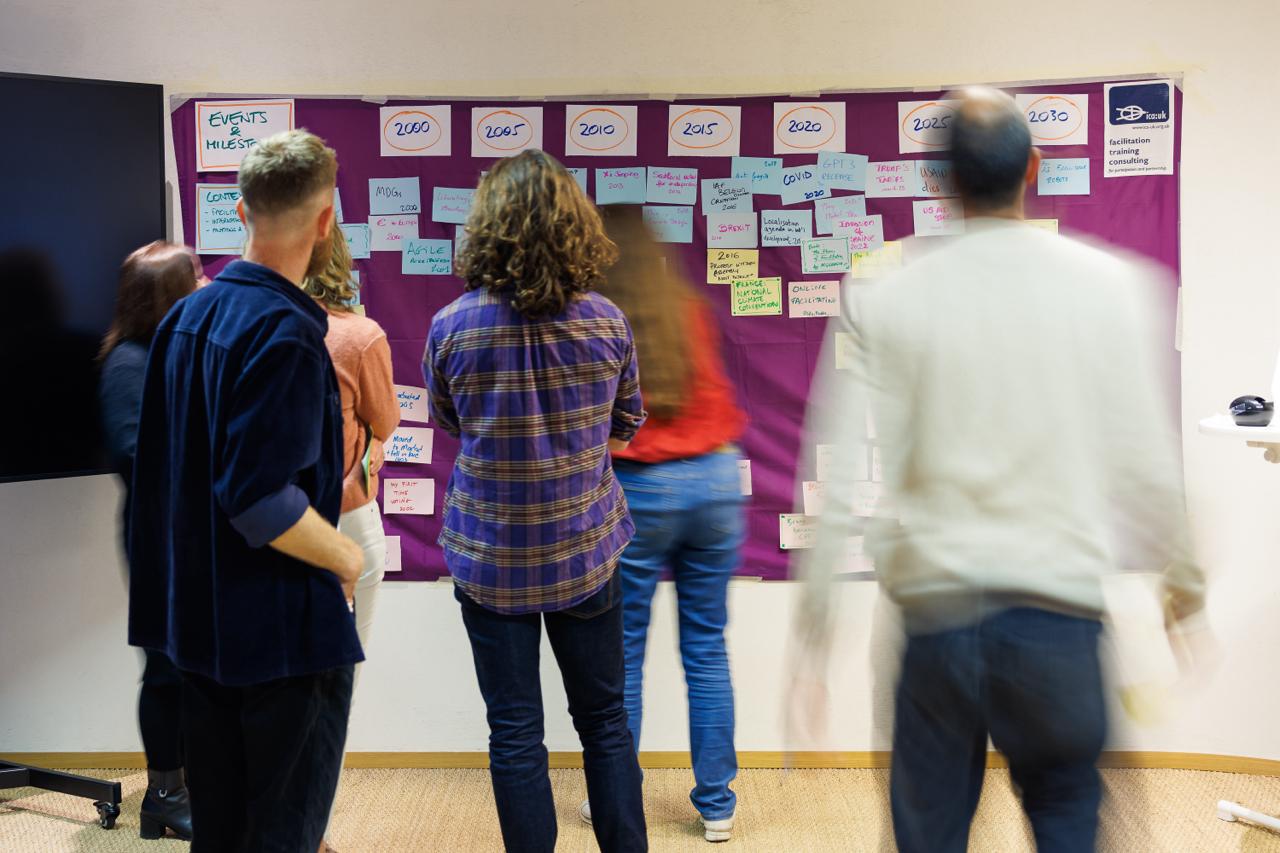
The course presents the two methods in a practical and participatory way. Each method is first demonstrated, then analysed and discussed, and then practiced in supportive small groups with guided reflection & feedback. Finally, participants plan how they will apply each method in their own situations.

What do participants say about this course?

93% of GFM participants rated the course 8/10 or higher. Comments from participants’ end-of-course evaluations included:

  • brilliant – a must-do if you want better, more effective meetings
  • provides two practical, easy-to-use methods to discover deep insights from diverse groups – useful tools for any group, organisation or community
  • benefits for experienced facilitator and novice alike
  • worth every penny – excellent content & great presentation

Your trainers

I am pleased to offer this course in partnership with ICA:UK.


See also about mehow I workwho I work with and recommendations & case studies, and please contact me about how we might work together.

Crafting a joint commitment on living wages in banana supply chains

Crafting a joint commitment on living wages in banana supply chains - workshop

“Participating retailers all agree on the need, and nearly all of them have expressed a desire to join a sector commitment. The focus of the workshop will be to agree a draft commitment that each company can sign onto.”

Context

IDH is a Foundation that works with businesses, financiers, governments and civil society to realize sustainable trade in global value chains.

In June 2022, Amanda Penn of the IDH UK team had been working with the nine major UK retailers on measuring living wage gaps in their banana supply chains, and on a sector commitment to close those gaps. Following previous online workshops together during the pandemic, she sought a facilitator for a first in-person workshop in London, from around 11am-5pm one day in July, to engage the CSR officers of the nine retailers to agree a draft commitment.

She wrote that “Participating retailers all agree on the need, and nearly all of them have expressed a desire to join a sector commitment. The focus of the workshop will be to agree a draft commitment that each company can sign onto.”

Participants were to number around 15-20 in total, including a few IDH staff. The loft room ‘Nest 2’ had been booked for the day at Wallace Space St. Pancras.  Participants were invited to stay for drinks together after the workshop.

Aims

Following our initial meetings, the aims of the workshop were agreed to be as follows:

  • To reflect and learn together from our partnership building work to date, and each other’s experience of it, to improve process and co-ordination and clarify needs and expectations,
  • To draw on the draft commitment circulated in advance to agree key elements of a commitment that we hope each company can sign on to,
  • To take a transparent and energizing, interactive and co-operative approach that will build mutual trust, confidence and commitment in the way forward together.

Approach

For this assignment, I drew on the following of ICA’s Technology of Participation (ToP) methods in particular:

The Focused Conversation method provides a structured, four-level process for effective communication which ensures that everyone in a group has the opportunity to participate.

The Consensus Workshop method is a five stage process that enables a facilitator to draw out and weave together everybody’s wisdom into a clear and practical consensus.

I arranged with Wallace Space to reserve the ground floor Locker & Rudder room in the same building in St Pancras, as an alternative to the loft room Nest 2 with its sloping walls, in order to allow vertical wall space for use with a ‘sticky wall’.

None of us were very used to meeting in person, due to two years of COVID restrictions, and it was far from clear that the pandemic was over. So I noted the COVID-19 protective measures in place at Wallace Space, and proposed some additional measures to reassure participants and encourage them to attend, and to further mitigate risks of infection.

These formed the basis of my subsequent blog post Mitigating COVID risks for in person and hybrid events.

Agenda & process

An outline agenda was agreed and circulated as follows:

11.00 Arrivals & coffee – breakfast, coffee and informal workspace is available from 8am
11.15 Opening – welcome & overview, introductions & expectations
11.45 Learning from our experience – including accomplishments & challenges to date, and benefits & challenges ahead
12.45 Lunch
1.30 Crafting our commitment – drawing on the circulated draft to articulate “What are key elements of a Living Wage Commitment for Banana Supply Chains that we would like UK retailers to be able to agree?”
3.15 Break
3.30 Next steps – next steps, reflection & close.
-5.00 Drinks – and informal networking

I used the ToP Focused Conversation method to structure the day as a whole, and to design the opening conversation and closing reflection – see Four steps to a universal principle of facilitation and learning.

I used the ToP Consensus Workshop method to articulate “What are key elements of a Living Wage Commitment for Banana Supply Chains that we would like UK retailers to be able to agree?”.

Critically, I invited participants to draw on the circulated draft commitment to identify elements that they would like retailers to be able to agree. For the purpose of consensus-building, I discouraged them from focusing on what they did not or could not agree, or what it would take for them to be able to agree. The former would be an unhelpful distraction, and the latter would be addressed under Next Steps and following the workshop.

To enable them to work most effectively together, I invited them to adopt the following working assumptions:

  • We are curious and open to learn
  • Everyone has wisdom, and we all need everyone’s wisdom for the wisest result
  • So we will listen with care to understand and speak with care to be understood
  • We will strive to ensure that our own participation does not exclude that of others
  • We will have difficult conversations with courage and compassion
  • We will respect each other’s time by being punctual and avoiding distractions
  • We will respect each other’s health by practicing COVID safety

Feedback and impact

Directly after the workshop, Amanda wrote “Anecdotally, everyone really enjoyed the facilitation and found it useful.”  Participants feedback included:

  • Facilitation was very effective
  • The activities were well designed and triggered really useful conversation at table and room level
  • I would say it met our aim to gain mutual trust and agreement on key elements
  • I think the key thing was to get agreement on the content of the commitment and a timeline for the next steps. Also just really helpful to get an idea of where others stand on this – easy to commit on a zoom call but much harder to maintain this face to face. Reassuring to see that everyone clearly wants to make this happen
  • For us personally it was a great way to get our voice heard by other retailers and encourage understanding of each retailer’s unique supply chain.

UK retailers commit to close living wage gaps in international banana supply chainsA year later, in July 2023, Amanda wrote:

“The top 9 UK retailers launched a living wage commitment in March. On numerous occasions the CSR managers who attended the workshop you led credited that day with being a pivotal moment in the process and paving the way for the ultimate result. So, thank you!” 

In the meantime, I had worked with some of Amanda’s colleagues at IDH to design and facilitate a series of three half-day workshops in London and Brussels for around 30 representatives of partner organisations to develop a joint commitment on living wage in Tea supply chains.

Since then, I was pleased to be able to work with Amanda again, and some of  the UK retailers and some of their European counterparts, to design and facilitate a one day hybrid workshop in Madrid. This involved around 30 in person and a dozen online, representatives of a variety of European partner organisations working to develop joint commitments on living wages in Banana supply chains in a number of European countries.


See also about mehow I workwho I work with and recommendations & case studies, and please contact me about how we might work together.

“Very practical and applicable in a range of contexts” – ToP facilitation training


“How can we have more purposeful & productive conversations, develop creative solutions and build group consensus?”

These are among the questions addressed by Group Facilitation Methods, the most popular course of ICA’s Technology of Participation ‘ToP’ facilitation training.

Are you looking for facilitation training or learning opportunities?

Read on for what recent participants have to say about their experience of ToP training, and check out my online and in-person ToP facilitation training courses, free facilitation coaching and occasional free facilitation webinars.

For public training courses, please register with ICA:UK or another ICA worldwide. To arrange in-house training for your group, please contact me.


Participants on my most recent ToP training in October last year rated the course on average 4.8 out 5, and shared comments including:

  • A very interesting course, very practical and applicable in a range of contexts – there was also a useful reference book which I can continue to refer to for a refresher as needed
  • Martin is a very good trainer, with a feel for pace and content based on the group he is dealing with. The training was relevant and well delivered.
  • Very relevant content, excellent delivery. Pace was good. Trainer was very good
  • The training focused on practical facilitation frameworks and skills and how to apply these in real situations – I found this a good way to learn
  • Martin was a brilliant trainer, gave practical tips, was very engaging: I learned a lot
  • The event was well paced and very informative – it gave me confidence that I could facilitate an event – success!
  • Excellent delivery by the trainer – I learnt from his facilitation skills
  • I found the content really useful and the delivery was excellent
  • The pace, content, relevance and delivery were all excellent

That was in-person Focused Conversation training, comprising day one of the 2-day Group Facilitation Methods course – both available also online.

On an earlier 2.5-hour Introduction to Facilitation Online session, Louise Reeve, Policy and Communications Business Partner at Newcastle City Council, wrote:

“Some training to recommend from Martin Gilbraith! I attended his Introduction to Facilitation Online course. Whatever your experience level, you should find something in this training which can make your online sessions just that bit better and more enjoyable”


See also about mehow I workwho I work with and recommendations & case studies, and please contact me about how we might work together.

Beyond COP26: The Conversations – facilitation case study

Communicate Beyond COP26 - the conversations

“How can we bring together 90 diverse stakeholders in a series of six online conversations in a day, to tackle complex environmental topics and have strong outputs – avoiding a ‘talking shop’”?

These were among the questions that led NHC Director Savita Wilmott to approach me in December 2021 to design and lead “Beyond COP26: The Conversations”. Savita was familiar with me, and with ICA:UK and ICA’s Technology of Participation (ToP), and knew that ICA’s ToP Focused Conversation method could be part of the answer.

Context

The Natural History Consortium (NHC) is a charitable collaboration of 14 organisations working together on a shared mission: to develop, test and disseminate best practice to engage everyone with the environment and natural world.

Communicate is the UK’s conference for environmental communicators, attracting around 200 attendees to previous in-person events and over 600 to the 2021 online conference ‘Communicate beyond COP26’. ‘The Conversations’ were the final phase of this 3-part online conference, following earlier sessions in June & September 2021.

Six round table Conversations of 90 minutes each were scheduled for one day in January 2022. Each were to have up to 16 different people attending – communication professionals from across the country, invited and/or nominated by NHC members, who may or may not have attended previous sessions in the series.

The overall theme was “What will we learn from COP26, and how will the UK’s environmental communication community translate international declarations into local action, and national programmes?” and in particular ‘has the landscape changed?’ The six Conversation topics were:

  1. Putting nature at the heart of climate change communication
  2. Learning from COP26 about better partnerships with young people
  3. Engaging people with trees, woodlands and deforestation
  4. Transparency, accountability, and avoiding greenwashing
  5. Breakthrough communication techniques and campaigns from COP
  6. From international declarations to local action.

Two people were lined up to give a 5 minute ‘provocation’ at the beginning of each Conversation, and then stay on to participate. Key insights were to be captured and shared with the Communicate community in a series of bite-size reflection papers, audio resources and tool kits.

The Conversations were to be held in Zoom to avoid ‘new platform fatigue’, with the plenary time recorded to support preparation of the ‘insight papers’ by the NHC team but the breakout spaces not recorded in order to encourage candid conversation. The six Conversations will be led separately from each other, however it was felt that it would add value to have a simple asynchronous digital place to which participants from across the conversations can contribute before, during and after the conversations.

Aims

In conversation with Savita, the aims of the Conversations were agreed to be broadly as follows:

  • To share learning and expertise about the topic between those present, to cross-fertilize ideas across the environmental communication sector after COP26
  • To generate insights that can be shared with the wider sector through NHC’s marketing channels
  • For participants to feel like they have had a satisfactory opportunity to share their experiences in a well-structured and safe environment
  • For participants to feel connected to the Communicate community, and more likely to engage in future events or be active in the network.

Approach

I had arranged for fellow ICA:UK Associate Megan Evans to work with me as co-facilitator, and with our ICA:UK colleague Alice Blackwell and David Linskey to work with us online session producers. I led three conversations in series with Alice, while Megan led the other three with David.

Our approach was to draw on the methods of ICA’s Technology of Participation (ToP), and the ToP Focused Conversation method in particular. Pioneered and refined by ICA in over 50 years of experience worldwide, ToP is a proven system of methods and tools that can be adapted and applied to help all sorts of groups accomplish a wide variety of tasks together. The core values of the ToP approach, which inform all of my work, are inclusive participation, teamwork and collaboration, individual and group creativity, ownership and action, reflection and learning.

The ToP Focused Conversation method provides a structured, four-level process for effective communication which ensures that everyone in a group has the opportunity to participate.

I proposed that we use this method to structure a series of questions for each conversation, tailored in collaboration with the NHC team to meet the above aims in respect of each topic. For examples of this approach in action we shared the ICA:UK Online Focused Conversation Series 2020 to which Megan, Alice and I had all contributed, and my own Free facilitation webinars.

Tools

For a simple asynchronous digital place to which participants from across the conversations could contribute before, during and after Conversations, I proposed that consider one of the following – depending on whether only brainstorming or also interaction may be helpful (and likely), and on which (if any) may already be familiar to participants:

We agreed to use EasyRetro for its simplicity of use and in order to easily export the data for editing into the insight papers. We agreed to use mentimeter as well for a simple participant feedback survey.

Pre-session communications to participants included:

To make sure that you will be able to join and participate, participants may need to join this Zoom test meeting in advance and then follow any instructions to download and install the Zoom app and configure your settings as necessary – https://zoom.us/test.

Participants will need a stable broadband internet connection with speed of preferably at least 10 Mbps download / upload. You can test yours at www.speedtest.net.

For greater functionality to maximise everyone’s engagement and learning, please use a laptop rather than a phone or tablet and join via the Zoom app not a browser. It is helpful to update your Zoom app to the latest version – see Zoom app upgrade.

Please use your own laptop (one per person), with headphones and a microphone, and join the session on your own from a quiet and well-lit place so that you can be seen and heard without distractions for yourself or others.

To use Easyretro on the same device as Zoom you will need to have a large screen and/or to navigate from one window to another and back again. It is not essential but can be helpful to have a second device or screen, in order to use one for zoom and one for the other tool.

Process

We applied the ToP Focused Conversation method to craft a series of nine ‘ORID’ questions that could be used across all six 90-minute Conversation sessions, for consistency of outputs.

We invited participants to respond to the first three (Objective level) questions in advance of the session in order to familiarise themselves with Easyretro, and then we reviewed and added to those responses at the start of each session. Participants responded to the remaining questions in conversation in small breakout groups, and were able to see the ideas of other groups in EasyRetro as they added their own. That enabled the plenary sessions to focus on discussion rather than reporting.

The three sessions I led started at 9.00, 12.00 and 2.30, and the three led by Megan started at 9.30,12.30 and 3.00. Staggering the start times by half an hour enabled Savita to attend and speak at the opening and closing of all six sessions.

Agenda Discussion questions
Opening & overview
Introductory conversation, building on responses shared on Easyretro in advance 

Objective level questions

1. Please share something about yourself and your work

2. Is there one thing that you hope to learn or gain from this Conversation?

3. What resources or links can you share on this topic?

First breakout groups, followed by plenary feedback & discussion 

Reflective level questions

4. How do you feel that your work or views on environmental communication have been affected by COP26?

5. How do you feel that your organisation or the wider sector is responding to the outcomes of COP26?

Break
Second breakout groups, followed by plenary feedback & discussion – with responses captured in Easyretro

Interpretive & Decisional level questions

6. What are some ways that the environmental communication sector could work together more effectively on this issue?

7. What are some of the barriers that we still need to tackle?

8. What is a key ‘call to action’ that we can share from this room to the wider Communicate community?

9. What are any issues that need more attention or discussion, perhaps at the upcoming Communicate conference in November 2022?

Takeaways & next steps
Evaluation & close

Outputs

Communicate Beyond COP26 - the conversations

The BNHC team wrote up the outputs of the six conversations and published them on their website as an insight paper.

What the participants had to say

BNHC Please-rate-this-session-a-how-far-do-you-agree

BNHC How-are-you-feeling-right-now

Savita Willmott, CEO of the Natural History Consortium, wrote in a recommendation on Jun 24, 2022:

“Martin supported our charity in January 2022 to bring together 90 diverse stakeholders into a series of six online conversations in a single day. We were looking to tackle complex environmental topics, and have strong outputs. His advice and support was invaluable to design an effective programme for the day as well as to expertly facilitate the session alongside another facilitator. We achieved our aim of avoiding a “talking shop” – the outputs of the session are informing our strategic work six months later, and the connections made between organisations are thriving. Martin strikes a brilliant balance between flexibility and attention to detail, and we’d recommend him without hesitation.”


See also about me, how I work, who I work with and recommendations & case studies, and please contact me about how we might work together.

Feminist Facilitation – free facilitation webinar

Online FC series - feminist facilitationMonday, 16 January 2023, 13:00-14:00 UK time

Scroll down for the session recording…


What does feminism bring to facilitation, and what does feminist facilitation look like? How can I ensure that my own practice as a professional facilitator is more effectively and explicitly feminist, anti-racist and anti-oppressive?

Exploring feminist facilitationThese are the questions that have guided my own exploration of feminist, anti-racist and anti-oppressive facilitation this past couple of years.

For more on that, see Exploring feminist facilitation.


Are you practicing or exploring feminist facilitation yourself, or are you interested to do so?

Join us to connect, share & learn on Monday, 16 January 2023, 13:00-14:00 UK time, for this next monthly session in the ICA:UK Online Focused Conversation Series – facilitated by fellow ICA:UK Associate Julia Makin and myself, and produced by ICA:UK ToP Training Co-ordinator Alice Blackwell.

These sessions are free and open for anyone to attend. The session will last 60 minutes and consist of a facilitated conversation using the ToP Focused Conversation (ORID) method, followed by a brief run through of the method used. The sessions are run by different members of the ICA:UK facilitation community, including lead trainers, trainee trainers, and past participants of our courses in their own style, around topics they have chosen.

In addition to participants learning from each other about the topic, the sessions will serve as an introduction to the method for those new to ToP and will be a useful reminder of the method for those who have already attended our popular Group Facilitation Methods course. Participants may opt to go on and take further training (either online or face to face) and/or continue to learn and share as part of a community of people using facilitation.

The session will be recorded, with the recording being publicly available after the session is over. If you do not wish to be identifiable, we will give you the option before we start the recording to turn off your camera and change your screen name.

Join us to connect, share & learn – register now at ICA:UK.


For recordings and other outputs of my own previous online Focused Conversation sessions and other free facilitation webinars, see free facilitation webinars.

See also about mehow I workwho I work with and recommendations & case studies, and please contact me about how we might work together.