Scroll down for the session recording and slides – with thanks to the 40 or so who attended!
Monday, 16 December 2024, 15:00-16:00 UK time
“If you have ever wondered what questions to ask, or in what order to ask them, to lead a conversation that is focused, intentional, inclusive, and productive, let this book be your guide.” – Martin Gilbraith
Have you ever wondered how to have a conversation that is focused, intentional, inclusive, and productive?
Join us to connect, share & learn on Monday, 16 December 2024, 15:00-16:00 UK time, for this special session following the format of the ICA:UK Online Focused Conversation Series.
An experiential introduction to the method will enable you to connect, share and learn with each other from your own experience of conversations that you have found challenging. Jo will then share some insights from the book, and both of us from our own experience, and there will be time for questions and discussion.
The session will be recorded, with the recording being publicly available after the session is over. If you do not wish to be identifiable, we will give you the option before we start the recording to turn off your camera and change your screen name.
Join us to connect, share & learn!
For recordings and other outputs of previous online Focused Conversation sessions and other free facilitation webinars, see free facilitation webinars.
The Carbon Neutral Cities Alliance (CNCA) is a collaboration of leading global cities working to achieve carbon neutrality in the next 10-20 years – the most aggressive Greenhouse Gas (GHG) reduction targets undertaken anywhere by any city.
CNCA’s mission is to mobilize transformative climate action in cities in order to achieve prosperity, social equity, resilience and better quality of life for all on a thriving planet.
Context
In March 2023 I was approached by Irene Garcia of the Carbon Neutral Cities Alliance (CNCA) to facilitate a 3-day event in Lille in June. In her first draft agenda she wrote:
“The project “Dramatically Reducing Embodied Carbon in Europe’s Built Environment” led by Carbon Neutral Cities Alliance (CNCA) aims to organize an in-person meeting in 2023 gathering the cities participating in the project.
The program will focus on developing an understanding of what the built environment looks like today in European cities, what are the main drivers and game changers to have the highest potential to produce deep, durable GHG emissions reductions in key systems at a “transformational” scale, and what efforts and policy changes would be required for cities to double down efforts on its decarbonization.
Recognizing the urgency, magnitude and multi-level nature of the change required in the built environment, the meeting will provide room for multi-level conversations with national and EU stakeholders. The organizations leading the national work in France, Finland and Scotland, as well the European work will be invited to join and contribute to the discussions.
Further, the programme will showcase to participants the hosts’ stellar projects to address embodied carbon and/or increase the use of bio-based materials, and seek to engage key community stakeholders involved in the projects that the group will visit.
The results of the workshop will feed into the ongoing project of CNCA and will influence future work from 2024 onwards.”
I learned in conversation with Irene that it would be only the second in-person, and final, meeting of a three-year project where cities have been participating to get policy support to address embodied carbon and increase the use of bio-based materials in their built environment. The group had had bi-monthly online meetings that would continue to the end of 2023. She hoped to use this final in-person meeting to create a moment where all participants could reflect together on where cities were at the moment, share their insights and approaches in a meaningful way that resonates and co-create some solutions to specific challenges they were currently facing.
Participants would be mostly city officials, including climate directors or technical staff in charge of the built environment. We would also have some participants dealing with the built environment at the national and EU level, as well as the project’s funder. She expected a group of up to 30 people, and the hosting city would provide meeting space. A photographer and videographer would help to record the meeting for publicity purposes.
Aims
In conversation, the aims of the meeting were agreed as follows:
to reflect and learn together on where cities are at the moment, and co-create solutions to specific challenges they are currently facing – in particular, what are the main drivers and game changers, and what efforts and policy changes would be required,
to provide room for multi-level conversations, including those leading the national work in France, Finland and Scotland,
to share top-notch practices in a meaningful way that resonates, to think out of the box and untap all the knowledge in the room,
to inform the ongoing project of CNCA and identify support that cities need from 2024 onwards,
to inspire, energise and enthuse, and build a sense of shared trust, commitment and mutual support.
Methodology and approach
I proposed to draw on the following three of ICA’s Technology of Participation (ToP) methods in particular, plus other methods and tools as appropriate:
The Focused Conversation method provides a structured, four-level process for effective communication which ensures that everyone in a group has the opportunity to participate.
The Consensus Workshop method is a five stage process that enables a facilitator to draw out and weave together everybody’s wisdom into a clear and practical consensus.
The Participatory Strategic Planning process is a 5-stage process, each stage typically involving a specially tailored Consensus Workshop process.
Design, adaptation and delivery
A key aspect of the meeting’s design was to work in three different venues around the city, each selected by the host city to highlight different aspects of building decarbonization—a central theme of the sessions. This added a dynamic layer to the event and allowed participants to fully experience the city’s commitment to sustainability.
I wasn’t able to visit the rooms in advance of designing the agenda and process, however I received pictures of the venue and I was able to arrive early on each day to set up the layout and adapt the methodology to suit each space. I was able to arrive in Lille early enough to view the first room on the afternoon before the meeting began, and the group’s site visits allowed me time during the meeting to plan and prepare in advance how best to make use of the other two.
In the end I was (just) able to use the Consensus Workshop method for a vision workshop, as I had proposed. I used the ToP Participatory Strategic Planning process as a design framework for the flow of the following sessions, but took considerable liberties with the methods and tools used for each – in order to best align with the agreed aims of the event, as well as to align with what would work best in the spaces available. I used the Focused Conversation method for opening and closing conversations throughout, and as a design framework for the structure of individual sessions.
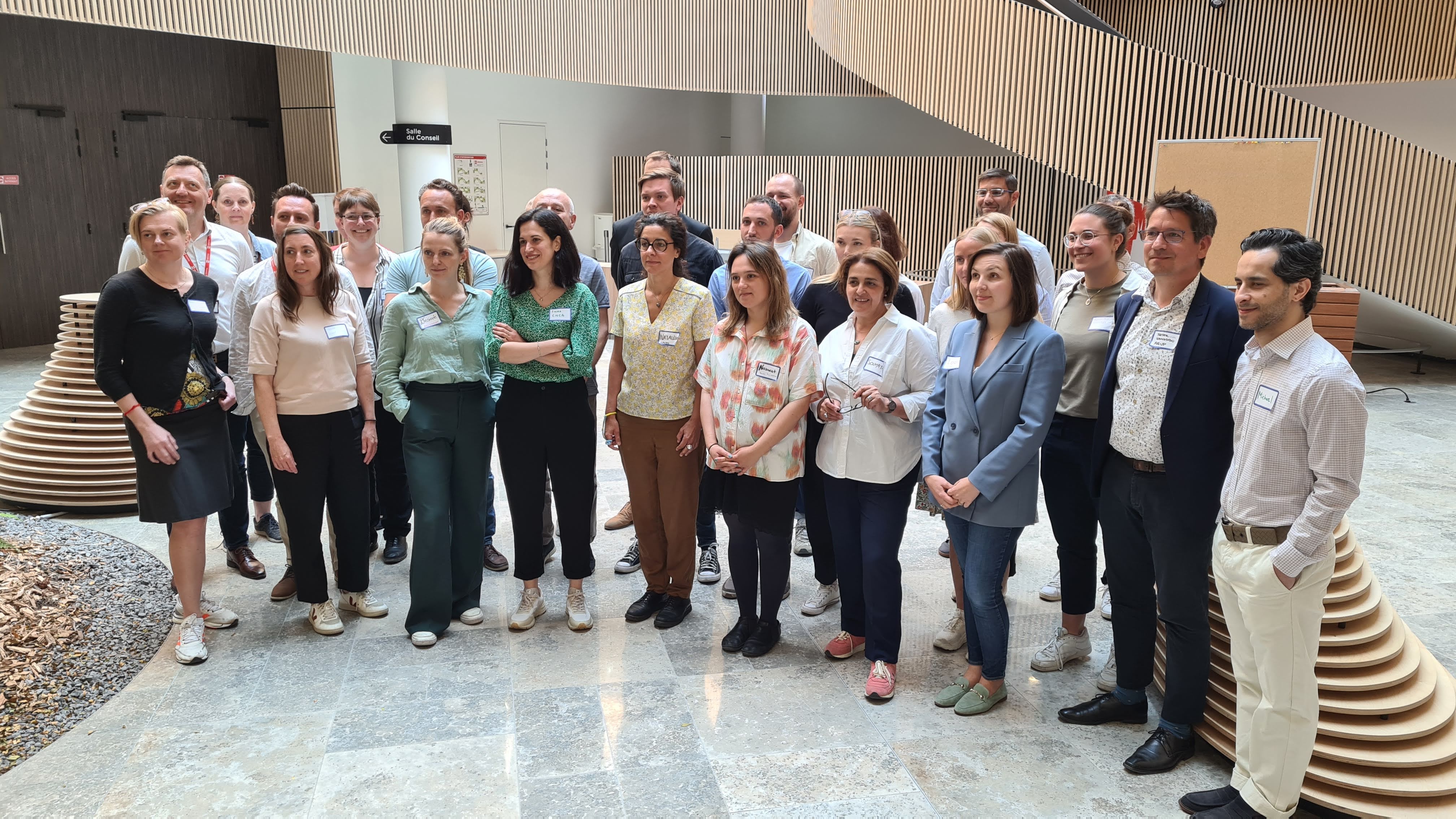
The event began on Tuesday in a large, multi-purpose function space opening on to the lobby of the modern Lille Metropole headquarters building (pictured). Cabaret style seating at pairs of tables served to accommodate an opening World Cafe conversation.
The rear of one of the doors from the lobby provided just enough space for a small sticky wall wide enough to accommodate a vision workshop using the Consensus Workshop method, by clustering cards in columns instead of groups. Delegates sat at their World Cafe tables to brainstorm and write their ideas on cards, and they stood at smaller, high tables for the clustering of cards and naming of clusters at the sticky wall.
After lunch was a slide presentation of the City Handbook for Building Carbon Neutral Buildings, followed by questions and discussion, and then the group left for their first site visit at Blanchemaille while I turned my attention to the space we would be using the next day.
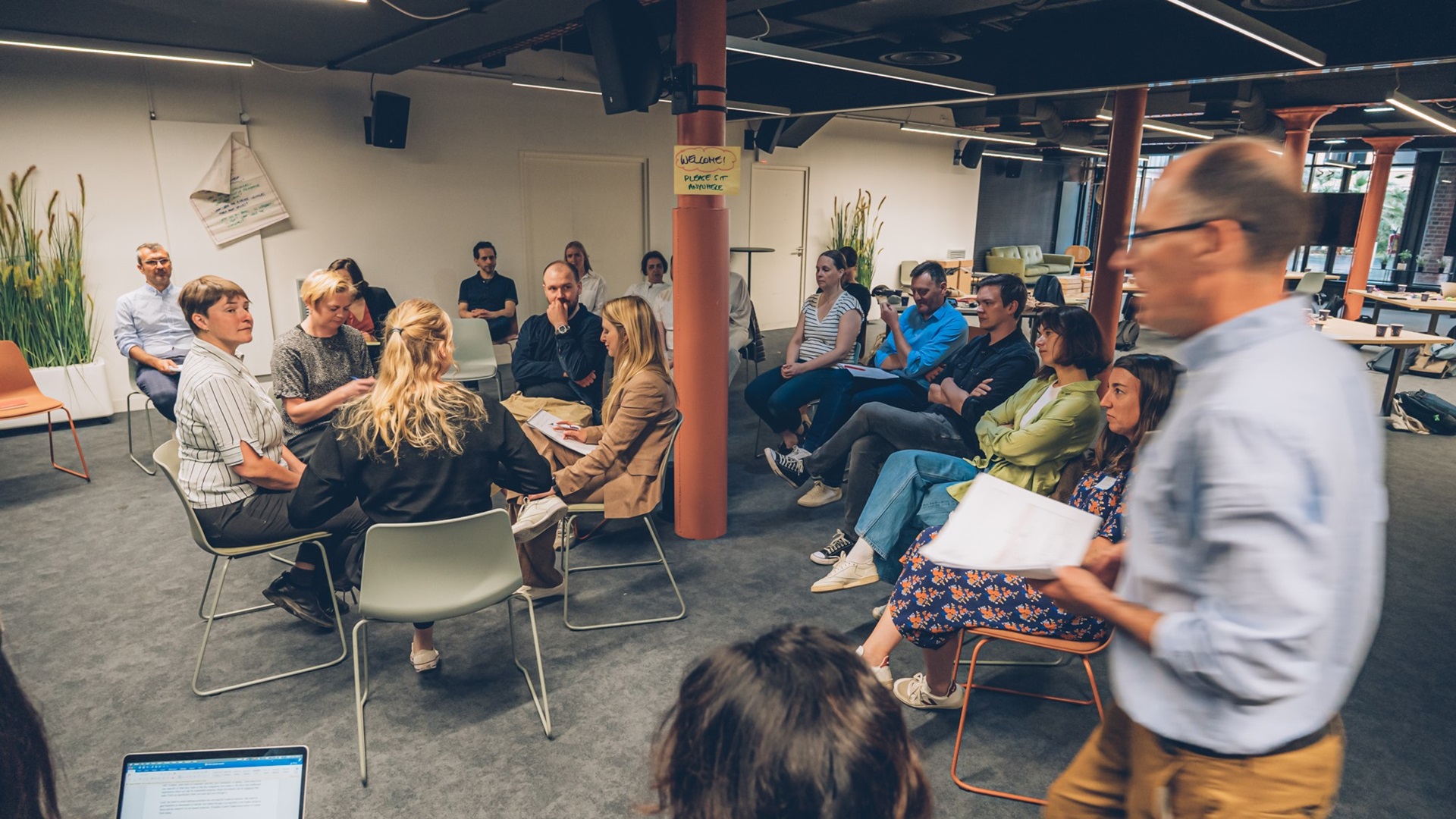
On Wednesday we met at the site of that afternoon’s visit at EuraTechnologies, a refurbished factory building. The large meeting room (pictured) was able to accommodate circles of chairs at one end, for a Fishbowl conversation on challenges in the morning, and cabaret style seating at pairs of tables for working on strategies and implementation the afternoon.
Once again, the many pillars in the room were not too much of an obstacle to people being able to see each other. A large, flat expanse of wall space by the window was able to accommodate a larger sticky wall. That was useful for displaying flip charts after they had been presented to the group, even though it was not central to the seating area and so not easily visible from all tables.
A large screen TV was available for short slide presentations illustrating strategies for success. As the group took their visit around the site at the end of the day, I returned to the hotel to prepare the space for final morning on Thursday.
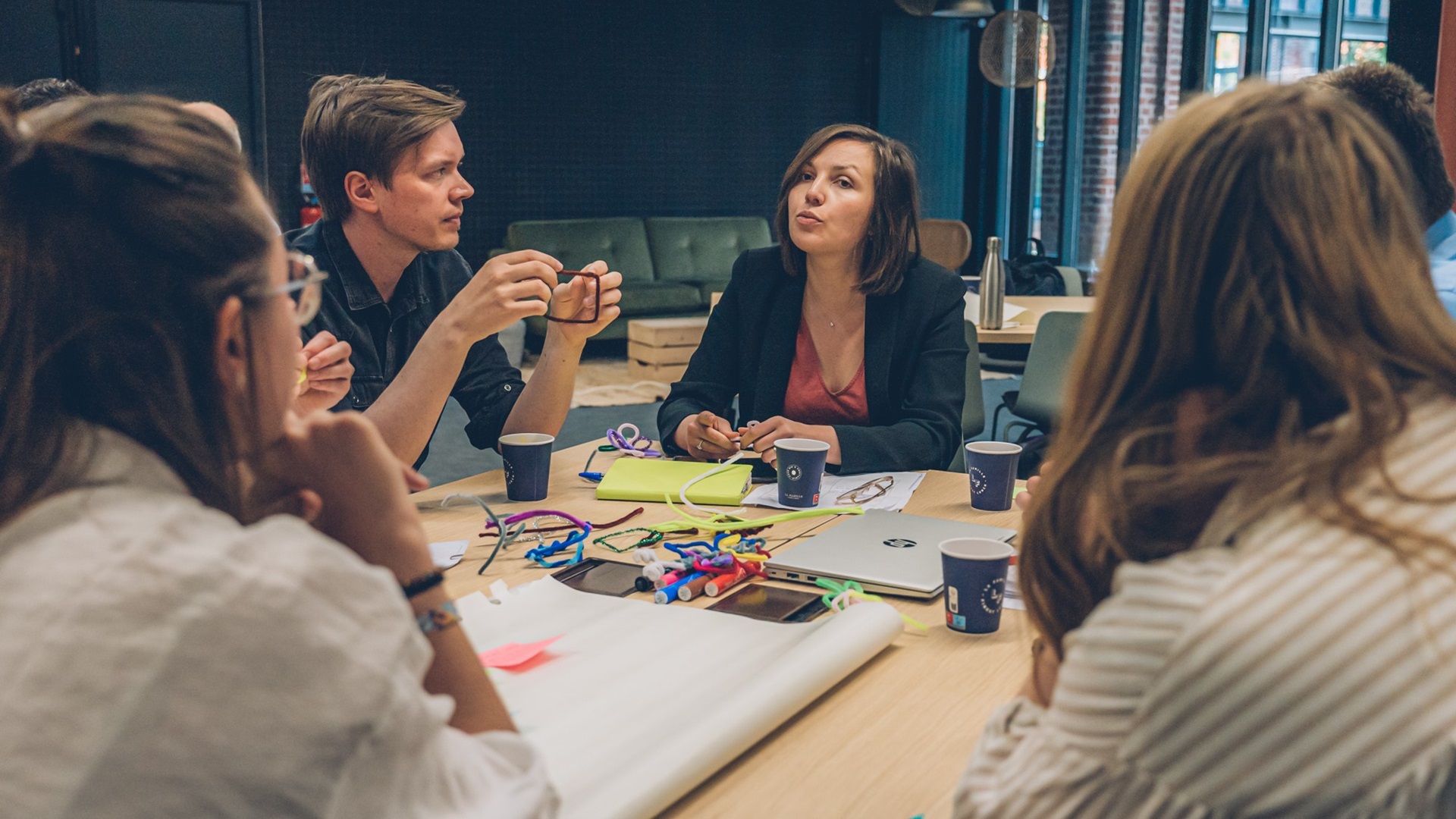
On Thursday morning we met in the delightful former chapel of the charming and historic L’Hermitage Gantois (pictured), the hotel where delegates had been staying.
The space was very much larger than necessary, it had poor accoustics and nothing could be attached to the walls. However, the projector screen worked well enough to accommodate a sticky wall for the purpose of convening an Open Space style workshop, as did the banqueting style tables. As delegates left throughout the morning for their trips home, it was very convenient to be located at the hotel rather than somewhere else.
Feedback and impact
Participants’ on-site feedback included:
Room for discussions and disagreement
A good flow and engagement of the group within the sessions
Really inspiring to witness first hand the tremendous progress that European cities are making to decarbonize the built environment. And how every year they keep breaking new ground over what gets to be constructed and how to mainstream sustainable buildings and dramatically reduce their embodied carbon.
She added in October 2024:
I had the pleasure of working with Martin Gilbraith for a 3-day event in Lille in June 2023 as part of the “Dramatically Reducing Embodied Carbon in Europe’s Built Environment” project, led by the Carbon Neutral Cities Alliance (CNCA). His facilitation skills played a crucial role in guiding multi-level conversations among participants. He was instrumental in organizing the flow of the sessions and seamlessly adapted to the unique needs of the group, making sure that the voices of all stakeholders were given due consideration. His preparation, energy, and professionalism enabled us to dive deeply into the complexities of decarbonizing the built environment, and the results of this workshop were wonderful.
Credit: video and photos as indicated by Fabrice Caterini, Inediz.
What does feminism bring to facilitation, and what does feminist facilitation look like? How can I ensure that my own practice as a professional facilitator is more effectively and explicitly feminist, anti-racist and anti-oppressive?
These are the questions that have guided my own exploration of feminist, anti-racist and anti-oppressive facilitation this past couple of years.
These sessions are free and open for anyone to attend. The session will last 60 minutes and consist of a facilitated conversation using the ToP Focused Conversation (ORID) method, followed by a brief run through of the method used. The sessions are run by different members of the ICA:UK facilitation community, including lead trainers, trainee trainers, and past participants of our courses in their own style, around topics they have chosen.
In addition to participants learning from each other about the topic, the sessions will serve as an introduction to the method for those new to ToP and will be a useful reminder of the method for those who have already attended our popular Group Facilitation Methods course. Participants may opt to go on and take further training (either online or face to face) and/or continue to learn and share as part of a community of people using facilitation.
The session will be recorded, with the recording being publicly available after the session is over. If you do not wish to be identifiable, we will give you the option before we start the recording to turn off your camera and change your screen name.
Join us to connect, share & learn – register now at ICA:UK.
For recordings and other outputs of my own previous online Focused Conversation sessions and other free facilitation webinars, see free facilitation webinars.
Thank you again to all those who attended this session yesterday, and especially to IAF Belgium for the invitation.
This session introduces a simple but powerful and versatile model that can be applied as a tool and even as a guiding principle. It can help facilitators to engage and empower their groups with greater confidence and versatility, to better enable them to make the change that they are seeking in the world.
The session is equally suitable for newcomers to facilitation and for experienced facilitators who are new to ICA’s Technology of Participation (ToP) methodology, and those who would like to deepen their understanding of the ToP ‘ORID’ model as a design tool.
The session is adapted from one originally delivered at the 2015 IAF Europe MENA conference in Stockholm, that has since been repeated a number of times both face-to-face and online.
How will you celebrate and promote the power of facilitation this year? Check out the global schedule of events at www.facweek.org, and you will not be left short of ideas!
I started out as a facilitator in 1986, with my first training in the ICA ‘Technology of Participation’ (ToP) methodology that has been my facilitation speciality ever since.
All of this time I have worked remotely, in and with geographically distributed groups, as well as face-to-face. I have been using online technology in this work for as long as it has been available.
I have never sought to make online facilitation a particular speciality, however – until now, of course. I have not made LEGO® Serious Play® a speciality either, in spite of having enjoyed a long and distinguished early childhood career in LEGO®!
I believe that a facilitator is first a facilitator, and only second an online facilitator or a LEGO Serious Play facilitator. I believe that the keys to mastering facilitation lie in the values and the stance of the facilitator, the competencies and the disciplines, rather than the space or the platform, the methods or the tools.
I know Sean, and that he is a competent, experienced and accomplished facilitator. Questions are the primary tool of every facilitator, and I know that he asks good questions and that he asks them well. In an early meetup of IAF England & Wales, in London in perhaps 2013, he posed the question: “Is there such a thing as a universal principle of facilitation?”
It didn’t take me long to think and respond that, in my own facilitation at least, there is certainly something approaching that – the ‘ORID’ model underlies of the ToP Focused Conversation method and the ToP methodology as a whole.
I know that Sean has since integrated this approach in his practice, and in his previous book ‘Mastering The LEGO Serious Play Method’. I was sufficiently inspired by the metaphor of ORID as a universal principle that I blogged about it then and have used it in my training ever since.
Many facilitators have rapidly developed a speciality in working online this year, as Sean and I have as well. Some have done so more quickly and easily than others, and some with greater enthusiasm. Most, in my experience, have had reservations about some of the very real limitations of online facilitation. Only recently I think more of us are becoming belatedly more aware of some equally real limitations of face-to-face, and some real advantages of working online.
So, it is not only LEGO Serious Play practitioners that might take heart and find inspiration in the many innovations that Sean shares in this book. There is much here for all of us to learn from – not least, the rigour and creativity with which he has designed ‘a digital process that uses bricks’ [substitute your preferred tool or method here] ‘rather than an analogue process poorly rendered online’.
I’ve heard it said that, in online facilitation, every participant brings their share of the meeting room with them. This is a challenge for LEGO Serious Play practitioners perhaps more than most, and one to which this book rises admirably.
As Sean makes clear in his Guiding Principles, success in achieving outcomes rather than just engagement through facilitation comes largely from the planning and preparation, and from the capacity to divert nimbly from the plan when the moment requires improvisation.
All of this can be considerably more complex and difficult online than face-to-face. So, if this is what can be done with LEGO Serious Play, think what else can be possible online!
Finally, we are in the midst of a climate emergency, as well as a public health emergency. I believe that the two are not unrelated, and that they demand new ways of connecting, communicating and collaborating that are less carbon intensive as well as more COVID-19 secure, and that are more creative, compassionate and empowering as well. I believe that facilitation has a central role to play on the latter, with bricks as well as without, and that designing and delivering facilitation well online must play a part on the former.
I have witnessed an extraordinary flourishing of creativity and innovation among facilitators in response to the pandemic and lockdown of recent months, and an extraordinary generosity of sharing of it as well – largely, of course, online.
I am delighted to see this valuable and timely new book enter the fray, and just in time for International Facilitation Week! I am proud to be able to welcome you to it, and grateful to Sean for sharing it.
Buy the book, online of course, from Serious Work.
See alsoabout me, how I work, who I work with and recommendations & case studies, and please contact me about how we might work together. Please do not delay before contacting me – the earlier I hear from you, the more chance that I will be able to help and the more helpful I may be able to be.


“If you have ever wondered what questions to ask, or in what order to ask them, to lead a conversation that is focused, intentional, inclusive, and productive, let this book be your guide.” – Martin Gilbraith