This piece ‘From the Archive’ is reprinted from ICA:UK Network News #15, November 2001 (p18). Around 30 ICA:UK members participated in this early application of the ToP Focused Conversation method to the emerging practice of online facilitation.
The conversation took place asynchronously over several weeks in November 2001. Also reprinted below are the questions used and a summary of responses. Members attending the annual Network Gathering in Ludlow in December 2001 drew on these responses to articulate a values statement that was approved by the ICA:UK Board in January 2002. That statement has stood the test of time, and remains current today – see About ICA:UK.
The new 2020 ICA:UK Online Focused Conversation Series offers a series of taster sessions led by different ToP facilitation trainers, examining and exploring different topics and also demonstrating the application of the ToP Focused Conversation Method online. See my own May session Taking your event online: what could possibly go wrong?, and register now for my June session How engaging can your online session be?
ICA’s Focused Conversation method began life as the Artform Method of the Ecumenical Institute in the 1960s. Historical documents are now available in the Facilitation Methods Collection of the ICA Social Research Center, newly unveiled this week by the ICA USA Global Archives project.
See also the importance of values in facilitation – #IAFpodcast FS7.
On-line conversation: ICA:UK values
Duncan Holmes in Toronto & Martin Gilbraith in Manchester
As a member of ICA:UK, you are being invited to participate in an online participatory process to discuss the values ICA:UK needs to hold as it moves into the future. This discussion has been initiated by the Board of ICA:UK. We will be using the ToP-on-line tools developed by ICA Canada. This will be an opportunity to explore these tools as well as discuss an important topic. We hope the on-line tools will promote discussion between members during times when we are not meeting face to face.
Duncan Holmes of ICA Associates Inc. in Canada is facilitating the online process. ICA Associates Inc. has a suite of tools to use. The process we will be using this time, asks you to go to the ToP-on-line web site and answer the questions that are there. You can go to the site as often as you want. You can add answers any time you want – either because you have thought of new ideas or you want to respond to something that has been said by another person.
Context for the Discussion
ICA:UK was incorporated last year. As ICA:UK becomes an employer and prepares itself for further growth and development, there has been a concern expressed on a number of occasions that we articulate what values we hold as ICA:UK, in order that these may guide our growth and development and so we may be careful to stay true to them.
In deciding to become an employer, the Board expressed a concern that new employees recruited from beyond the membership be expected to share and adhere to ICA:UK’s values. At the recent ToP programme strategic planning event, ToP Associates identified an ‘ethic of participation’ as distinguishing ICA:UK from other proponents of participatory methods, but felt that this was poorly understood or appreciated within ICA:UK, and especially among clients & partners. On both occasions it was felt that ICA:UK has values that are distinctive and important, and that it is time to articulate them for our own benefit, and for that of ICA:UK and its development.
The rational aim of this discussion is to elicit perspectives of ICA:UK network members on what values they discern and appreciate in ICA and its work; ultimately, to articulate a values statement to guide ICA:UK’s organizational & programme development, and against which to be held accountable. In participating in this conversation you may find yourself considering your relationship to ICA and to each other at a deeper level than programme or even policy. We hope to plumb the depths of what ICA means to members and what it stands for.
What values do we hold as ICA:UK?
Summary of responses, November 23rd 2001
1. What first attracted you to become involved with ICA or to become re-involved if your interest lapsed?
Most members were first attracted to ICA by the opportunity to volunteer overseas in a grassroots community development project. Others were attracted by the participatory facilitation skills or referred by someone they knew well. Members stayed involved because of the emphasis on Civil Society, Participatory Values and the global mission and spirit dimension of ICA. The quality of the training, the opportunity to stay connected with like minded people, and the opportunity to learn about life are also contributing factors to members continued involvement.
2. What have been some most meaningful events or experiences for you, in your involvement with ICA?
The most meaningful events and experiences have been Volunteer Training events and the international volunteer experience; visiting other ICAs and attending global ICA events that broadened one’s understanding of ICA; taking facilitation courses and being able to immediately use the tools; being part of an ICA training team; being welcomed at other ICA UK network events and being involved in a network/team of people who are making a difference in many different ways. Members also appreciated events that have grounded their understanding of ICA and its role.
3. When have you felt ICA addressing something of great importance to you? Describe it briefly.
Members felt ICA was addressing something of real importance during programmes that challenged their life direction or reminded them that they individually and collectively could make a difference; during ICA training and facilitated events where people realize the value of their own wisdom and potential; and when talking about real life issues and the ICA approach to those issues.
4. When have you discerned a fundamental characteristic of ICA that distinguishes it from other organizations or networks that you have known?
The fundamental characteristic of ICA that distinguishes it from other organizations or networks are: the consistent focus on Process and Participation; ICA’s focus on the personal responsibility and the development of the individual; and the belief that each individual has a valid contribution to make. There is a movemental feel to the organization. The values and beliefs are aligned in every aspect of the organization. The spirit dimension and understanding allows the organization to focus on asking the right questions and not just on having the right answers
5. When have you felt a fundamental tension or mismatch between you & ICA?
A fundamental tension or mismatch was felt between the members & ICA around ICA’s language, the cost of the VFC; and when we spend time on policies and procedures. There is also a tension when we consider working in areas that appear to be in conflict with our values and when I feel out of alignment with the values I know ICA holds. As a new person on the journey of development, a member experienced tension.
6. What is there fundamental about ICA that it is important not to lose?
As ICA UK goes forward it is important not to lose the fundamentals of: Value based methods and approaches that provide people with effective ways of working together; individual and personal responsibility within the larger collective whole; recognition of the uniqueness of each individual; maintaining a global & historic perspective as a context for our actions at the local and international level; the valuing of individual and organizational honesty and trust;the engagement of the spirit dimension in life; and the sense of belonging to a team.
7. What are other key words or phrases that describe the uniqueness of ICA:UK and you would like to see included in a statement of values?
Other key words and phrases to describe the uniqueness of ICA:UK are: Participation Concerned with the human factor in development Local and international network Addressing the spirit of people Learning, sharing, questioning A commitment to tackling injustice and inequality in a way that values and welcomes diversity The individual and collective responsibility, within the group and in life.
See also about me, how I work, who I work with and recommendations & case studies, and please contact me about how we might work together. Please do not delay before contacting me – the earlier I hear from you, the more chance that I will be able to help and the more helpful I may be able to be.
Register now on Eventbrite also for my regularly scheduled ToP facilitation training courses in London and Brussels, and now also online.
Like this:
Like Loading...


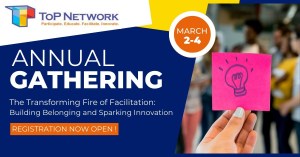 Meanwhile, you are (just!) in time to register for this year’s ToP Network Annual Gathering “The Transforming Fire of Facilitation: Building Belonging & Sparking Innovation”, a 3-day online conference of 150 or so practitioners of ICA’s Technology of Participation from next Thursday 2 March to Saturday 4.
 I am sorry to see so many participating actively in no communities at all. While there is much to be learned from books, courses, and all the other resources mentioned, I think there is no substitute for active participation when it comes to developing and improving skills in facilitating just that.