ToP facilitation training at your place – and free places for you!


Register now for public courses in EventbriteAre you interested in taking or commissioning ToP facilitation training – but you don’t find any scheduled public courses to suit you, and you don’t have a group large enough to make an in-house course cost-effective?

I’d be happy to talk with you about scheduling a partnership course with you, at your place wherever you are – please contact me.

If you can provide a suitable space for the training, or perhaps venue & catering and trainer accommodation as well, then you could enjoy a number of free and/or discounted places for you or your delegates. We would only need to recruit enough fee-paying trainees between us by an agreed deadline, to make up the numbers and the budget to confirm the course. Depending on the location and the deadline I may be able to recruit those extra people myself, and handle online registrations and payments. If you can recruit more people from your networks, and if you can handle registrations and payments, then you could have more free or discounted places and maybe a shorter lead time as well.

If you choose one of my regularly scheduled public courses listed below then there will be less risk of cancellation even if you can’t recruit many people yourself. If you have particular training needs and you can recruit others who share them, then we could develop and schedule a course tailored to meet them.

I deliver in English only and in English with simultaneous interpretation. I draw on the worldwide ICA network to provide ToP training materials in many languages, and to arrange for experienced local ToP trainers to deliver with me (or without me) in many languages.


See also about mehow I workwho I work with and recommendations & case studies, and please contact me about how we might work together.

Register now in Eventbrite for my own upcoming public courses in London & elsewhere and see ICA:UK for additional courses offered by fellow ICA:UK Associates online and elsewhere. To arrange an in-house course for your group please contact me.

Evidencing facilitation competencies: planning with people with learning difficulties

I had thought that I might share this ‘from the archive’ piece during International Facilitation Week recently, as a way of promoting and celebrating IAF’s Certified Professional Facilitator accreditation programme in conjunction with that. As it turned out, Facilitation Week prompted such an avalanche of activity around the world and online that I had a hard time keeping up as official @FacWeek tweeter, so here it is now. 

The piece was prepared as part of my own initial assessment for Certified Professional Facilitator accreditation in 2008, in the format required to summarize a workshop I had designed and facilitated in order “to illustrate your application of the Facilitator Core Competencies in your work”. It drew on an extended case study that I had prepared previously for ICA:UK, ToP facilitation with a group of people with learning difficulties.

ToP facilitation with a group of people with learning difficulties

Connect in the North: Big Meeting, August 2007 in Leeds

1. What workshop are you summarizing? Nb:Core facilitator competencies illustrated are indicated in square brackets [A-F]

Connect in the North: Big Meeting (August 2007). For the organisation to listen to people with learning difficulties and update its business plan – to improve services and opportunities for people with learning difficulties.

2. Is there anything specific about the background leading up to the workshop that we need to understand? If necessary, provide a brief paragraph describing the background leading to the event.

[E3, F2] ICA:UK is concerned with the human factor in world development – creating a humane and sustainable future for all, through partnership and participation. We work nationally and internationally to enable individuals, organisations and communities to work together to bring about positive change.

Connect in the North (CITN) brings together people with learning difficulties and not-for-profit organisations to improve services and opportunities for people with learning difficulties.  CITN Director Cathy Wintersgill had attended a number of ICA:UK’s public Technology of Participation (ToP) facilitation training courses since 2003, and had used elements of the approach in her work within CITN and with client organisations as well.

After attending our ToP Participatory Strategic Planning (PSP) course in May 2007, Cathy expressed an interest in contracting me to apply elements of this method to CITN’s “Big Meeting”, an annual event for the organisation to listen to the views of people with learning difficulties and update its business plan.

She had not before attempted to facilitate a full ToP Consensus Workshop with a group of people with learning difficulties, however, and was concerned that some of those attending the Big Meeting might find the clustering of ideas and naming of clusters difficult and boring, and so disengage.  Although I did not have prior experience of facilitating groups of people with learning difficulties, my experience generally has been that the methodology is sufficiently robust but flexible to be applied successfully with virtually any group.  So, to help to assess what sort of approach would be appropriate, I offered to do some research to explore the experience of other facilitators who have facilitated such groups, using both ToP methods and other approaches.

3. What were the workshop objectives?  Please provide a concise paragraph describing the workshop purpose (objectives, or deliverables.).

[A1, A2] In my proposal to Cathy I articulated the aims of the day as follows:

  • to develop a shared big-picture understanding of the longer-term direction of the organisation, grounded in CITN’s values, and it’s practical implications
  • to generate some clear ideas for future projects or activities that might attract external funding or otherwise generate additional income
  • to involve key stakeholders, and particularly people with learning difficulties themselves, in such a way that they feel a sense of ownership of the organisation and empowerment to shape it’s future

For the purposes of the meeting itself I expressed these as:

Why are we here? – aims of today

  • To build a big picture together of our future direction
  • To have new ideas for future activities and income
  • For everyone to get involved and feel that they own it

4. What was the Agenda for the workshop?  Please provide, in list format, the workshop Agenda.

[A3, B2] The process was designed on the basis of four sessions of around 45-60 minutes, each allowing about a half as long again for activities as I might typically plan for.  The outline of the day I presented like this:

What we will do – today’s schedule

  • Opening and introductions
  • Context: what will affect our future – Strengths, Weaknesses, Opportunities & Threats
  • Break
  • Workshop: projects and activities for the future
  • Lunch
  • continued…
  • Break
  • Reflect and close

5. How many participants did the workshop include?

[F2] 20 people attended the CITN Big Meeting in August, prior to their AGM which was to follow some weeks later. This included all 5 staff, most of the 9 Board members and some other members as well – both individual members and representatives of organisational members.  The majority were people with learning difficulties, including some of the staff and most of the members and Board members.

6. What were your responsibilities as Facilitator of the event?  (from B)

[E3] Contractor to the client and sole facilitator.The process design was informed by prior research with facilitators experienced in working with people with learning difficulties, by means of GRP-FACL and three other email forums

7. How long was the workshop?  (In hours or days, from B above)

A single short-full day facilitated event (10am-3pm)

8. Description of the Workshop   Please describe the workshop, highlighting the following:

  • Your preparation for the event
  • Session design considerations/approach
  • Facilitation techniques used
  • Tools, equipment, visual aids, etc. used
  • Results achieved
  • Difficulties encountered and their solutions/lessons learned
  • How the Foundational Facilitator Competencies were exhibited throughout the event

[C4, E1, E3] Soon after Cathy’s initial enquiry in May 2007, I emailed a brief query to four online facilitation discussion groups, and within 10 days had received 22 responses totalling 17 pages and a wealth of experience and insight.  The four groups were ICA:UK’s own ToP Associates network, the global ICA ToP trainers network, the IAF Group Facilitation discussion group and the UK Community Participation Network.  My request was for respondents to share any experience of facilitating groups with people with learning difficulties that might point to any potential issues, and to share any hints & tips for success.

[A2, B1, C2] I used the ToP Consensus Workshop method to discern six key insights from the responses received.  I shall describe how I designed and facilitated the event relative to these six insights.

i. collaborate with members of the group (and others with experience of working with them) to design & facilitate a process that will work for them

[A1, A2, C4, D2, F3] Cathy & I agreed early on that I would meet with a small group before the event to hear their perspectives directly on what we should aim to achieve on the day and what sort of approach might be most effective, and also to help to build the group’s commitment and sense of ownership of the approach to be taken.  I met with five of the Board members (4 of whom had learning difficulties) and the 3 full-time staff.  I listened to their answers to my questions and answered some questions of theirs as well. This enabled me to confirm my understanding of their aims for the day, and we agreed broadly how it should be structured and the approach to be used to achieve their desired outcomes, and our respective  roles and responsibilities.

[A2, A3] Based on what I had learned from this design meeting of the organisational context and the client groups’ needs, I was able to revise my original process proposal to comprehensively document our consensus on the way forward as the basis of the contract between us.

ii. adapt/slow the pace

[B2] Well before the design meeting it was a clear parameter that the Big Meeting would be a ‘short full day’, ie: around 10am-3pm, including morning & afternoon breaks and lunch.  Therefore  it was clear from the outset that nothing close to a full 4-workshop PSP process would be possible.

[A3, B2, C1, C4, D1, D2, D3, E2] Instead, I proposed that we focus the day around a single ToP Consensus Workshop to help to meet all three aims, with the fairly general and straight-forward focus question “What projects or activities would you like to see over the next five years?”  To ground this workshop in CITN’s values and in the practical implications of the charity’s current circumstances, Cathy agreed to give a 5-minute power-point presentation on the organisation’s mission, values and recent & current activities; and we followed this with a ‘carousel’-style participatory SWOT analysis – strengths (“what are we good at?”), weaknesses (“what are we not so good at?”), opportunities (“what might help us?”) and threats (“what might be a problem for us?”).  To break the ice and warm people up to participating fully, we began with introductions, sharing hopes & fears for the day, and an energiser – working as a team to ‘play’ happy birthday to one of the group, as a ‘human orchestra’ (humming, clapping etc. or making any noise without singing or using words).  We closed the day with a reflection using a set of “transport cards”, with participants choosing to stand under one of 8 images representing modes of transport and describing how the day for them had been like a journey by coach, bicycle, skateboard, spaceship etc.

[C1, D1] Keeping sessions short and using a variety of activities and ways of ways of working within them seemed to be enough to keep everyone engaged throughout the day.  I invited people to feel free to get up and move around, or leave and come back, if they wanted to, and to a limited extent they did.  To try to ensure that everyone was understanding and being understood adequately I regularly reflected back what I was hearing and asked others to do so as well, and when a question of content or clarity was raised I generally sought one or two responses from the group to satisfy it rather than try to answer it myself.  The warm up exercise was well received, and generated much laughter, if not much of a tune!

iii. adapt & vary the size & composition of small groups (eg: use “learning partners”)

[B2, C2] About three quarters of the time overall was spent working in small groups and individually, rather than in plenary – probably more than I would typically plan for a group of such a size.  There was a great diversity of communication styles in the group, so I think this was important to allow everyone the time and space they needed to contribute safely and comfortably.

[B2] The group were seated at four tables of about five each throughout the day, facing a 5m ‘sticky wall’ for the visual presentations and workshop.  This made for quite intimate and supportive small group working.  Initially I invited participants to choose their own tables, in order that they seat themselves with others that they would be comfortable working with, although with the proviso that at each table there should be at least one person who would record the group’s ideas on paper.  This turned out to be no problem at all as most were keen to participate in recording.  At the beginning of the workshop session I invited 3 at each table to each move to different tables, to vary the groups, but again I left it up to them to choose who would move and where to. This seemed to work well, and I was glad that I had not tried to be more prescriptive about who should work with whom.

iv. use (& allow use of) words, symbols, images, colours etc. with care & creativity to hold meaning

[C1, C4] In asking people to record I made it clear that they were welcome to do so using words, images, symbols, colours or in any other way that they found helpful.   I made a particular effort myself to use images and symbols alongside words on everything that I presented during the event, and I included plenty of photographs of both the group and their work alongside the textual documentation in the report of the event.  I experimented for the first time with providing the tables with multi-coloured half-sheets for recording their ideas on during the workshop, and reserved white half-sheets for the cluster titles (I am in the habit of using white half-sheets for the brainstorm ideas and a single colour to differentiate titles).  I provided the tables with markers of a variety of colours as well, with the additional fun of a different fruit scent to each colour!

In the event the group recorded its work largely in words, and only a few images and symbols were used – in fact participants seemed to relish the challenge of demonstrating their writing skills. How far my own modest graphic facilitation skills were appreciated was not clear, but the multi-coloured half-sheets were a great success in making it easy for people to refer to ideas on the sticky wall without having read or describe them each time (“the blue card, bottom-left, goes with the top-centre cluster with the red & green cards”).

v. allow & encourage people to relate ideas, and form & name clusters, in whatever ways are meaningful to them

[C1, C3, C4, D2, F2, F3] I made explicit during the workshop that there was no right or wrong way to cluster ideas or name the clusters, but that we were looking for clusters and names that would be meaningful to the group and which would help them to make the best of the ideas they had come up with and put them into practice after the meeting.  In fact many of the group took to the clustering with such enthusiasm that the plenary became quite noisy and chaotic at times – such that on several occasions I reminded people to speak one at a time, asked specifically to hear from someone who had not spoken for a while, and called for silence to allow everyone to think for a moment.

[C3, D3, E2] The naming of the clusters was accomplished quite easily, and much more quickly than I had anticipated – every activity up until that point had taken at least as long as I had planned for, such that I was becoming quite concerned as to whether we would be able to complete the workshop and close the day before people started leaving in their pre-booked taxis.  In fact the names were proposed and agreed much more quickly that most groups I have worked with, and it became clear to me that this group really was perfectly satisfied with quick, simple and intuitive names – in contrast to many groups which can want to get the names just right, and so find it very difficult and time-consuming to agree (Sam Kaner’s ‘Groan Zone’ of participatory decision making).  Conflict was not an issue.  Far from running over time, in the end we were able to enjoy a relaxed closing reflection and finish early with 10 minutes to spare.

[C4, E2, F3] As usual, the original ideas, the clusters and the cluster names all clearly meant more to the participants than they did to me – which I take as a good sign in any workshop!  However, I felt in no way that I would have wanted to cluster or name any differently myself, had I been involved as a participant rather than as impartial facilitator.

vi. show respect for people & their diversity of abilities & styles

[B1, C2, C3] It was indeed a diverse group, in terms of age, gender and culture as well as in terms of physical and learning abilities.  I hope that I did show respect for this group and its diversities, as I would any group.  However my experience was that I did nothing particularly different with this group in order to do so, and that nothing particularly different was required.  In fact the various styles and behaviours of this group may have been sometimes more overt and less subtle than those of most groups that I work with, but they were not really so very different.  The group itself was certainly no less respectful than most, on the contrary perhaps more so.  One participant with physical impairments needed several minutes to communicate any verbal contributions with the help of a support worker yet, even when the group was quite boisterous, all voices fell silent and everybody waited patiently whenever he had something to contribute.

Conclusion

[A3, B1, F2] It is for the group themselves to judge the success or otherwise of their meeting, and of course the real test will be the extent to which it has made a difference to them and CITN in the future.  Certainly the group expressed their satisfaction with the process as it unfolded – at the design meeting, during the day and in the closing reflection. In fact, the event ended with quite a sense of excitement and anticipation.  Cathy wrote shortly afterwards, from her point of view:

“Thank you so much for the brilliant job you did on Friday. The day was better even than I had hoped. The level and quality of participation was very high, everyone enjoyed it and we now have a clear sense of a shared direction.  The report looks absolutely excellent – thanks for putting it together so quickly.”

[E1, E3, F1] For myself, both the initial research and the facilitation experience have been a refreshing opportunity to test my assumptions, reflect on my practice, and stretch my skills in a context that has been new to me.  I found it both reassuring and gratifying that the process was received as well as it was, not least because of how little I felt I needed to tailor the ToP methodology and my own facilitation style on account of participants’ learning difficulties.

I was pleased to take the opportunity to write up my experience of both the workshop and the research, including extracts of the email responses I had received in respondents own words.  I published this as a case study on the ICA:UK website, and made it available via the four email groups that I had consulted, including all those who had responded.

[A1] I am also delighted that the process has helped me to develop my relationship with Cathy and Connect in the North, such that two further staff have since enrolled on ICA:UK’s ToP facilitation courses, and Cathy has joined a project team with ICA:UK and others to conduct a participatory evaluation for another client of a programme involving young people with learning difficulties in politics in Wales.

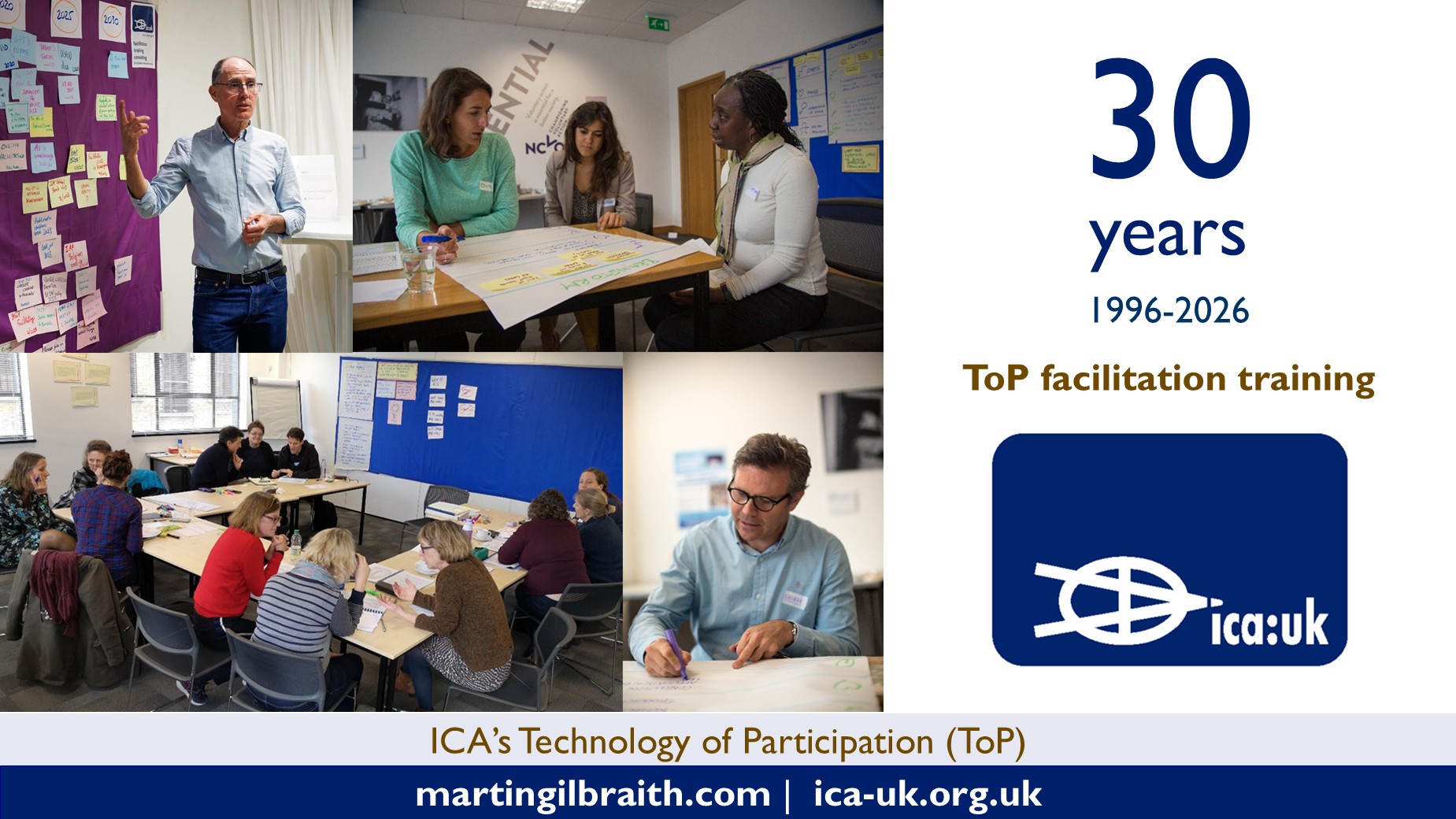
Technology of Participation (ToP) facilitation training

See also ToP facilitation training at your place – and free places for you!

I am an ICA Certified ToP Facilitator (CTF) and a licensed provider and experienced lead trainer of the full range ICA:UK Technology of Participation (ToP) facilitation training courses – see how I work, and please contact me with any questions or for further details.

the Institute of Leadership and ManagementThese courses are accredited by the Institute of Leadership and Management for an ILM Development Award, and participants are eligible for student rate IAF membership representing a 50% discount on their first year’s fee.

Follow these links to see the new course description pages:

I deliver in English only, and in English with simultaneous interpretation. I draw on the worldwide ICA network to provide ToP training materials in many languages, and to arrange for experienced local ToP trainers to deliver with me (or without me) in many languages.

I also draw on my own experience and the wealth of curriculum developed by ICA over many years to design and deliver tailored programmes to help particular groups to meet their learning goals.

Please contact me with any questions or for further details – including how to commission a tailored course for your group and availability of scheduled public courses, in the UK and worldwide.


See also about mehow I workwho I work with and recommendations & case studies, and please contact me about how we might work together.

Register now on Eventbrite for my free facilitation webinars, and for my regularly scheduled ToP facilitation training courses in London and Brussels.

Two books and three methods for facilitating social transformation

This post was written for the IAF newsletter the Global Flipchart, June 2013.

Transformational Strategy   Transformative Scenario Planning

Transformational Strategy: facilitation of ToP Participatory Strategic Planning – Bill Staples, iUniverse 2013
Transformative Scenario Planning: working together to change the future – Adam Kahane, Berrett-Koehler 2012
The Kumi method for Social Transformation in Conflict – Transform e.V. in partnership with ARIA, IICP, ICA & others

An advantage of stepping down recently as Chair of IAF and as Chief Executive of ICA:UK, and now working freelance instead, is that I am finding more time for reading, writing and ideas.  Of the many books that I have enjoyed and found stimulating in recent months, I want to recommend these two in particular to readers of the Global Flipchart – for the inspirational stories and insights that they offer, and for their wealth of concepts, tools and tips with immediate application to our facilitation practice. Both focus on the transformative potential of group process for positive social change, but each takes a somewhat different approach.  In reviewing the two books I found myself led to review the third, hybrid approach to social transformation as well, as will become clear.

I have known Bill Staples of ICA Associates in Canada for many years as a colleague within the ICA (the Institute of Cultural Affairs) and also as an active member of the IAF (International Association of Facilitators).  Bill is publisher of the IAF Journal, and chaired the IAF Toronto conference in 2000 that attracted over 1100 participants.  His book Transformational Strategy details the theory and practice of the Participatory Strategic Planning process of ICA’s Technology of Participation (ToP) methodology, an approach in which I have been a practitioner and a trainer for many years myself.  So this book covers ground that is very familiar to me, although I found it no less insightful for that. Bill previewed the book at the ICA International Global Conference on Human Development in Kathmandu last October, and elements of the approach were embedded in the design of the conference.

I came across Adam Kahane of Reos Partners through his 2004 book “Solving Tough Problems: an open way of talking, listening, and creating new realities”.  He was head of Scenarios for Royal Dutch Shell in London during the early 1990s, and facilitated the Mont Fleur Scenario Exercise in which a diverse group of South Africans worked together to effect that country’s transition to democracy following apartheid.  That exercise, and subsequent attempts at working with leaders to ‘get unstuck’ some of the world’s toughest problems, helped to generate the reflections and refinements to the Transformative Scenario Planning methodology that he describes in his subsequent book “Power and Love: a theory and practice of social change” and now this one as well.  So this is an approach with which I am somewhat familiar in theory, although its insights resonate with my own experience in many respects.  Kahane previewed this book at a lecture I attended at the RSA in London, also last October, ‘How to Change the Future’.

Transformational Strategy is structured in four parts over 270 pages. Part I outlines the global and historical role of participation in transformative social change, and the history and evolution of the ToP approach.  Part II introduces the spiral image as a metaphor for the thought process of planning, and to describe the underlying dynamics of the ToP Participatory Strategic Planning process and the values that underpin it.  It places the spiral planning process in a wider framework that includes the preparation and research that precedes the planning and the implementation that follows it, and introduces a number of particular ToP tools and techniques to support each stage.  Part III has a chapter of in-depth theory and practical tips on the application of each of the four key stages of the spiral process that will be most familiar to ToP facilitation trainees and practitioners – articulating the practical vision, discerning the underlying contradictions, forging breakthrough strategies and action planning for implementation.  Part IV outlines some possible variations in the approach for different groups and groups sizes, and additional follow-on steps to inspire commitment through implementation. The book is richly illustrated throughout by practical examples and longer case studies from ToP practitioners working in a range of different settings around the world, from corporate board rooms and government departments to local communities and voluntary groups.  Example worksheets and planning documentation charts are included in the appendix.

Transformative Scenario Planning takes a more narrative approach, through nine chapters over an altogether lighter 120 pages. First Kahane tells the story of the Mont Fleur Scenario exercise, and how it helped a diverse group of South African leaders from across the many divisions of that society to talk through what was happening, what could happen and what needed to happen in their country – and then to act on what they had learned, so contributing to some peaceful forward progress in a situation that had seemed violently stuck.  Drawing on another 20 years of subsequent practice with scenarios, Kahane goes on to outline his conclusions on when and how such planning works best – namely, in situations seen to be unacceptable or unsustainable, that cannot be transformed directly or by people working only with those close to them, and by means of a five stage process detailed in subsequent chapters. The five stages are framed as a creative application of the U-process described by Peter Senge et al in Presence (2008) and Otto Scharmer in Theory U (2009). This involves firstly convening a team from across the whole system (‘coinitiating’), observing what is happening and constructing stories about what could happen (‘cosensing’), discovering together what can and must be done (‘copresencing’), and finally acting to transform the system (‘cocreating’ and ‘coevolving’).  Through this process actors gradually transform their understandings, relationships and intentions, and thereby their actions and their larger social system.  This book too is richly illustrated with examples and stories, from exercises seeking to transform often profoundly conflicted societies including Zimbabwe, Guatemala, Quebec, Colombia and Sudan.

Kahane adopts a more personal and reflective style than Staples, sharing something of his frustrations and setbacks in his practice of Transformative Scenario Planning and what he has learned along the way.  Staples in contrast provides a brief overview of the evolution of the method, through research and development involving many hundreds of practitioners over 50 years, and focuses more on where and how the method has been successful and (in some detail) on how to apply it.  While Staples provides an entire chapter of case studies and an appendix filled with related materials, Kahane takes a deeper and longer view on the outcome and impact of the examples he offers. He relates a memorable story of a return visit to Colombia in 2012, 16 years after a scenario project began and some eight years after it had appeared to have failed, to hear the then President announce ‘that it had always been alive and was now the leitmotif of the policies of his new government’.  He quotes the Bhagavad Gita, in a wry comment on the uncertainty of outcome inherent in any facilitative leadership:  “The work is yours, but not the fruits thereof”.

Both books emphasise that collaboration and a comprehensive approach are key to achieving social transformation, and that an inner transformation of those involved is both an outcome of and a pre-requisite for social transformation.  Both books also emphasise the role and power of stories, metaphors and images, in achieving both internal and external transformation.

Where the two approaches appear to differ most substantially is perhaps in the type of (en)visioning that is employed, and its role relative to reflection on and analysis of current reality. In ToP Participatory Strategic Planning it is a compelling and practical vision of a desired future, held in creative tension with a searching and in-depth analysis of present blocks or ‘contradictions’ to that vision, that drives transformation through implementation.  In Transformative Scenario Planning it is not one desired future but several possible futures that are envisioned, and these future scenarios emerge from a deep and broad reflection on current reality rather than themselves focusing the analysis of that current reality from which strategies and tactics are developed.  Where the two approaches appear to be in agreement, however, is in the transformative power of that creative tension between clearly articulated future(s) and honestly and profoundly explored present. Also they concur in the paradox, as Kahane describes it, that “we move forward by stepping back: we get unstuck not by pushing but instead by pausing”.  As Staples writes, “naming the contradiction bursts illusions about the current situation and blows the door to the future wide open”.

Both approaches are described as fractal processes, in that each stage contains within it a micro version of the whole process and each process can itself be expanded to serve as a stage in a larger whole.  From this point of view it matters less, in theory, whether articulation of the future should precede exploration of the present or vice versa.  What matters more, in practice, is what particular (micro or macro) process will help a particular group achieve a particular goal in a particular context – the key question at the heart of any facilitation process design, and any in-the-moment facilitation intervention.  It is at this point that the skilled and experienced facilitator will draw from her extensive toolkit to adapt and apply what methods and tools she has available, to tailor a process for the particular needs of the occasion.

I wonder whether the apparent difference in the two approaches in fact to some extent simply reflects a difference in emphasis in how they are described, and a difference in the contexts in which they are illustrated.  As the book titles suggest, Kahane focuses primarily on the role of scenarios in transformation, and Staples primarily on the role of strategy. From this broader perspective, Participatory Strategic Planning could be seen as a tool to apply in order to move from stages 4 to 5 of the Transformative Scenario Planning process (from ‘discover what can and must be done’ to ‘act to transform the system’), and stages 1 to 4 of Transformative Scenario Planning could be seen as elements of the preparation and research that is required to precede a particular Participatory Strategic Planning process.  Kahane draws his examples largely from situations of conflict, and frames his approach as a means to ‘get unstuck’ in the face of tough economic, social and environmental problems.  In contrast, Staples’ examples are largely not drawn from conflict situations, and he frames the ToP approach not as a means of problem-solving but as a means to empower people ‘to see fresh opportunities, to step onto the stage of history, and take an active part in directing it the way they want their world to go’.

I am not clear to what extent Transformative Scenario Planning has been applied in situations other than conflict, but Jonathan Dudding of ICA:UK has written about the application and the limitations of ToP in situations of conflict in the 2012 ICA Nepal book ‘Changing Lives Changing Societies: ICA’s experience in Nepal and the World’.  Dudding has been a key contributor also to the multi-disciplinary, collaborative research process that has developed the new Kumi method for social transformation in conflict.

The Kumi project was initiated in 2003 by conflict analysts Ahmed Badawi and Ofer Zalzberg. Badawi is an experienced ToP practitioner (he & I worked together with ICA Egypt in the early 1990s) and Zalzberg worked with Kahane on his Jewish-Israeli Journey scenario project of 2008. The project brought together ToP practitioners and experts in identity-based conflict and conflict analysis to develop a hybrid approach drawing on the three traditions, informed by a series of pilot events involving Israelis, Palestinians and Europeans seeking to address the Israeli-Palestinian conflict.  An international network of around 35 Kumi practitioners is now experimenting with broader applications of the method.  An early learning of ToP practitioners in this process was that conflicted parties in such a context may need to do considerable work to address the conflict, and their relationships to it and each other, before they are able to embark on a participatory planning process that requires the group to speak and plan as ‘we’.  The resulting method is a five stage process that moves from (1) initial contact, exploration and design through (2) stage setting, group building and articulating the issue and conflicts to (3) deep conflict engagement and analysis, (4) ToP participatory strategic planning and (5) supporting implementation.

Like Transformative Scenario Planning the Kumi method may be understood as an application of Senge and Scharmer’s U-process, it uses story-telling as a key tool for exploration and discovery and it is designed to help a group to ‘get unstuck’ in order to find a creative way forward together.   Kumi does not make use of multiple scenarios, but does make use of the contradictional analysis that lies at the heart of ToP Participatory Strategic Planning.  I hope that one day we might see a book on the Kumi method, to help us better understand how it’s evolution and applications relate to those of Transformational Scenario Planning and ToP Participatory Strategic Planning – to help facilitators learn from the experience of all three approaches, to better design and lead processes that empower people in all contexts to transform their situations together for the better.


For more on my work, and what others have to say about it, please see how I workwho I work with and recommendations & case studies – or view my profile and connect with me on LinkedIn.

You can connect with me also by joining my free facilitation webinars online, and IAF England & Wales’ free facilitation meetups in London and elsewhere.

Facilitating innovative practical solutions to today’s social challenges – bringing together IAF, ICA and the RSA in Moscow

conference image

I am delighted to have the opportunity to deliver a conference master class and two days of pre-conference training for the 4th annual Facilitators Conference of IAF Russia, in Moscow from April 3-5.

.

See the conference website in Russian or an approximate English translation, including a video clip (above) of me conveying greetings as IAF Chair to last year’s conference. This clip was recorded by conference organiser Liudmila Dudorova during the ICA:UK Participatory Strategic Planning training that she attended with me in London last year.  I shall be joined as international VIP presenter by Bruce Rowling of UK-based Pinpoint Facilitation.

The theme of this year’s conference is ‘Facilitating the creation of ideas, innovation and sharing of experience‘.  I therefore thought immediately of ICA:UK’s work with the RSA over recent years, as a source of insight and inspiration for my conference masterclass.  See the session description below, and watch this space for some of that insight and inspiration in a future blog post…

ICA UkraineThe pre-conference training will be specially adapted from ICA:UK’s Group Facilitation Methods and Action Planning courses, with Russian language materials kindly supplied by ICA Ukraine. Both the training and the conference session will be delivered in Russian by simultaneous interpretation.

Conference masterclass: Facilitating innovative practical solutions to today’s social challenges

the RSAThe RSA (www.thersa.org) is an enlightenment organisation committed to finding innovative practical solutions to today’s social challenges. Through its ideas, research and 27,000-strong Fellowship it seeks to understand and enhance human capability so we can close the gap between today’s reality and people’s hopes for a better world.

ICA:UK, the participation & developpment charityICA:UK, the participation and development charity (www.ica-uk.org.uk), is one of the Institute of Cultural Affairs’ (ICA’s) global network of non-profit, non-governmental organisations working to develop, test and demonstrate effective approaches to personal, organisational and social transformation.  ICA:UK applies this approach to developing and sustaining a culture of participation, specialising in the Technology of Participation and working with others both nationally and internationally to demonstrate effective facilitation, to train people in facilitation methods and skills, and to research the application of participatory approaches in new areas.

Since 2011 ICA:UK has partnered with the RSA to help it engage with and mobilise its Fellowship, to increase it’s social impact and achieve its ambition of being ‘the best place to have an idea’.  In this highly interactive session, Martin Gilbraith will share some examples of the approach used and its impact to date, and some of the learnings of those involved.  Participants will be introduced to some key elements of the ToP methodology, including simple but powerful tools that they can take away and try.

Martin Gilbraith is an independent facilitator, trainer and consultant based in London, UK.  He is an IAF Certified Professional Facilitator, and former IAF Chair and IAF Europe Director.  He has been facilitating and training ICA’s ToP facilitation methods since 1986.  He is an Associate and former Chief Executive of ICA:UK, and is currently serving as President of ICA International. He is a Fellow of the RSA