
Reflecting on another year of freelance facilitation, 2018-19

ORID the kitten at Group Facilitation Methods training in Brussels

October 1 will be exactly seven years since I went freelance as a facilitator, and on June 30 Martin Gilbraith Associates Ltd completed its sixth full financial year. So, a relatively quiet week in the August holiday season offers a good opportunity again to pause and review the last year, and look ahead to the next. It is timely too, after 6-7 years, that the coming year offers an opportunity for something of a sabbatical (again)!

In the year to June 2019 I delivered 25 contracts for 14 clients in 7 countries. These involved 31 face-to-face events and one virtual, 14 facilitated processes and 14 facilitation training courses. I spent 47 nights away from home – 14 in the UK and 33 abroad. That all compares to 20 contracts for 16 clients involving 21 events in the previous year – and over the previous five complete years a total of 90 contracts to 53 clients involving 121 events. I also declined 25 prospective client projects during the past year, compared to 11 the year before, mostly because I was not available. I failed to win 11 that had I quoted for, compared to 9 the year before.

So, slightly fewer clients and nights away, but considerably more contracts and events – those declined and lost, as well as those delivered. Again, about half-and-half facilitation and training, and all but one face-to-face.

Returning clients in the past year have included Amnesty International, Oxfam, Water Harvest (formerly Wells for India), Xpedio and of course ICA:UK. New clients have included ABBYY (with CircleIndigo), BeLiminal, Greater Cambridge Partnership, EASL, Heinrich Boell Foundation Turkey, Malaria Consortium, Octopus Network, St. Luke’s Community Centre and Virtual Not Distant. I joined Nordic Consulting Group as an Associate on a new framework contract with SIDA.

So I have continued to work with international NGOs, foundations, associations, networks and alliances, and a few others, largely in Europe and the Middle East and particularly in London and Brussels. However, this year has seen the return of UK local authorities and multi-sector partnerships, after many years working with such clients on behalf of ICA:UK in the 2000s. New fields for me this year include agile coaching, software development, Results Based Management and remote team working.

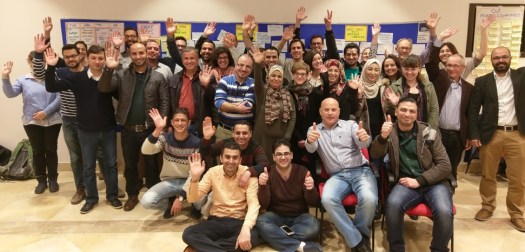
I have extended my partnerships with ICA:UK and ICA Associates in the past year to offer more scheduled public facilitation training than ever before. These include courses of the IAF-endorsed ‘ToP Facilitation Essentials’ series and, in new partnerships with local IAF colleagues, public course dates in Edinburgh, Lisbon and Pisa as well as London and Brussels. Two courses in Brussels also included a kitten (pictured above), affectionately named ORID by the group!

My leadership role with IAF England & Wales again accounted for most of my volunteer time. My role was formalised this year by election to a new chapter Board, and appointment as Chair. Our programme of peer networking and learning meetups has grown to reach our growing E&W chapter membership of now 90, plus over 1,000 members of five regional meetup groups. Monthly tea and coffee networking meetups are held in 12 cities in most major population centres of England & Wales, and online, and longer networking and learning meetups are held bi-monthly in London and three times per year in other regions.

Our all E&W meetup for International Facilitation Week has been extended to a 2-day Annual Conference for 2019 – the Power and Practice of Facilitation, 18-19 October, with 55 already registered. Meetup hosts across the country have joined an expanded Leadership Team of now 24 members. We are supporting new sister meetup groups in Scotland and Ireland, and a new IAF E&W podcast team has begun to create a series of 10 episodes to support the programme, inspired by a session at a meetup.

I also joined the new IAF Global Mentorship Programme as a mentor, and began to meet regularly online with my mentee in Jordan. I attended the IAF Europe conference Agile Facilitation in Milan and participated in monthly online meetings of Europe MENA chapter leadership. I continued to participate in events of IABC UK, but not the IABC EuroComm conference this year in Bahrain. I continued to participate in the ICA:UK ToP trainers’ network and to serve as volunteer webmaster for ICA International, but I did not attend this year’s conference of the US ToP Network. Regrettably also I missed my first ICA Europe regional gathering for about 20 years, in Kiev.

After collaborating for some years with Michael Ambjorn of AlignYourOrg to explore the intersect between communication and facilitation, and the power of applying facilitation and communications in partnership, we have co-authored a chapter on that topic for a forthcoming book on the Power of facilitation. We are part of a wider team of authors involving expert facilitators from around the world. The shorthand for the project is #FacPower and each chapter of the book will have a different focus. In combination the aim is to show the power of facilitation in various fields and contexts.

I have hosted four free facilitation webinars during the year, including one on that book project and two with the authors of two new books published during the year that I have been pleased to endorse – Rebecca Sutherns on Nimble facilitation and Jim Campbell on Facilitating Authentic Participation and the facilitation cycle.

Regular readers of this blog may have noticed that I have not found so much time this year for blogging. I published just 15 posts during the past year, of the 180 published in the seven full years since my first welcome post – but of course I have been no less active micro-blogging on twitter.

So, what of a sabbatical? October to March in Sitges in Spain will be mostly for my husband, following his recent retirement from career-long, full-time employment. I shall continue to work and travel as necessary, not least for existing client commitments in London and elsewhere, for scheduled public ToP facilitation training most months in London or Brussels, and for events including the IAF England & Wales annual conference in Birmingham and the ICA Europe regional gathering in Vienna.

However, I shall welcome opportunities to work virtually and locally in Spain during that time, including perhaps with ICA Spain and with the forthcoming IAF Spain chapter – starting with its timely launch event in Barcelona during International Facilitation Week in October.

I do intend to take time for myself also to reflect, write and learn, to look ahead to my next seven years of freelance facilitation – and to enjoy a little less busyness and a little more sunshine! I hope that regular readers may notice the difference on this blog, and that Spanish speakers may notice the difference next time they greet me with “Hola”!

Thank you for following…


See also about me, how I work, who I work with and recommendations & case studies, and please contact me about how we might work together. Please do not delay before contacting me – the earlier I hear from you, the more chance that I will be able to help and the more helpful I may be able to be.

Register now on Eventbrite for my free facilitation webinars, and for my regularly scheduled ToP facilitation training courses in London and Brussels.

Another summer, another year of freelance facilitation, 2017-18

IAF India Conference, 2017 in Chennai - photo IAF India, facilitation Martin Gilbraith #ToPfacilitation #IAFIndia17 1

Another summer means another opportunity to pause and reflect, as in June I completed my fifth year in business as Martin Gilbraith Associates Ltd.  The image from last year’s IAF India conference in Chennai is of my plenary session subtitled “Reviewing the past to prepare for the future“. Like every good ORID process, a reflection or review must start with Objective level data.

The data tell me that in 2017-18 I have delivered 20 contracts for 16 clients in 6 countries, involving 20 face-to-face events and one virtual event and 10 facilitated processes and 11 facilitation training courses. Also that I spent 56 nights away from home, 3 in the UK and 53 abroad. That compares to 26 contracts involving 35 events in the previous year, and over the 5 complete years a total of 90 contracts to 53 clients in 18 countries involving 121 events – 109 face-to-face and 12 virtual, 69 facilitation and 52 training.  So it has been another busy year, albeit not quite such a bumper year as the previous, and a marked increase in the proportion of training to facilitation contracts.

Returning clients in the past year have included Amnesty International, Girls Not Brides, Lorensbergs, Oxfam, Wells for India and of course ICA:UK, and new clients have included the Alternative, Article19, CCL, Edrington, EFFA, EPIM, GCF, JMIC and NNC. So I have continued to work largely with international NGOs, foundations, associations, networks and alliances, largely in Europe and the Middle East and particularly in London and Brussels. However, the NGOs continue to include more campaigning as well as international development and humanitarian, the Associations continue to include industries as well as NGO networks, and new fields for me this year include Scotch whiskey, Danish politics and global catastrophic risks!

Somewhat fewer contracts this year has allowed somewhat more time for business and professional development.

In new partnerships with ICA:UK and ICA Associates I have extended my schedule of public facilitation training to include dates in London and Birmingham as well as Brussels and new courses of the new IAF-endorsed ‘ToP Facilitation Essentials’ programme, Meetings That Work and Facilitating Client Collaboration.

My networking and volunteering has been focused primarily on IAF England & Wales, where four regional groups totaling around 750 members are now hosting 5 or 6 meetups every month around the country, led by a virtual leadership team that meets monthly online. I finally joined IABC as a member this year, and became more active with IABC UK as well as presenting at EuroComm18 in Copenhagen, after collaborating for some years to build an informal partnership between IABC and IAF that resulted this year in a more formal MoU at the EMENA level.

I have also enjoyed opportunities to participate in and lead sessions at IAF conferences and events  during the year in Australia, Canada, France, India & Jordan, and at ICA regional gatherings in Nepal and Poland as well as in the UK.  I have been pleased to have been able to host five free facilitation webinars during the year, with colleagues of all of these networks that I respect very much. I am very excited to have begun collaborating with IABC past-President Michael Ambjorn and more than a dozen other IAF colleagues to co-author a book on the Power of Facilitation – for more as the project develops, follow us at @FacPower.

Since last summer’s 5-year review of participant feedback on my ToP facilitation courses, taster sessions & webinars I have been requesting post-course feedback 3-4 months after every training, so I hope to share some insights from that as well before long. Other substantial additions to this site during the year have included a series of cases studies on Responding to changing situations and needs with ToP Consensus Workshop, a new image gallery and (of course!) a Privacy policy.

With five public courses and half a dozen client contracts already in the pipeline for the autumn, another webinar and another IAF India conference and of course International Facilitation Week in Birmingham, it looks like there will continue to be plenty to blog about when I can find the time. Thank you for following!


See also about me, how I work, who I work with and recommendations & case studies, and please contact me about how we might work together. Please do not delay before contacting me – the earlier I hear from you, the more chance that I will be able to help and the more helpful I may be able to be.

Register now on Eventbrite for my free facilitation webinars, and for my regularly scheduled ToP facilitation training courses in London and Brussels.

Responding to changing situations and needs with ToP Consensus Workshop – #FacWeek

This is the 6th and last of a series of six weekly posts to mark International Facilitation Week 2017, starting today! Drafted as I enjoyed a welcome opportunity to pause and reflect this summer, the posts share a series of examples of how I have applied, customised and adapted the ToP Consensus Workshop method in my practice over the past year. 

How will you celebrate and promote the power of facilitation this week? Please share online with the #FacWeek hashtag, or in a comment below…


Example 6 – IABC UK, London

In May I facilitated a 2-hour evening strategy workshop with the UK Board of the International Association of Business Communicators. For more on my work with IABC, and my session at the recent IABC Europe MENA conference, see Facilitating transformation: reviewing the past to prepare for the future at #EuroComm17.

New IABC UK President Mike Pounsford is a keen ToP facilitator himself, and an IAF Certified Professional Facilitator. He had approached me to apply the Consensus Workshop method with the new Board of nine so that he could participate fully.  For an example of his own application of the method see Facilitation and Communication to lead ‘The Big Conversation’: Digital Transformation.

We quickly agreed that a ‘textbook’ Consensus Workshop process could help to meet the group’s needs well. These were articulated in terms of Rational & Experiential Aims as ‘to outline our strategic focus for IABC UK for the next 24 months, and what roles we will each play to help to deliver it‘ and ‘to build shared clarity, commitment and enthusiasm for the way forward together‘. The workshop Focus Question was to be ‘What practical projects & initiatives could help to deliver IABC’s mission & strategy in the UK in 2017-18?’.

The workshop was preceded by an opening conversation and a short presentation from Mike on the vision, purpose and philosophy of IABC as a whole, as parameters for IABC UK’s own strategy.

According to the textbook approach, Board members brainstormed their responses to the Focus Question individually, with the parameters in mind. They wrote ideas on half-sheets in pairs, which they shared on the sticky wall and clarified as necessary before pairing and clustering. The ‘adaptation in the moment’ came in finalising the Clustering stage of the workshop prior to Naming the clusters. It made no sense to the group to discern and name clusters unique to IABC UK’s 2017-18 strategy – what made sense was to map the brainstorm ideas to the three components of IABC’s global Purpose: ‘to advance the profession, to create connection and to develop strategic communicators’ .

So that is what we did. That allowed time then for members to self-select into three teams to to articulate the UK’s new strategic focus for each of the three areas, and to propose collective commitments.

I reflected to Mike, ‘I suppose we could have presented as a parameter that these [advance, connect and develop] would be the UK’s strategic focus, and we could have asked instead about collective commitments aligned with them. That might have saved a moment of doubt & confusion, but as you say perhaps at the expense of a sense of openness, possibility & engagement. A bit of challenge can be a valuable opportunity for a group to find its own way!’

Mike PounsfordMike replied: “I thought it was great, thank you for your help and for your agility in responding to the group’s needs. Most importantly we achieved consensus on a focus for our work for the next two years, which is to enhance the strategic communication capabilities of our members”.


Finally, in case you’re still wondering…

  • no group is too small for the ToP Consensus Workshop method – page 52 of the ICA:UK Group Facilitation Methods course workbook includes procedures for using the method on your own as an individual.
  • the method can work online as well as face-to-face, although like all online facilitation it will be different than when done face-to-face – see for example the Spilter ToP Consensus platform, specially developed to provide full digital support for the method, and see below a youtube video of an online ToP Consensus Workshop of ICA Ukraine using LinoIt with Google Hangout.
  • if you have nowhere to put a sticky wall, take advice from US ToP trainer Barbara MacKay of Northstar Facilitators, also in a youtube video below.

Start again from example 1…


For more on my work, and what others have to say about it, please see how I work, who I work with and recommendations & case studies – or view my profile and connect with me on LinkedIn.

You can connect with me also by joining my free facilitation webinars online, and IAF England & Wales’ free facilitation meetups in London and elsewhere.

Responding to changing situations and needs with ToP Consensus Workshop – #FacWeek -1

This is the 5th of a series of six weekly posts to mark International Facilitation Week 2017, starting just 1 week from today. Drafted as I enjoyed a welcome opportunity to pause and reflect this summer, the posts share a series of examples of how I have applied, customised and adapted the ToP Consensus Workshop method in my practice over the past year. 

How will you celebrate and promote the power of facilitation this year? Please share online with the #FacWeek hashtag, or in a comment below…


Example 5 – Eurochild, Brussels

A good example of both customised design and adaptation in the moment was the General Assembly in Brussels in April of Eurochild, ‘a network of organisations and individuals working in and across Europe to promote the rights and well-being of children and young people‘. This involved around 100 individual members and member representatives plus Board members and Secretariat staff over two days.

One morning of the GA was designed as an opportunity to engage members in a year-long process to develop a new strategy for the network as a whole for 2019-21. The event had been preceded by an online survey of members, and was followed by a Participatory Strategic Planning retreat with Board, staff and a few key member representatives to develop the basis of the new strategy – for more in-depth consultation this autumn, with a view to final adoption at the next GA in April 2018. The Focus Question for the planning process as a whole was ‘How could Eurochild best mobilise and add value to the work of its members from 2019-21, to promote the rights & well-being of children & young people in Europe?‘

The design of the half-day member consultation began with an opening conversation and brief contextual presentations, followed by a 90 minute Consensus Workshop and then a series of ‘World Café’ style table conversations – to brainstorm and capture ideas for the Practical Vision, Current Reality and Strategic Directions stages of the Participatory Strategic Planning process respectively.

Participants sat at 13 pre-assigned tables of 8, each hosted by a Board or staff member. The workshop process was ‘super-sized’ as with ICUU, with whole-A4 sheets for writing ideas and all table hosts coming to the sticky wall at once to share ideas in turn and cluster quickly in columns under symbols as they did so. Cluster titles were drafted at tables and accepted without lengthy discussion or revision.

Also as with ICUU, it had been clear in the design process that a deep level of consensus would not be possible with such a large group in such a short time. It was also clear that such a consensus would not be necessary for this workshop, just one consultative element in a much longer and more elaborate process of consensus building over the course of a year.

The adaptation in the moment came in the Naming stage of the workshop. The Focus Question was ‘What would make us happy that the strategic planning process has been a success? (in terms of the new strategy & membership model themselves, in terms of member engagement in the process, and otherwise)’. The intent had been that the resulting ‘indicators of success’ would serve as guidelines and a means of accountability for the process of strategy development and member engagement over the year, and that substantive content for the new strategy would be contributed during the following World Cafe session.

What happened was that many of the ideas contributed in the workshop were in fact answers to the Practical Vision question ‘What do we want to see in place by 2021 as a result of delivering our new strategy? (how will Eurochild be different, and what difference will Eurochild have made?)‘. It made no sense to address the Vision question again separately, and it seemed to make more sense to accept that the group was ready to work on its Vision right away rather than to spend time first trying to name indicators of success. So what we did was to cluster the mix of ideas into 11 columns representing 11 vision elements, with just the original symbol to identify each. Then participants self-selected into 11 table groups to name the vision element on a flip chart, and also articulate relative to that element any indicators of success, current reality and practical projects and initiatives.

Jana Hainsworth, Secretary General at Eurochild, wrote in September:

“Great that we had structure, but also great that we could think on our feet to adjust the planning according to what we were hearing from members. All in all we got a huge amount of raw material for development of the strategic plan. The methodology clearly helped.”

Read on for example 6…


For more on my work, and what others have to say about it, please see how I work, who I work with and recommendations & case studies – or view my profile and connect with me on LinkedIn.

You can connect with me also by joining my free facilitation webinars online, and IAF England & Wales’ free facilitation meetups in London and elsewhere.

Responding to changing situations and needs with ToP Consensus Workshop – #FacWeek -2

This is the 4th of a series of six weekly posts to mark International Facilitation Week 2017, starting just 2 weeks from today. Drafted as I enjoyed a welcome opportunity to pause and reflect this summer, the posts share a series of examples of how I have applied, customised and adapted the ToP Consensus Workshop method in my practice over the past year. 

How will you celebrate and promote the power of facilitation this year? Please share online with the #FacWeek hashtag, or in a comment below…


Example 4 – Oxfam, Gaza & Jerusalem

In February of this year I worked with Oxfam in OPTI to support its staff team of around 100, based in Jerusalem, Ramallah and Gaza, to operationalise the new ‘One Country Strategy’ and ‘Country Operating Model’ that had been developed last year. An explicit experiential aim was ‘to help staff & teams to align with each other and with the new strategy & structures, and to renew staff solidarity, motivation and team spirit as One Oxfam OPTI’. However, travel restrictions meant that there would be no opportunity for all the staff from the three locations to meet together at once.

As in the earlier cases of Manchester Primary Care Trust and the Oxfam in Lebanon One Country Strategy process, we used separate Consensus Workshops with the same Focus Question to consult with different groups in series. In this case two ‘consultation workshops’ were held, one in Gaza and one in Jerusalem, each for all staff who could attend. A third ‘consensus-building workshop’ involved a cross-section of around 40 staff, who had been members of either or both of the consultation groups, to build consensus from the results of them both.

The Focus Question was ‘what can we learn from our survey responses and from our experience of recent years, internal & external to OPTI & the OCS process, to inform our plans for OCS operationalisation?‘. The result informed a further two days of review, learning and planning with the cross-section of around 40 staff.

Fabrizio Biondi Morra, Program Manager at Oxfam in OPTI , wrote in August:

“Following the workshop delivered by Martin with Oxfam in OPTI, the country team had a roadmap that laid out all the next steps sectorial working groups had to carry out. Also, through the consensus building process staff from across sectors and offices could come together and strengthen their relationships. These to elements together enabled us as team to renew our professional and personal bonds and work effectively.”

Read on for example 5…


For more on my work, and what others have to say about it, please see how I work, who I work with and recommendations & case studies – or view my profile and connect with me on LinkedIn.

You can connect with me also by joining my free facilitation webinars online, and IAF England & Wales’ free facilitation meetups in London and elsewhere.