Exploring feminist facilitation

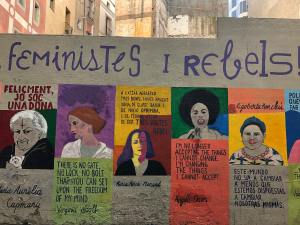
Photo by Red Dot on Unsplash

What does feminism bring to facilitation, and what does feminist facilitation look like? How can I ensure that my own practice as a professional facilitator is more effectively and explicitly feminist, anti-racist and anti-oppressive?

This longer-read post tells the story of why and how I have been exploring feminist, anti-racist and anti-oppressive facilitation this past year and more, what I have learned and how I am starting to apply it.

Are you practicing or exploring feminist facilitation yourself, or are you interested to do so? Please share any reflections, questions or links in a comment below, below, or contact me.


Why and how I have been exploring feminist facilitation

I wrote last September in Reflecting on a year of freelance facilitation online, and looking ahead:

I have been challenged by the Black Lives Matter movement and other recent manifestations and responses to systemic injustice and oppression, and by clients who have been similarly challenged, to reflect on how I might ensure that my own practice is more effectively and explicitly anti-racist, feminist and anti-oppressive, and to commit to working on that.

One of the clients I was referring to was Amnesty International, with whom I have facilitated several regional and global governance events since 2020, including last year’s 2021 Europe & Central Asia Regional Forum and Global Assembly – see Who I work with and Recommendations & case studies.  Discussions of anti-racism and feminist leadership have featured prominently in these events, and we sought to model an explicitly feminist and anti-racist approach to their design and facilitation.

In Reflecting on Amnesty International’s Global Assembly 2021, international member representative and youth activist Dumiso Gatsha of Botswana wrote powerfully of her vision of “the kind of Amnesty I want to continue to be a part of; one that lives and advocates what it truly means to be born of dignity through solidarity and action for those who don’t have the power”, and of the “feminist leadership approach to which our movement committed” at that Assembly.

In preparing for the Europe & Central Asia Regional Forum earlier that year, I had searched online for references to feminist facilitation and resources that I might draw on as we sought to uphold that commitment to feminist leadership and anti-racism in our design and facilitation. I did not find much, but what I found on twitter (to my surprise, above) led me back to an earlier exchange in which Leila Billing of We Are Feminist Leaders had asked me in 2019 if I could share any such references and resources with her! We had met a few years before that when I had provided ToP facilitation training to Girls Not Brides.

I concluded that I might need to do more to find what I was looking for than just a quick online search, but also that there were others out there who I might learn from and with – even if none of them had yet shared an easy-to-find online beginners guide to feminist facilitation…

Those that I have learned with and from since then include all those with whom I have worked at Amnesty International during this period, including my co-facilitators for those contracts – most notably and repeatedly Orla Cronin and Marie Dubost.  They also include several other clients and prospective clients during this period, my IAF mentees and the young social justice activists who have accepted my offer of free facilitation coaching. They include IAF colleagues of the Social Inclusion Facilitators Special Interest Group, ICA colleagues of the US ToP Network in particular and fellow facilitators of the Involve Practitioners Network. They also include a number of authors and podcasters that I have discovered along the way, not least adrienne maree brown and other black feminist contributors to Holding Change: The Way of Emergent Strategy Facilitation and Mediation.

What has been most helpful for me, however, has been participating this year in the 12-week online feminist leadership development programme of We Are Feminist Leaders, led by Leila Billing and Natalie Brook. This has provided me with a comprehensive framework by which to understand what feminism brings to leadership, and thus to facilitation, and also a powerful demonstration of what feminist, anti-racist and anti-oppressive facilitation can look like in practice. I am grateful to Leila and Natalie, and especially to the cohort of mostly young feminist leaders with whom I shared the programme from whom I learned much too.
What I have learned

A comprehensive framework by which to understand what feminism brings to leadership, and thus to facilitation

What I learned in those 12 weeks can be summed up in large part by Leila in her earlier tweet summarizing what she had found herself, that “basically power analysis is key“.

The programme covers key concepts and principles behind feminist leadership, with particular emphasis on intersectionality and different dimensions of power and privilege, and key practical aspects including power sharing and self & collective care.  Much of the power analysis was familiar to me from my work in international development and human rights, although I was struck by how far the theory has progressed since my own development studies MA of 25 years ago now. Much of the practice would be familiar to any good professional facilitator, however what I found most interesting and valuable was what I found to be largely absent or at best implicit in much professional facilitation – namely power, and politics & purpose.

Feminist Leadership DiamondIn Feminist Leadership for Social Transformation: Clearing the Conceptual Cloud, Srilatha Batliwala identifies four essential components of feminist leadership which she presents in the Feminist Leadership “Diamond” (right).

Batliwala describes values as ‘the ethical norms that guide behaviour’ and principles as ‘norms that guide action’. These are thus broadly analogous to the IAF Statement of Values & Code of Ethics for facilitators, described by IAF as the ‘values and ethical principles that guide our actions’.  She describes practices as being ‘about ways of doing and enabling a myriad of things’. These are therefore broadly analogous to the IAF Core Competencies, ‘the basic set of skills, knowledge, and behaviours that facilitators must have in order to be successful facilitating in a wide variety of environments’.

So, what do we notice when we compare Batliwala’s framework for understanding feminist leadership with the IAF’s framework for guiding and certifying professional facilitation?

What I think the two frameworks clearly share at these levels of principles & values and practices are a belief in ‘the inherent value of the individual’ (IAF) and in the value of ‘consultative, collective, transparent and accountable decision-making’ (SB), and ‘Respect, Safety, Equity, and Trust’ recognising ‘the culture, rights, and autonomy of the group’ and seeking to ‘promote equitable relationships’ and ‘honour and recognise diversity, ensuring inclusiveness’ (IAF). Like the feminist leadership framework, the IAF framework recognises diversity and difference, the potential for conflict and risks to welfare and dignity and the importance of ‘a safe environment for conflict to surface’.

What I think feminist leadership brings to facilitation, that the IAF framework lacks, is a clear recognition of the structural and systemic sources of inequity of power and privilege in wider society, how these may be reflected in groups and how they must be addressed in order to achieve broader goals of human rights, peace and a healthy planet – even just to achieve an inclusive participatory meeting or process. This broader social context features prominently even in the principles & values and practices quadrants of Batliwala’s Diamond of feminist leadership, and warrants a further quadrant each for power and for politics & purpose. I did not find the words power, privilege, politics or purpose in the IAF Statement of Values & Code of Ethics or the IAF Core Competencies, except purpose in relation to the aims of a meeting and privilege in relation to conflict of interest.

A key emphasis of the IAF framework that is absent from that of feminist leadership is the ‘impartial’ role that facilitators are called upon to fill ‘in service to our clients… [including] the groups we facilitate’, involving ‘stewardship of process and impartiality toward content’.  I argued in my last post Facilitator neutrality in the context of war and oppression in March that facilitation is not a neutral practice or profession at all, and that as professional facilitators we must stand up against systems and structures of power, discrimination and oppression, violence and war. I think that the missing feminist leadership quadrants of power and politics & purpose provide clues to how we might do that.

Power

“Leadership is first and foremost about power – it is about holding power, exercising power, and changing the distribution and relations of power…  Feminist leadership means functioning with a greater consciousness not only of others’ but also of one’s own power” – Srilatha Batliwala, Feminist Leadership for Social Transformation: Clearing the Conceptual Cloud

During the programme we drew in particular on a power analysis outlined by Lisa VeneKlasen and Valerie Miller in A New Weave of Power, People & Politics: The Action Guide for Advocacy and Citizen Participation. This identifies four ‘expressions’ of power (familiar to me from Naila Kabeer’s 1994 Reversed Realities), namely Power Over, Power With, Power To and Power Within; three ‘realms’ in which power is expressed, namely Public, Private and Intimate; and three ‘levels’ of political power, namely Visible, Hidden and Invisible. We looked also at the notion of ‘deep structures’ in organisations, “the hidden sites and processes of power and influence… where the culture of the organisation is embedded and reproduced“, a locus of Invisible power and where Power Under is often expressed (Batliwala).

Suffice to say here that the analysis suggests that power is available to everyone to a greater or a lesser degree, determined in large part by the nature and degree of each individual’s intersecting privilege, and that power can be exercised in such a way as to enhance or diminish the power and privilege of others – and so to respect their rights or to violate them. Batliwala argues that “Feminist leadership will strive to make the practice of power visible, democratic, legitimate and accountable, at all levels and in both private and public realms.”

To explore intersectionality, the way that people’s identities and privilege intersect, and so their sources of power and inequality, we drew in particular on the CRIAW-ICREF Intersectionality Wheel (right).

If we are to meaningfully “recognise barriers to participation and ways to address them” in order to “honour and recognise diversity, ensuring inclusiveness“, as  the IAF Core Competencies (C2) expect of professional facilitators, then this is where  such “power analysis is key“.

Politics & purpose

“I define feminist leadership as a process of transforming ourselves, our communities, and the larger world, to embrace a feminist vision of social justice. It’s the process of working to make the feminist vision of a non-violent, non-discriminatory world, a reality (…) It’s about mobilizing others around this vision of change” – Srilatha Batliwala, The Feminist Leadership project: a series celebrating feminist leaders

Batliwala defines feminist leadership here in terms of its feminist political purpose, rather than in terms of its principles & values or its practices. It is perhaps appropriate that the purpose of a professional association can be seen to be non-political, as I think the IAF Vision and Mission can. Perhaps also then it is appropriate for IAF, in contrast, to define professional facilitation in terms of its principles and practices in the IAF Statement of Values & Code of Ethics and IAF Core Competencies.

Clarity of desired outcomes is central to the professional facilitators’ task, however, as made clear in the IAF Core Competencies (D) ‘Guide Group to Appropriate and Useful Outcomes’. In a world that is inescapably political, I would argue that professional facilitators have both a right and a responsibility to be transparent and accountable to their own political purpose of their professional facilitation practice, as well as to the desired outcomes of each particular facilitated process. Many facilitators already are, not least those who apply facilitation in their practice of feminist leadership, anti-racism and social inclusion, and in social justice movements more broadly.

“Enabling people to bring about positive change in their organisations and communities through facilitation… [toward] a just and sustainable world for all” – ICA:UK Misson & Vision

IAF was founded in 1994 by a global network of 70 ICA ToP facilitators, and the practice and provision of training in ICA’s Technology of Participation facilitation methodology remains central to the work of ICAs around the world. For ICA and for ToP facilitators, facilitation is seen as a tool of transformational change – toward a mission and vision described by ICA:UK as “enabling people to bring about positive change in their organisations and communities through facilitation” toward “a just and sustainable world for all“.

I have continued to regard that as my own purpose as a professional facilitator since I helped to articulate it more than 20 years ago as part of a 2001 online Focused Conversation on ICA:UK values.  I recognise it as a political purpose, and therefore that ‘power analysis is key‘.

A powerful demonstration of what feminist, anti-racist and anti-oppressive facilitation can look like in practice

Many if not most of the IAF Core Competencies were in evidence in the design and facilitation of the We Are Feminist Leaders programme. Notable exceptions were D3. ‘Guide the group to consensus’ and F3. “Model neutrality”, as consensus and content neutrality were not really relevant or necessary in such a facilitated group process of individual learning and leadership development. What I found particularly noticeable was how attention to power and privilege helped to ‘honour and recognise diversity, ensuring inclusiveness’ (IAF Core Competence C2); and how practical aspects of feminist leadership such as power sharing and self & collective care were demonstrated.

Applying the concepts and tools of feminist leadership together to our own and each other’s lived experience helped to ‘create a climate of trust and safety’ and ‘recognise barriers to participation and ways to address them’. Power sharing was demonstrated by means of effective co-facilitation by the programme leaders, and by means of the very participatory process by which members of the group themselves exercised leadership together throughout the programme.

Self & collective care was demonstrated by diligent application of the ’10 principles of a feminist classroom’ that were shared at the outset and referred to throughout. These included the importance of mutual learning and building a learning community; attention to lived experience, to feelings as much as thoughts, and to our own and each other’s power and privilege and how they affect our positions and perspectives; courage and compassion in sharing and challenging in safety, and in taking action on what we learn in pursuit of social justice beyond the classroom. Perhaps most important, that “the feminist classroom will not be perfect, because we are not perfect”.

Even as an older white man among a diverse group of mostly younger women, I felt entirely welcome and included myself – although I had felt some trepidation before about signing up for a programme ‘for emerging leaders’. I think I can credit my own experience of inclusion to the very welcoming and inclusive space that was created, as well as to my own ‘unique circumstances of power, privilege and identity’ (CRIAW) that can make it relatively easy for me to feel welcome and included.

The privilege of my own unique circumstances was brought home to me most powerfully when we reflected on how we can care for our own and each other’s well-being in the face of the trauma that can be experienced by those resisting systemic oppression or inequality, and struggling to make a non-violent, non-discriminatory world a reality.  I do not feel traumatized by my own work toward a just and sustainable world for all, and generally I do not struggle with caring for myself and others – because generally I can expect to be cared for by society, and it is not violence and discrimination against me that is standing in my way.

How I am starting to apply it

I seek to take a feminist and anti-racist approach to my work, informed by an understanding of the way people’s intersecting identities (age, race, sexuality, gender, class, ability etc.) impact the ways that they have power and privilege, and the ways they face marginalization and discrimination. Mindful of such inequalities, I strive to create a safe environment that is inclusive of diverse lived experience, and ensure that even the most excluded have an equal voice and opportunity to contribute.

I recognize that my own intersecting identities as an older, anglophone, white British gay man (middle class and able-bodied) may position me to be better able to achieve those goals with some groups than with others. With clients and groups for whom I may not be best positioned to facilitate myself, I recommend others and/or offer to partner or co-facilitate with others as appropriate.

I have included the above text on my web page How I work, and I now use or adapt it as appropriate in proposals to clients and in contracting and design conversations with clients and groups. I have recommended clients to others, and partnered and co-facilitated with others, where I have realised that I was not best positioned to facilitate with a particular group myself.

I have started to offer free facilitation coaching to young people using facilitation in their work for peace, climate justice, gender equity or anti-racism, or otherwise in response to systemic injustice and oppression or toward achieving a just and sustainable world for all – in order to support and share power with them, and to be inspired and learn from their experience; and also to further diversify the network of colleagues who I am able to recommend to clients and/or offer to partner or co-facilitate with.

ECA Regional Forum 2022 - Invitation to guide behaviour in sessionsI have started to draw on principles and practices of feminist leadership and anti-racism in how I contract with groups and invite them to contract with each other. This invitation to guide behaviour in sessions, for example, was first developed for Amnesty’s ECA Regional Forum in 2021, and then adapted for use at their 2021 Global Assembly and 2022 ECA Regional Forum as well.  It drew on insights of a capacity building session led by my co-facilitator Orla Cronin, which itself drew on ActionAid’s Ten Principles of Feminist Leadership.

I shall continue this exploration in professional development with colleagues and in my professional practice with clients and groups.  Among an abundance of professional development opportunities, I am particularly looking forward to joining an Action Learning Set with other ’emerging’ feminist leaders who have completed the 12-week We Are Feminist Leaders programme. I am looking forward to learning also in my volunteer role with the (predominately older, white, gay male) Gay Outdoor Club as it works to implement a new Inclusion and Diversity Policy – toward a more diverse and inclusive GOC, “for everyone in the LGBTQI+ community who wants to enjoy outdoor activities”.

As I continue to educate myself, I hope to be better able to help to educate my clients and groups as well – on how we must all be prepared to invest time and budget, as well as creativity, courage and compassion, to address power and privilege as we must if we truly mean to ‘recognise barriers to participation and ways to address them’ in order to ‘honour and recognise diversity, ensuring inclusiveness’.

Are you practicing or exploring feminist facilitation yourself, or are you interested to do so? Please share any reflections, questions or links in a comment below, below, or contact me.


See also about mehow I workwho I work with and recommendations & case studies, and please contact me about how we might work together.

Facilitator neutrality in the context of war and oppression #StandWithUkraine

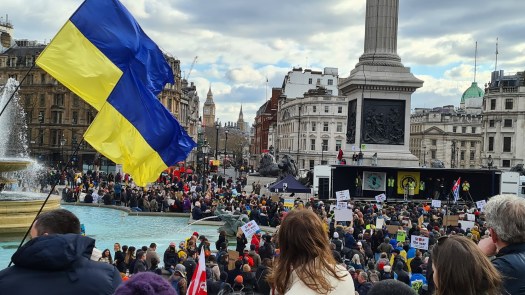
Ukraine anti-war protest, 6 March 2022 in London

“We will remember not the words of our enemies, but the silence of our friends” – Olga Gulaya, facilitator – Kyiv, 6 March 2022.

Better to light a candle than curse the darkness – Amnesty International

The supposed ‘neutrality’ of the facilitator has been something of a bone of contention among facilitators for as long as I can remember. Perhaps because of that contention, the word neutrality does not appear in the Statement of Values and Code of Ethics that all IAF members are required to support, although it does appear in the Core Competencies that all IAF Certified Professional Facilitators are required to demonstrate and evidence.

IAF Statement of Values

As group facilitators, we believe in the inherent value of the individual and the collective wisdom of the group. We strive to help the group make the best use of the contributions of each of its members. We set aside our personal opinions and support the group’s right to make its own choices. We believe that collaborative and cooperative interaction builds consensus and produces meaningful outcomes. We value professional collaboration to improve our profession.

F3. Trust group potential and model neutrality

  • Honour the wisdom of the group
  • Encourage trust in the capacity and experience of others
  • Vigilant to minimise influence on group outcomes
  • Maintain an objective, non-defensive, non-judgmental stance

What I think is apparent, notwithstanding competence F3, is that facilitation is not a neutral practice or profession at all. It is not neutral to support some values over others, or some competencies over others. It is not neutral to advocate for facilitation to be “used throughout the world to address the challenges faced by people in their groups, organizations and communities” as the IAF Vision does.

While we “set aside our personal opinions and support the group’s right to make its own choices“, and while “we are vigilant to minimize our influence on group outcomes” and “maintain an objective, non-defensive, non-judgmental stance“, we “believe in the inherent value of the individual and the collective wisdom of the group“, we “do not impose anything that risks the welfare and dignity of the participants” and we “strive to engender an environment of respect and safety where all participants trust that they can speak freely and where individual boundaries are honoured“.

While we must strive to ‘model neutrality’ in respect of the content of the group’s work, in order to be effective in our role as facilitator, we need not and perhaps cannot be neutral to it. We cannot and must not be neutral to the group’s process. We must demonstrate and advocate for respect, equity and inclusion, for dialogue and consensus.

To demonstrate and advocate for the values and competencies that we believe are needed to improve group effectiveness and to address the challenges faced by people around the world, we must stand up for them and we must be seen and heard to stand up for them. That must mean also standing up against those systems and structures of power, discrimination and oppression, violence and war, that deny the inherent value of the individual and the collective wisdom of the group, that risk people’s welfare and dignity and that obstruct or destroy an environment of respect and safety.

As I wrote last September in Reflecting on a year of freelance facilitation online, and looking ahead, “I have been challenged by the Black Lives Matter movement and other recent manifestations and responses to systemic injustice and oppression, and by clients who have been similarly challenged, to reflect on how I might ensure that my own practice is more effectively and explicitly anti-racist, feminist and anti-oppressive, and to commit to working on that.“. That work has already included joining the excellent Feminist Leadership Programme of We Are Feminist Leaders and seeking to ally with others by offering Free facilitation coaching.

More recently I have been shocked and appalled by the unfolding Russian invasion of Ukraine. I have been concerned for the safety and well-being of IAF and ICA colleagues that I have worked with in Ukraine, and more recently in Russia. I have been struggling to know how to respond, knowing that I cannot know what is needed and that anything that I do will not be enough.

I have been awed and inspired by much of the resolve, resistance, solidarity and leadership that I have seen in response to the war. I am grateful to those colleagues in Kyiv who have challenged me this week to realise that every show of support is valued, and that support that is unseen and unheard is no support at all. I am grateful also to those colleagues in Moscow who have shown support and resistance themselves.

ICAI Sunflowers

I am thankful that ICA colleagues are mobilizing together to show solidarity and support in Standing with the peoples of Ukraine, and that IAF colleagues too are making plans to do so.

Please do whatever little you can to add your support, and to show your support and solidarity. #StandWithUkraine️


See also about me, how I work, who I work with and recommendations & case studies, and please contact me about how we might work together.

Reflecting on a year of freelance facilitation online, 2020-21, and looking ahead

Scaling up engagement and dialogue the power of facilitation and communications in partnership #FacPower

I Declare A Climate Emergency

This time last summer, as I reviewed the year to June 2020, I reflected that my January 2020 resolution to travel less and work more online had worked out well so far. I am still wondering when I might finally be tempted to accept any face-to-face work.

As in previous years, I shall share here some data and reflections on the last year of my professional practice, and some insights and implications for my future practice and professional development. It is a four-level ORID reflection, of course.

In the year to June 2021 I delivered 32 contracts for 22 clients. That compares with 25 contracts for 19 clients the year before, and 25 for 14 the year before that. As my work has gone wholly online the past year, and part of the year before, numbers of contracts and clients have risen. It has felt busier too. After deciding and then failing to keep this summer largely free of client commitments, I am appreciating that I have now finally made some time to catch up and reflect.

This past year’s contracts involved a total of more than 100 individual online sessions and no travel at all. That compares to 14 face-to-face, one ‘hybrid’ and 16 wholly virtual events (of one or more sessions) the year before, involving 28 nights away from home for work; and 31 face-to-face and just one virtual event the year before that, with 47 nights away. My business expenses for travel and accommodation fell to zero for the past year, and with them the associated carbon impact (and the many transactions to be recorded and reconciled in the accounts).

Introduction to Producing Virtual Events

Because most online sessions require a producer as well as a facilitator, or two or more facilitators to share those roles, most of these these contracts have involved working as a team. For ten I was sub-contracted to a colleague, and for 19 I sub-contracted one or more colleagues myself. That compares to 7 and 4 the year before. This past year I have worked solo hardly at all, whereas before the pandemic I worked alone more often than not. I have very much enjoyed the opportunities for broader and deeper collaboration with colleagues.

Partners that I have contracted with this past year include ICA colleagues Megan Evans, Alan Heckman, Jo Nelson and particularly Orla Cronin, and IAF collegues Marie Dubost and Bruno Selun. I have collaborated too with others of the ICA:UK team, and that of Orla Cronin, and with many IAF colleagues – some mentioned below.

Clients I have worked with have again been largely UK charities and international NGOs, European agencies and contractors, NGO networks, Associations and a few others. In addition to my usual mix of clients and projects in the fields of international development, humanitarian response and human rights, this past year has seen a welcome increase for me in environmental and climate justice work (another January 2020 resolution) as well as in health and education.

Of this past year’s contracts, 11 involved facilitation while 18 involved training and 7 involved coaching and consulting. That compares to 7 facilitation & 16 training the year before, and 14 facilitation & 14 training the year before that. So I find myself providing increasingly more training relative to facilitation, and increasingly coaching and consulting as well. I have enjoyed devoting more of my energy to supporting others in their facilitation roles and practice, and less doing it for them myself.

Tired but hopeful after an online Management Team “Away Day”

Facilitation contracts this past year have ranged in scale from a single session of 90 minutes at relatively short notice to a series of 20 sessions collaboratively designed and prepared over several months:

Julie Deutschmann, ACE

Julie Deutschmann, Communication Officer at Architects’ Council of Europe (ACE-CAE), wrote in a recommendation:

“We would like to thank and congratulate Martin for the work done to facilitate the Architects’ Council of Europe (ACE) online Strategic Development Session. The preparation went very well and the integration of new digital tools into the session was very helpful in allowing for the valuable contribution from our members. The excellent facilitation provided by Martin and his colleague Orla allowed participants to articulate strategic thinking while sticking to the aims of the workshop.”

Barbara Weber

Barbara Weber, Director, Global Strategy and Impact at Amnesty International, wrote:

“Thanks for facilitating our online Strategy Labs – cross-regional, multiple languages. You supported us in focusing on the main issues. Very much appreciated.”

Introduction to Facilitation Online

My scheduled public training this past year has been limited to my Introduction to Facilitation Online session, which I provided 6 times publicly during the year and 9 times in-house. I worked with fellow ICA:UK trainers to develop and deliver the new Group Facilitation Methods I Online and with Orla Cronin to deliver and offer the new Introduction to Producing Virtual Events I Online session and Facilitating Virtual Events I Online course as well. Instead of offering the longer courses publicly myself, I have chosen to offer them in-house only and to refer individuals to the ICA:UK schedule.

Training contracts this past year have ranged in scale from a single introductory session for one group to a series of multi-session courses for multiple groups:

Louise Reeve, Policy and Communications Business Partner at Newcastle City Council, wrote in a recommendation:

“Some training to recommend from Martin Gilbraith – I attended his Introduction to Facilitation Online course. Whatever your experience level, you should find something in this training which can make your online sessions just that bit better and more enjoyable”

Enrico Teotti

Enrico Teotti, Agile coach and (visual) facilitator at Avanscoperta, wrote:

“I attended Martin’s ORID class online Group Facilitation Methods Online. The class was divided with practical homework and exercises which I find a great way to learn. Martin and Jo were great hosts able get in to deeper conversations when the group desired that still respecting the course agenda.”

Coaching and consulting contracts this past year have ranged in scale from one or two one-hour sessions with a single coachee to providing training, coaching and consulting support for multiple teams to design and lead multi-session and multi-lingual international conferences for hundreds of delegates:

Rosa Brandon

Rosa Brandon, Programme Quality Officer at Oxfam Ireland, wrote in a recommendation:

“Martin provided invaluable support to Oxfam Ireland in the build-up to a series of multi-stakeholder online workshops. He provided tailored ‘coaching sessions’ to our team, which helped us to prepare and deliver several engaging virtual sessions. These sessions directly catered to our needs, building our ‘hard’ and ‘soft’ virtual facilitation skills and knowledge. Furthermore, he also co-facilitated an in-house “Introduction to Facilitation Online” workshop with colleagues across Southern and Eastern Africa. This excellent workshop was well received by all participants. Thanks, Martin!”

Björn van Roozendaal

Björn van Roozendaal, Programmes Director at ILGA-Europe, wrote:

“Together with other folks at the Kumquat team Martin helped us to organize the ILGA-Europe Gathering Online 2020. Organizing a large event online for the first time came with many questions and challenges. Martin particularly helped us with providing training and assistance to put together the flow of the programme and to ensure that we were ready to facilitate the many spaces that our event was made up with. It was a pleasure working with Martin!”

Just as last year was drawing to a close in June, a new contract with Amnesty International was getting underway in preparation for its first online Global Assembly. This involved me and my team of Marie Dubost, Orla Cronin, Hector Villarreal Lozoya & Charo Lanao in the design and facilitation of a series of 16 Discussion Group sessions in July & August and parts of last week’s plenary meeting as well, with 3-4 delegates of each of 65 national entities worldwide working in English, French and Spanish.

Dr. Anjhula Mya Singh Bais

Anjhula Mya Singh Bais, Interim Chair of the International Board, wrote:

“Martin has been an asset to Amnesty International. He was a consistent and compassionate presence through multicultural regional meetings and strategy sessions. Throughout 16 sessions of the online 2021 Global Assembly of Amnesty International, he demonstrated a high technical proficiency on the complexity of organisational procedures, terminology, and processes. He demonstrates that he truly hears and sees everyone and increased the quality of our participation.”

In my volunteering, I completed 5 years of chapter leadership with IAF England & Wales in December. That left me (happily) without regular Board meetings to attend for the first time in perhaps 25 years!

IAF E&W 2020 Annual Conference

For International Facilitation Week in October, the first online IAF England & Wales Annual Conference had attracted over 100 participants for a full week’s programme of over 25 peer-led learning and networking sessions, led largely this year by Susannah Raffe and others of the IAF E&W Leadership Team. The regular schedule of several free, online facilitation meetups each month continues still.

I continued to serve as a mentor in the IAF mentoring programme, stepping up my commitment this year to working with two mentees in parallel. I have continued to gain as much as I have given, and have very much enjoyed the opportunity to accompany fellow facilitators on their professional journey in this way.

Chizu Matsushita, Facilitator of dialogue and participatory community/team development, wrote:

“I grew from being not confident at all to quite confident about the facilitation skills I have been developing. I have felt a tangible impact. I now believe that a professional facilitator is a real and incredibly impactful profession through which I can make contributions in areas I deeply care.”

I have not been anxious to take on another long-term leadership role, but I have diversified my volunteer interests a little by turning my social media experience to tweeting since last September for the Gay Outdoor Club. This is a group that I have appreciated participating in for many years, all the more since I have been travelling less and keen to be outdoors more. I have continued to serve as volunteer webmaster for ICA International and to tweet for International Facilitation Week.

Facilitation Competencies for Agilists

I continued to host free facilitation webinars, although somewhat less regularly this past year and mostly only in response to invitations from partners. This happened to result in two sessions for different groups on Facilitation Competencies for Agilists, plus Is there a single, universal principle of facilitation? with IAF Belgium and Scaling up engagement and dialogue for the IAF global webinar series.

This last session drew on insights of previous work with Michael Ambjorn of AlignYourOrg on the power of partnership between facilitation and communication, including research for a chapter in the book the Power of Facilitation #FacPower.

FacPower out now!

Now available since May, this book is free to download in order to enable and encourage everyone to read it and to share it.

For your free copy please click here or on the image (right), and for recordings of ‘meet the author’ sessions held over the summer see News – #FacPower.

Facilitating Breakthrough, Adam Kahane

I have been increasingly been invited this past year to contribute to, endorse or help to promote the publications of other colleagues as well, and I have been pleased to be able to do that. This has included an endorsement and an online session in support of More Than Halfway to Somewhere: how exposure to other cultures has shaped our lives with ICA colleague John Burbidge, a Foreword to How to Facilitate LEGO Serious Play Online by Sean Blair and most recently an endorsement and an online session (next month) in support of Facilitating Breakthrough: How to Remove Obstacles, Bridge Differences, and Move Forward Together by Adam Kahane. I am more than a little awe-struck to find my endorsement for that latter book listed next to one from Nelson Mandela.

In September I joined IAF Chair Vinay Kumar in exploring the rapidly growing field of virtual facilitation in a podcast Re-Tooling for Virtual Facilitation.

So what I have learned, and what are some implications for my future practice and professional development?

If keeping my resolution to travel less and work more online was ever going to be difficult, it didn’t turn out that way. Before the pandemic I had found it difficult to commit to multiple short online sessions over time while remaining available to commit to several days or a week at a time for a face-to-face event plus travel. Since my schedule has filled with short online sessions that can be delivered from home, or even elsewhere, I have had no appetite to commit to being in a particular place to deliver, nor to accept the risks and uncertainties now associated with working face-to-face. When I am finally tempted to accept face-to-face work again, it will most likely be at short notice and local to me or at least easy to reach without flying. My expectation is that I shall continue to work mostly if not wholly online.

When is online better than face-to-face

I find that there is ample continuing demand for online facilitation services, not least among international organizations and other distributed groups who may also be concerned to reduce the expense and carbon impact associated with meeting face-to-face. My experience has been that many clients and groups have been pleasantly surprised and impressed over the past year and more by what can be achieved online, that they continue to recognize that they have much to learn in order to best reap the benefits and avoid the pitfalls, and so they continue to recognize the potential added value of professional facilitation services more than for the face-to-face context with which they are still much more familiar. While they are finding that meeting effectively online does not save all of the costs of meeting face-to-face, the savings can allow them to budget for facilitation that they otherwise may not have.

After growing and leading a team of Associates with ICA:UK over many years, and leading and managing larger and more collaborative client projects, I chose to keep my practice small and work largely solo since I went freelance in 2012. While I have enjoyed that, I find now that I have enjoyed leading and managing larger and more collaborative client projects again, online, so I am inclined to allow that to grow further.

After choosing to keep my taxable business turnover below the threshold at which I would be required to register for VAT, partly in order not to make my services more expensive to unregistered smaller clients and individuals on public courses, I have found myself unable to maintain that this year and I have had to apply to register. So I am inclined to accept the administration of VAT in preference to that of public courses, and to accept the potential loss of smaller clients and projects in favour of fewer larger ones.

I have enjoyed the growth of coaching, consulting and mentoring that has occurred organically in my practice over the past year and more, so I shall include those more explicitly in my offer in order to grow them further.

I have enjoyed working on several client projects involving international governance this past year, and finding my own governance experience relevant and helpful for that, so I am interested to see that grow further – and therefore I am interested that two such new opportunities have just arisen already in the past weeks.

I have been challenged by the Black Lives Matter movement and other recent manifestations and responses to systemic injustice and oppression, and by clients who have been similarly challenged, to reflect on how I might ensure that my own practice is more effectively and explicitly anti-racist, feminist and anti-oppressive, and to commit to working on that.

I have enjoyed continuing to advance my Spanish learning since returning from Sitges into lockdown last year, and finally being able to return for a first visit again last month. I hope to continue advance, and to continue to visit.

Thank you for following!


See also about mehow I workwho I work with and recommendations & case studies, and please contact me about how we might work together.

Tired but hopeful after an online Management Team “Away Day”


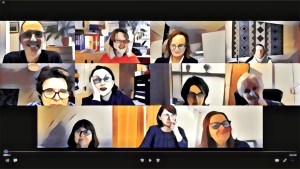
How can we take time out to reflect, learn and plan together as a team when the COVID19 pandemic prevents us from coming together for an in-person ‘Away Day’, as we once would have done?  What can be achieved by an online ‘Away Day’, and how could that work?

These were among the questions that led the Director of a national public sector educational service to approach me for facilitation of an online Management Team “Away Day” earlier this year.

Context

The Director had written in advance, by way of context:

The service is a business unit of the central government department rather than separate from it. The service is provided by 221 individual providers working across 23 offices nationally.  We are a busy senior management team of 9, always progressing and developing and allowing ourselves little time to think and reflect on the bigger picture. We are hoping to take time together to do that, and to come up with a plan for how to go forward. We started off with the idea that we need an organisational review to look at our function and form and adjust our form to meet our evolving function.

The team had cleared a precious two days in their diaries for their ‘Away Day’ – a Friday and the following Monday, later that month. We quickly agreed to schedule a maximum of two 2-hour online sessions over each of those two days, and turned our attention to how to best spend that time – and any asynchronous time that the team could make available in advance.

Aims

Following further conversation, we agreed that the aims of the ‘Away Days’ were to be broadly as follows:

  • to reflect and learn together on the team’s experience of the unfolding story of development and change of the Service, over time and in context,
  • to develop and agree principles that should be upheld in how the Service is structured to best fulfill its changing functions,
  • to develop and consider models of how those principles might best be applied in a new organizational form,
  • to agree next steps – including perhaps consultation with staff and other stakeholders, and
  • to build shared clarity, confidence, and commitment toward to a new way forward together.

Approach

The approach I proposed drew on the methods of ICA’s Technology of Participation (ToP). Pioneered and refined by ICA in over 50 years of experience worldwide, this is a proven system of methods and tools that can be adapted and applied to help all sorts of groups accomplish a wide variety of tasks together. The core values of the ToP approach, which inform all of my work, are inclusive participation, teamwork and collaboration, individual and group creativity, ownership and action, reflection and learning.

The Focused Conversation method provides a structured, four-level process for effective communication which ensures that everyone in a group has the opportunity to participate.

The Consensus Workshop method is a five-stage process that enables a facilitator to draw out and weave together everybody’s wisdom into a clear and practical consensus.

The Historical Scan method combines elements of these two. It provides a participatory approach for a group to review the past to prepare for the future, to reflect and learn together from their own and each other’s experience of the team and organisation’s change and context.

Tools

We agreed that the sessions would be held in Zoom, for it’s audio, video and chat functions, and use Mural for visual brainstorming and clustering of ideas.

The team used WebEx for their regular online meetings, but they were familiar with Zoom and quick to agree to use that – it was an ‘away’ day they wanted, after all!  They were not familiar with Mural, but the Director was encouraged by a quick demo and quick to agree the advantages of such a visual approach.

Process

The agenda for the two days comprised three 2-hour sessions, two on Friday and one on Monday afternoon, plus asynchronous individual or small group work on Monday morning:

  Friday  Monday 
Morning.

10am–12 noon

Session 1

  • Opening & welcome, introductions & hopes
  • Overview of aims, process & tools
  • Historical Scan – what can we learn from the unfolding story of the Service, over time and in context?
  • Reflection & close
Individual or small group work

Developing models of how those agreed principles might best be applied in a new organizational form for the Service

  • visually in Mural or on paper
  • physically in Lego, playdough or whatever you have to hand!
  • or in a chart, diagram or text.
Afternoon.

2-4pm

Session 2

  • Opening
  • Consensus Workshop – what principles should be upheld in how the Service is structured to best fulfill its changing functions?
  • Your assignment of individual or small group work for Monday afternoon
  • Reflection & close
Session 3

  • Opening
  • Presentation & review of models – reflections & patterns, insights & implications, how can we build on the best of them all?
  • Next steps – commitments & deadlines
  • Reflection & close.

On the Monday before the away days I circulated details of the aims, process and tools to the whole team. I invited them to familiarize themselves with Mural in advance, by watching a short video tutorial and sharing introductions and hopes for the sessions there on digital ‘sticky notes’. I invited them also to bring some brainstorm ideas to our opening session if they could – in answer to the question: “What are some key events and milestones in the unfolding story of the Service and its context, from 2000 to the present (and, as you might anticipate, ahead to 2030)?”

I was joined for the sessions by fellow ICA:UK Associates Orla Cronin (session 1) and Megan Evans (2 & 3). Neither of them was available at short notice for all three sessions, but the three of us were well enough acquainted with each other and the ToP approach that that barely mattered.

How it unfolded

Even for such a relatively small group and simple process as this, it did prove invaluable to have Orla and Megan with me in the sessions to play the role of producer. We certainly could have managed without, but only at the cost of time and attention – both especially precious commodities online. They were both able to alert me to things I hadn’t noticed in the group and its process, even while taking care of the tech so that I and the group could pay attention to the group and its process.

The group took very quickly to both the process and the tools. Giving the group a chance to use the practice Mural in advance was a good idea, as was a second email to encourage them to try it. While one or two found Mural to be something of a distraction to them on occasions, all three small groups chose to present their models on the Mural board in session 3. One group added not just photographs of their models, but lots of additional material as well.

Our impression was that their time for asynchronous working on Monday morning had been very valuable in thinking about the future format of the service. All participants appeared very engaged in the discussions, although perhaps also concerned about the reality of developing new ways of working in a post COVID19 world.

Giving participants enough time in the Consensus Workshop in session 2 to discuss their ideas in groups certainly paid off. Little clarification was needed and discussions were constructive. As they were a small group who knew each other and the organisation very well, the naming stage proceeded remarkably quickly. The participants inputted their ideas directly onto cards pre-loaded onto the Mural with no problems and in the next stages the fact that as facilitators we could see which cards they were moving despite them being in breakout rooms helped us to manage the time well.

All of the sessions could have benefited from more time, and we did extend a couple of them a little in order to end them well. However, we were glad not to have packed more screen time into the two days than we did, and to have allowed for 10 minute breaks with each session.

I learned that sharing shortened bit.ly links to the Mural boards, as a more user-friendly alternative to the very long and cumbersome original Mural links, in fact excluded some whose security settings prevented them from following the links!

What the participants had to say


See also about mehow I work and who I work with, and please contact me about how we might work together. Please do not delay before contacting me – the earlier I hear from you, the more chance that I will be able to help and the more helpful I may be able to be.

Register now on Eventbrite for my free facilitation webinars, and for my regularly scheduled ToP facilitation training courses in London and Brussels and now online too.

Reflections on 5 years of chapter leadership with IAF England & Wales

IAF England & Wales 2020 Annual Meeting

Hosting the 2020 online Annual Meeting of IAF England & Wales last month was one of my last acts as chapter Chair before completing my 2 year term at the end of December. I am sharing here the zoom recording of the meeting, and also the 2020 Board report (pdf) that we presented as a Board and Leadership Team.

It is also now just over 5 years since I took over as organiser of the IAF London meetup group, and it will very soon be time this month for the new England & Wales Board (and separately also this month the IAF global Board) to meet again to make plans for the year ahead.

So I thought I would share a little of the story of these 5 years, and a few reflections from my own experience of what I think has worked for us.


In a small way I had supported Julia Goga-Cooke and Martin Farrell in their hosting of the first meetups of IAF England & Wales, in London from November 2013. We met monthly on Thursday evenings in a meeting room near Charing Cross for 2 hours of informal networking and learning exchange. We had groups of up to around 8 or 10, sometimes only one or two (even none!). Nevertheless we attracted a small but loyal band of regular attenders, who came to appreciate our little community greatly.

Join IAF facilitators & friends for regular facilitation meetups in London and elsewhere

When I took over as host in November 2015, I sought to grow the community at first by diversifying the meetups. I continued the London networking and learning meetups in a meeting room every other month, as afternoon sessions of 3-4 hours to encourage and enable people to travel further to attend. I alternated those with bi-monthly evening social meetups in a pub, and added monthly morning networking meetups in a coffee shop.

I found that my meetup.com organiser fee entitled me to 3 meetup groups for the price of one. So I launched new regional groups for the North of England and South West, and invited others to host monthly local coffee meetups near them and to share in hosting of regional networking & learning meetups on a quarterly basis.

Join us in Birmingham for International Facilitation Week, and where you are! #FacWeek

We held our first all-day, all-England & Wales meetup for International Facilitation Week in Birmingham in October 2016, with I think 16 participants.

We made extensive use of twitter and other social media to reach out to others, using the hashtag #IAFmeetup and sharing selfies of every meetup – at least when joined by others!

IAF England & Wales Leadership Team plans the year ahead

As the network grew, I invited meetup hosts and attendees to join me in forming a Leadership Team, and six of us first met for an afternoon of action planning in London in May 2017.

In 2018 we launched the Midlands & East of England group, and six of us stood for election by the chapter membership to form a new chapter Board.

We asked some of our regulars what they have appreciated most about IAF E&W Meetups and why should others be interested, and listed some of their replies on our web page.

Join our monthly facilitation networking & learning meetups, now throughout England & Wales and online!

In 2019 we invited all of our growing community of meetup hosts around the country to form an expanded Leadership Team of around 30, with an online home in Basecamp. In that year’s election we expanded the Board from six to nine. We also launched the Wales meetup group, supported sister groups to launch in Scotland and Ireland, and launched the monthly UK & Ireland online coffee meetup.

The Power and Practice of Facilitation – annual conference programme

For International Facilitation Week in 2019 our national event in Birmingham became a two-day Annual Conference, attended by around 100. We also launched the #IAFpodcast Facilitation Stories that week – an initiative sparked by a conversation at a London meetup earlier that year.

Early 2020 saw a dozen or so attend our first overnight Leadership Team meeting in Birmingham in January, and the launch of IAF England & Wales Hubs to support IAF facilitators and friends to pursue a shared interest together – the first being the Climate Hub. Then of course we took all of our meetups online, and then our October 2020 Annual Conference as well…

The 2020 Board report shared here illustrates something of the experience and outcomes of IAF England & Wales this past year in text and images, and the Annual Meeting recording illustrates the experience and outcomes of many of those involved in their own stories and from their perspectives.


I am enormously proud of what we have become as a community – and not least how that community has innovated and transformed itself, and enabled those involved to innovate and transform their own facilitation practice and businesses, this past year.

I am enormously gratified, also, to be able to step down from my own leadership role with great confidence in the strong, distributed and very facilitative leadership that remains in place. I mean my successor as Chair Helene Jewell, and the newly (re-)elected chapter Board of nine and wider Leadership Team, and also the IAF England & Wales community as a whole as well.

Our IAF England & Wales 2020 plan, like those of previous years, includes a few simple principles that we have developed over the years to capture how we have sought to work together as chapter. For me these reflect much of what has worked for us in terms of chapter leadership over the past 5 years.

  • IAF England & Wales is a not-for-profit unincorporated association, constituted as a Chapter of IAF according to Chapter Bylaws approved by the IAF Board in 2011 and governed by an elected Board of local IAF members

As a chapter of IAF we are guided by the Vision, Mission and Values of IAF and we engage actively with other chapters, and with the Association as a whole, both to learn and to contribute. Our Bylaws are adapted from those of IAF as a whole and our Board structure and roles are adapted from those of the global IAF Board. This has helped us to build alignment.

  • IAF facilitators & friends, our wider network, welcomes everyone with an interest in facilitation in E&W, IAF members and non-members alike. Non-IAF members from among the wider network may be appointed by the E&W Board to the wider IAF E&W Leadership Team.

The greatest value that an Association like IAF can offer its members, in my experience, is the opportunity to exercise leadership in service to others and to the world at large. Thus we have not sought to provide a service to members so much as to build an open community to support members and others to serve each other and the wider world. We have used social media and online platforms as well as face-to-face and virtual meetups to broaden and deepen our connections. This has enabled us to build engagement.

We are a community of facilitators, after all, with a mission to promote and advance the highest professional standards among all those with an interest in facilitation. This has helped us to build credibility.

  • We seek to reflect and also broaden the diversity of the facilitation community

This is perhaps the principle that we have had least success in living up to, as yet, and so perhaps it is the one that is most deserving of greater attention. I believe that such attention is demanded by our Values and Ethics as facilitators and by our Values as an Association, so I am encouraged by the Board’s ongoing committed to this. This will increasingly help us to build our impact.

  • We follow our passion & energy, and those of our community. We lead to inspire more leadership, rather than to gain followers – so we encourage, challenge & support others to lead sessions, to host meetups and to lead in other ways

As facilitators we make it easy for groups to achieve amazing results, so in other leadership roles we make it easy for ourselves and each other to do so as well. Perhaps my greatest source of pride in my leadership of IAF England & Wales is to have had my name taken as short-hand for the experience of finding oneself to have volunteered for a leadership role – in other words, to have been ‘Gilbraithed’! I am prouder still to hear talk among my fellow chapter leaders of doing the same to each other and to others in future, taking their own and each others’ names as short-hand. This has helped us to build our leadership.

  • We manage our finances on a low-cost, low-risk, break-even basis.

In order to make it easy on ourselves and each other as leaders, and to make our community as widely accessible as possible. This has helped us to build our resilience.


This story of IAF England & Wales is a story of IAF as a whole as much as it is a story of the chapter. I believe that the chapter has had some influence on the story of IAF as a whole over these 5 years, but I am quite certain that the reverse is true.

I am proud and gratified also that IAF and its global and regional leadership has provided such an enabling and empowering environment for such a story to unfold in England & Wales, and in a rapidly growing number of other IAF chapters and groups around the world. I think it was well deserved that IAF won the AAE Award for Best Membership Engagement in 2019.

I am excited that the IAF global Board this month will be reviewing a new ‘IAF Scale of Participation’, developed by Marketing Director Jeffer London with inspiration from New Power. This could help to build a global journey of leadership development, in conjunction with the IAF Professional Development Pathway.

IAF Worldwide

Join us in promoting the power of facilitation worldwide!

Everyone with an interest in facilitation is welcome and, while our meetups are largely all online, there will always be an #IAFmeetup near you!


See also about me, how I work, who I work with and recommendations & case studies, and please contact me about how we might work together. Please do not delay before contacting me – the earlier I hear from you, the more chance that I will be able to help and the more helpful I may be able to be.

Register now on Eventbrite also for my regularly scheduled ToP facilitation training sessions, now all online.